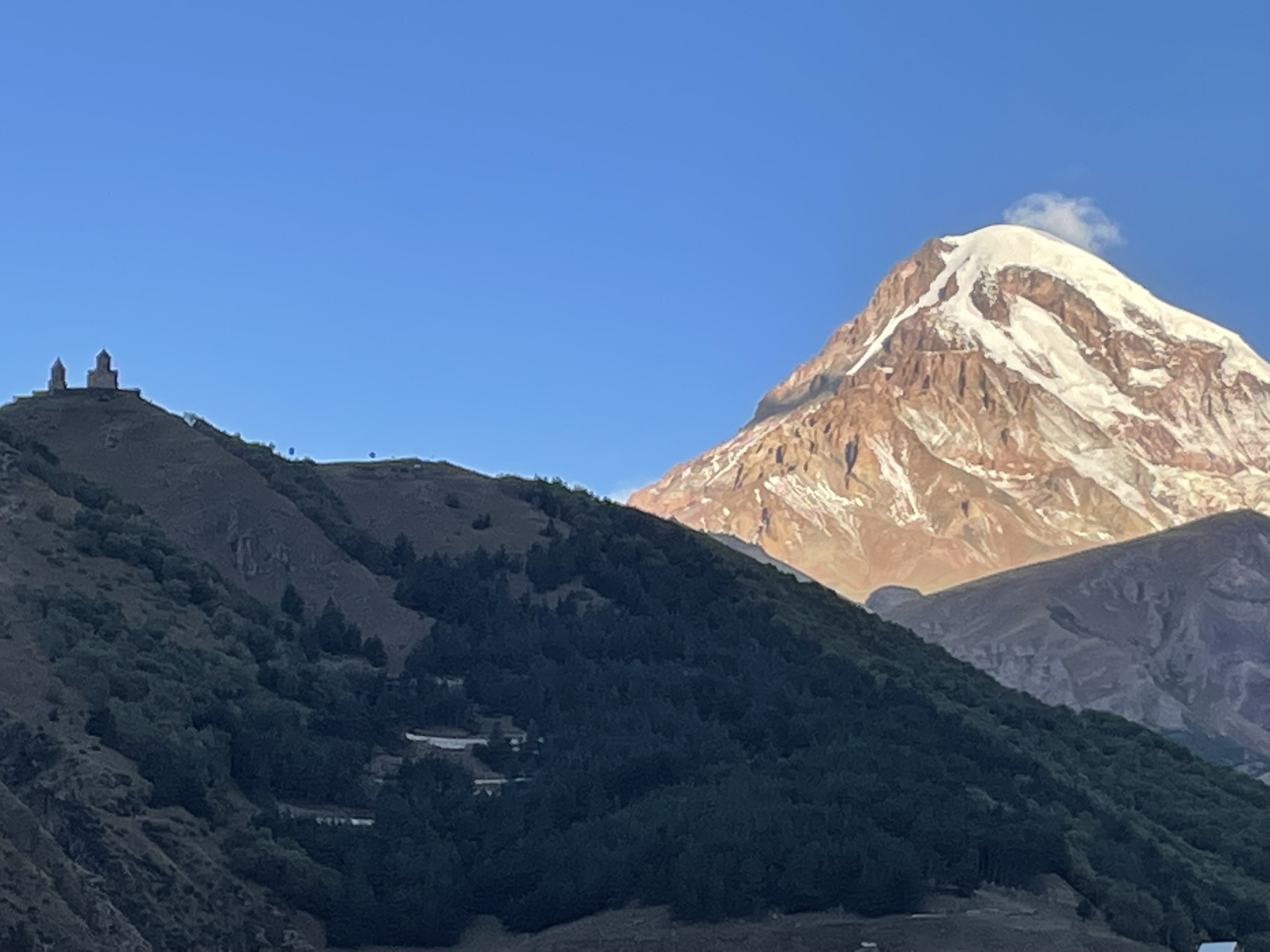
We set off on our travels again this morning, enjoying the wall to wall sunshine that i seem to have taken for granted! Most days have started about 20c and peaked around 30c….
Here are some early morning pics for you of Gergeti Trinity Church and Mount Kazbeg, plus a couple of cloud formations i thought were really lovely…..

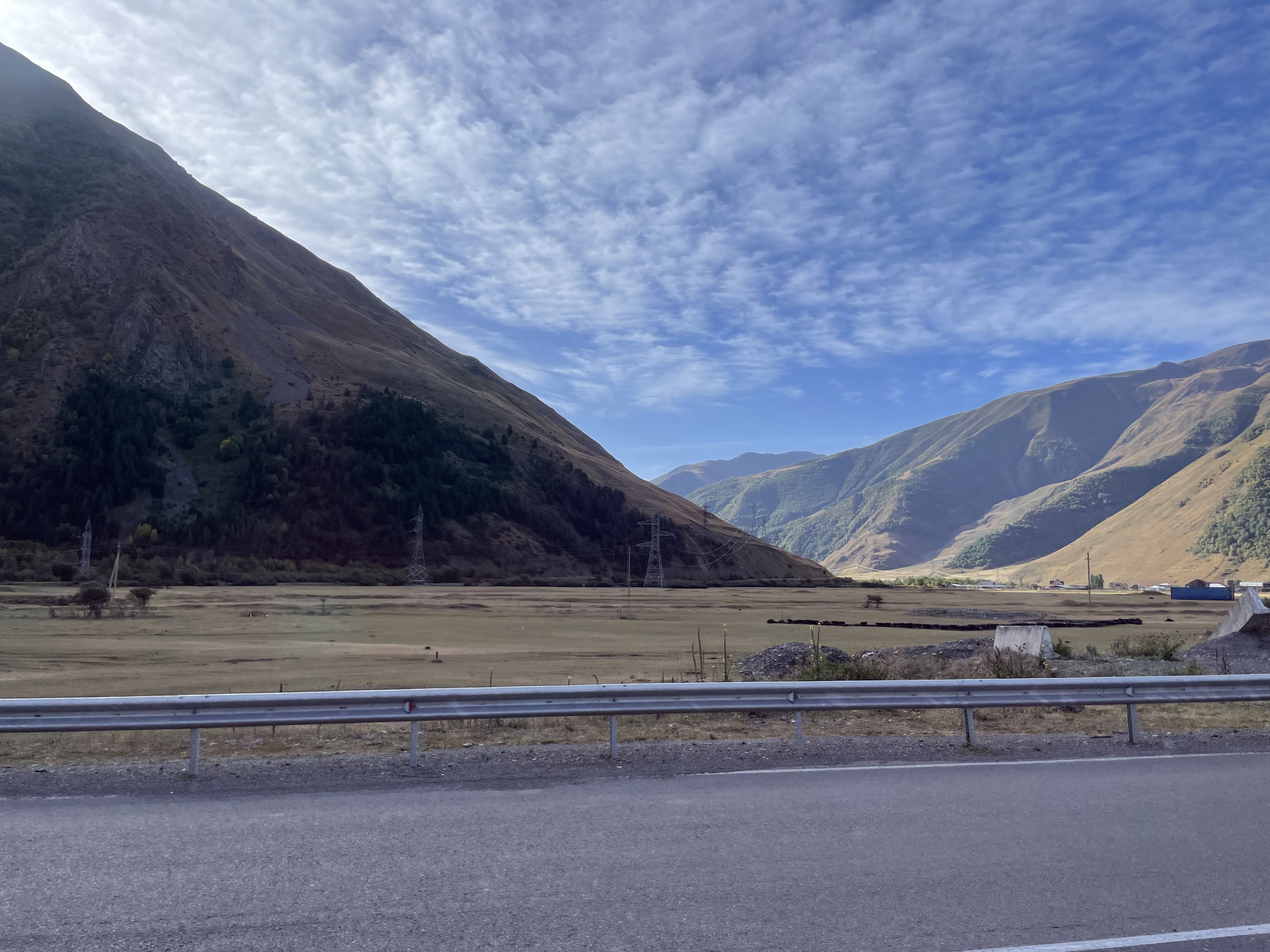
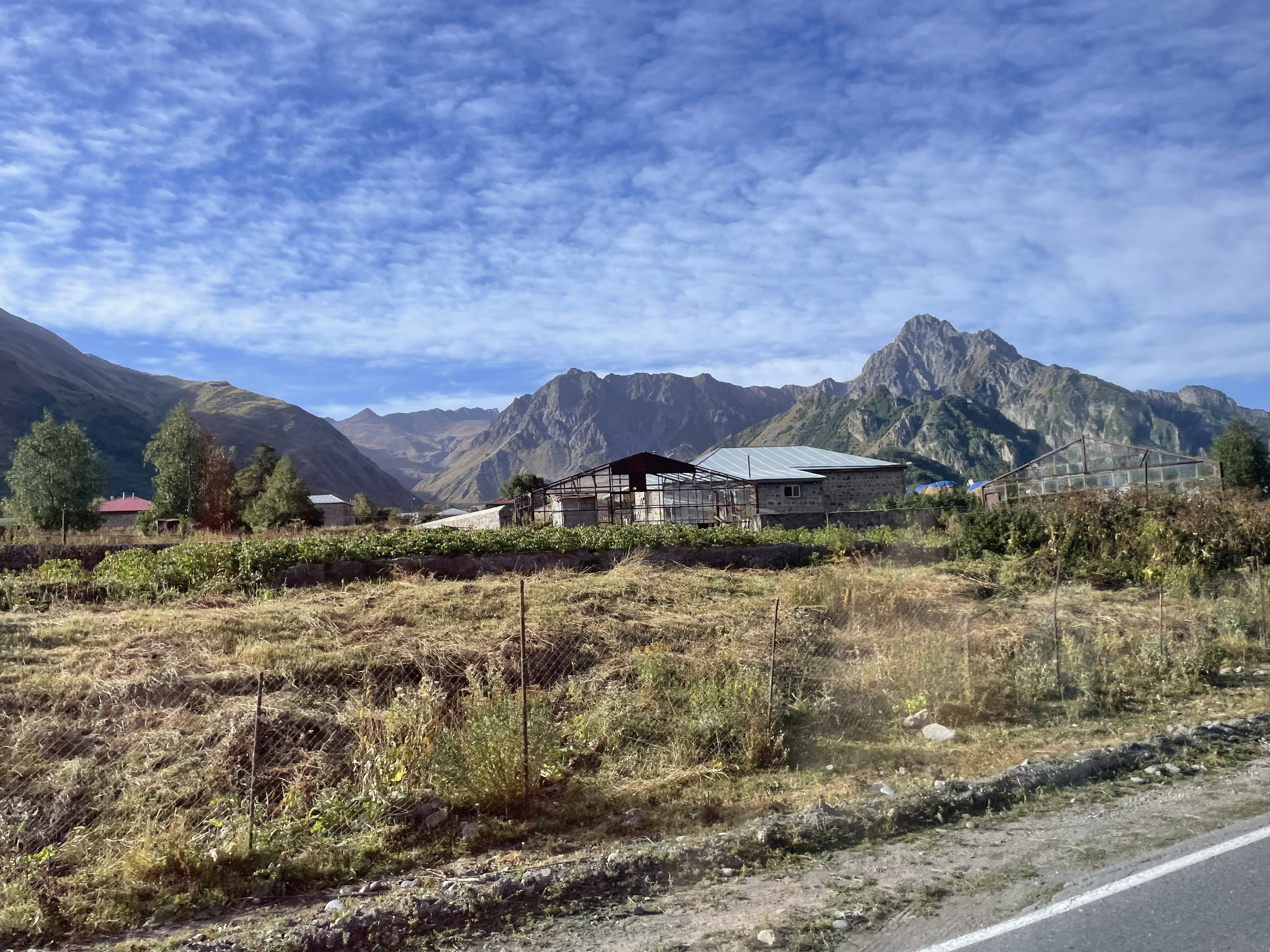
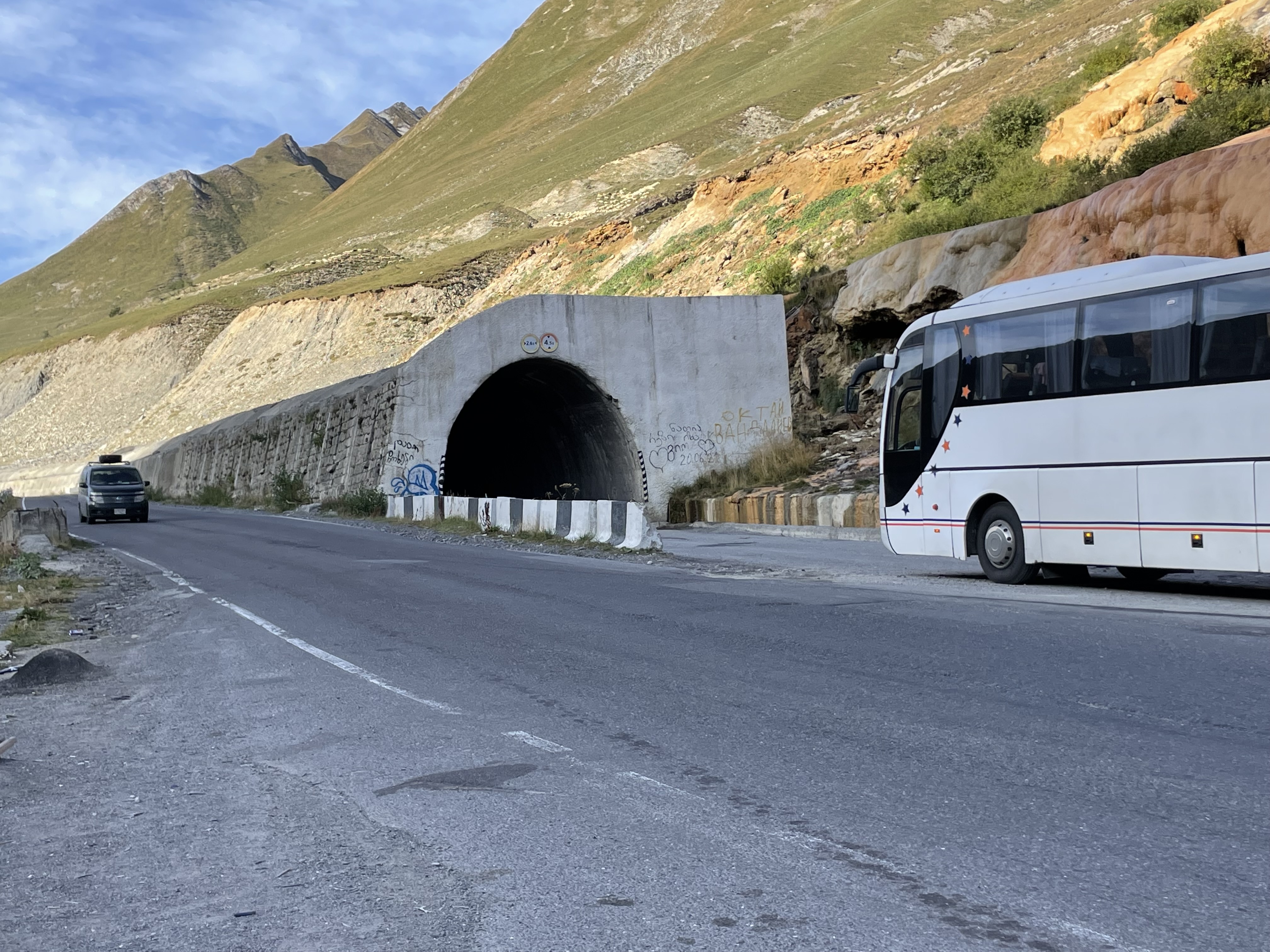
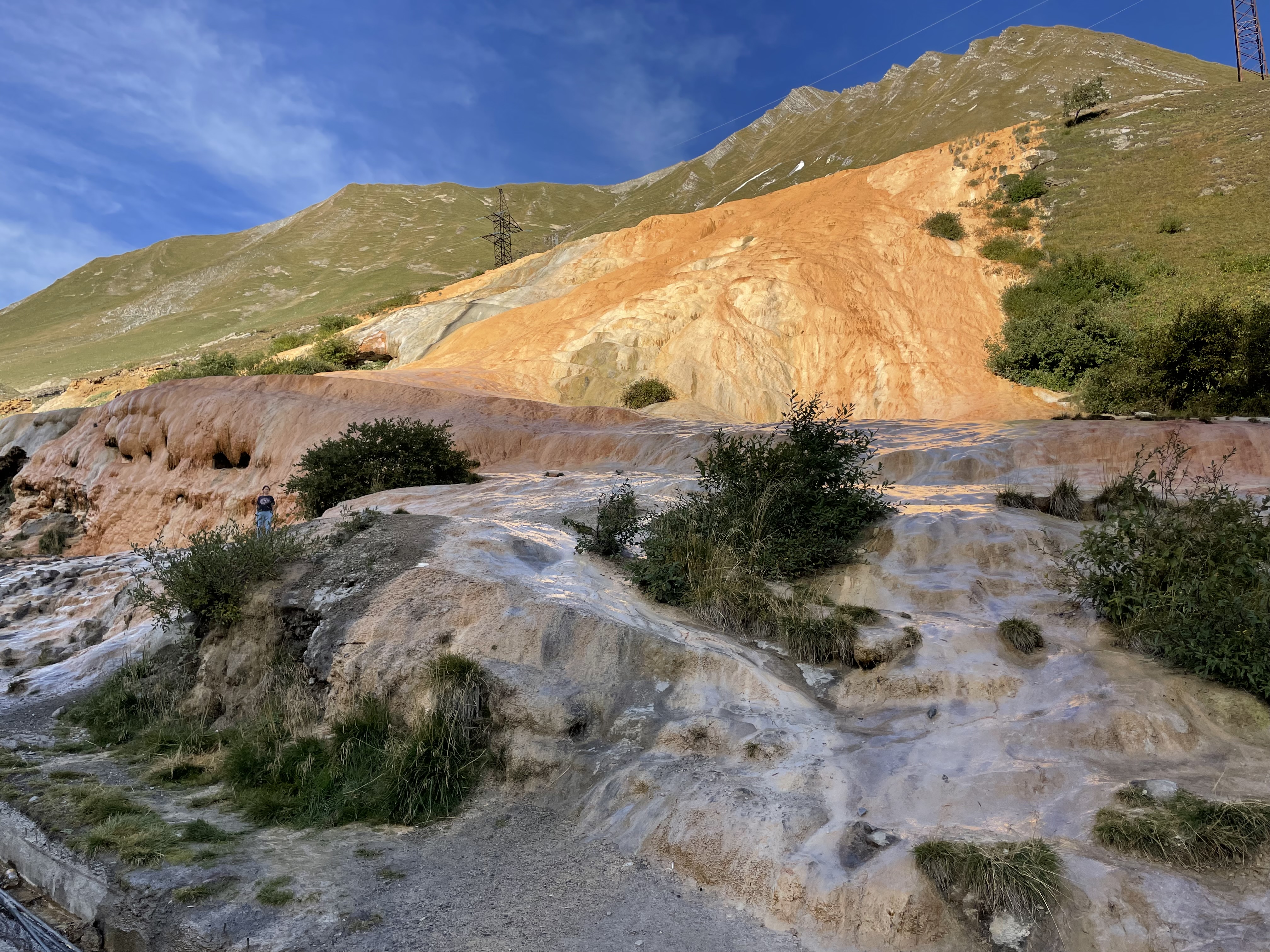
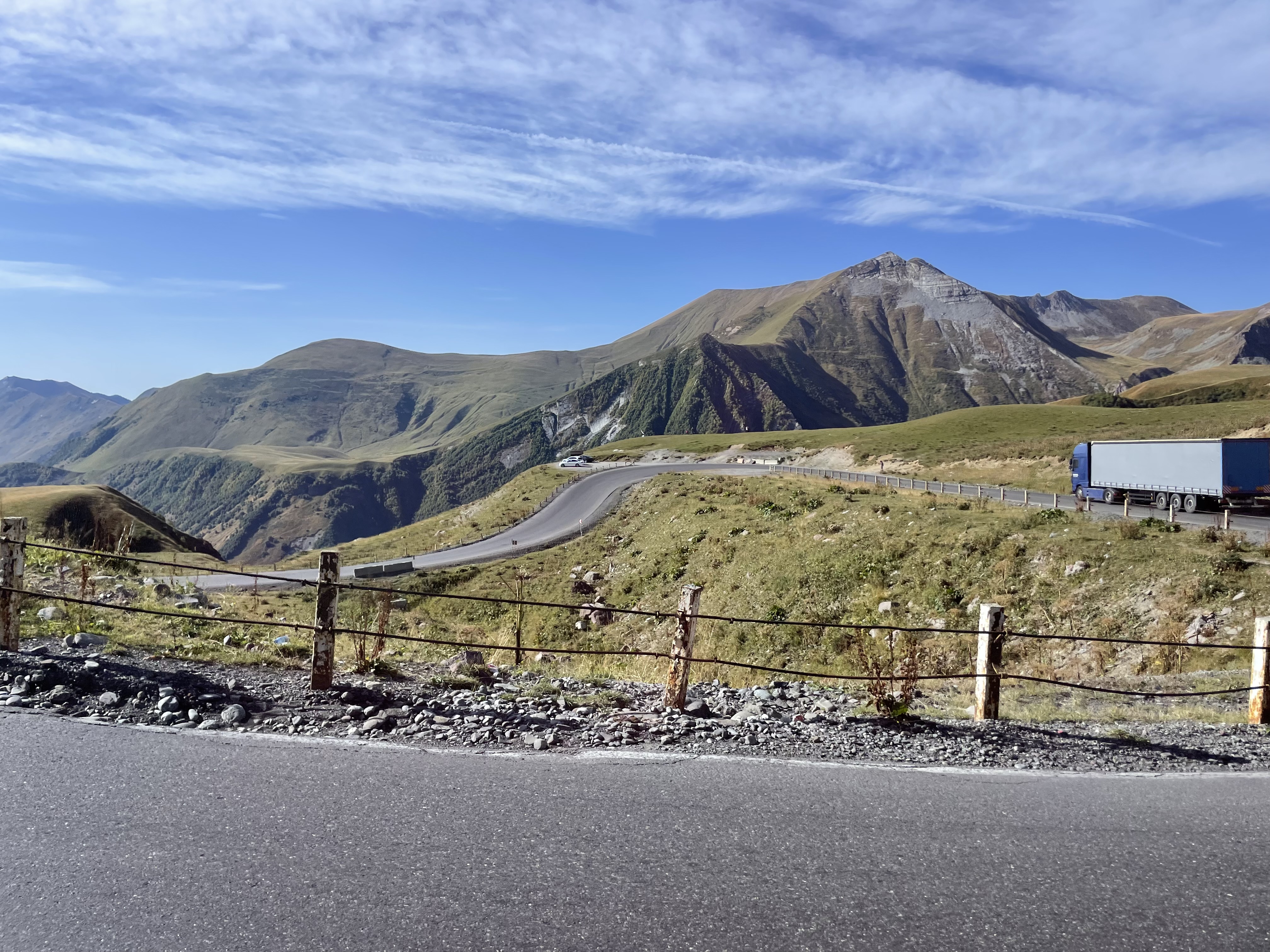
Given the Georgian Military Highway is the only crossing that the Russians are permitting for trucks moving between Georgia and Russia, it’s important that they keep it open as much as possible during the harsh Caucasian winters. This is a shot of one of several ‘snow tunnels’ we saw which are constructed where the road is especially vulnerable to snow avalanches: they look pretty inadequate to me – my guess is they are not big enough to carry two way traffic and so must be operated as some kind of one-way system. There was also a remarkable looking rock formation right next door to this tunnel. Although the road Highway has a grand title and is clearly of major strategic importance, it is far from being what the Brits call a Motorway, as you can see from the final pic:
Apologies in advance for this poor quality video of the queuing trucks: i’ve included it just to give you some idea of the chaos being caused by the Russian border authorities. The ridiculous holdups do of course make no economic sense at all for any of the countries involved least of all for Russia…..
Next stop was the ironically named Russia-Georgia Friendship Monument. It was constructed in the Soviet era in 1983 to commemorate the bicentennial of the tready of Georgievsk and the ‘ongoing friendship’ between Soviet Georgia and Soviet Russia. Given Russia has invaded Georgia twice since it was built, bombing Tbilisi and a few other places and has annexed South Ossetia one might have expected the Georgians to tear it down, but i guess that might be a bit like poking the bear in the eye with a sharp stick…..
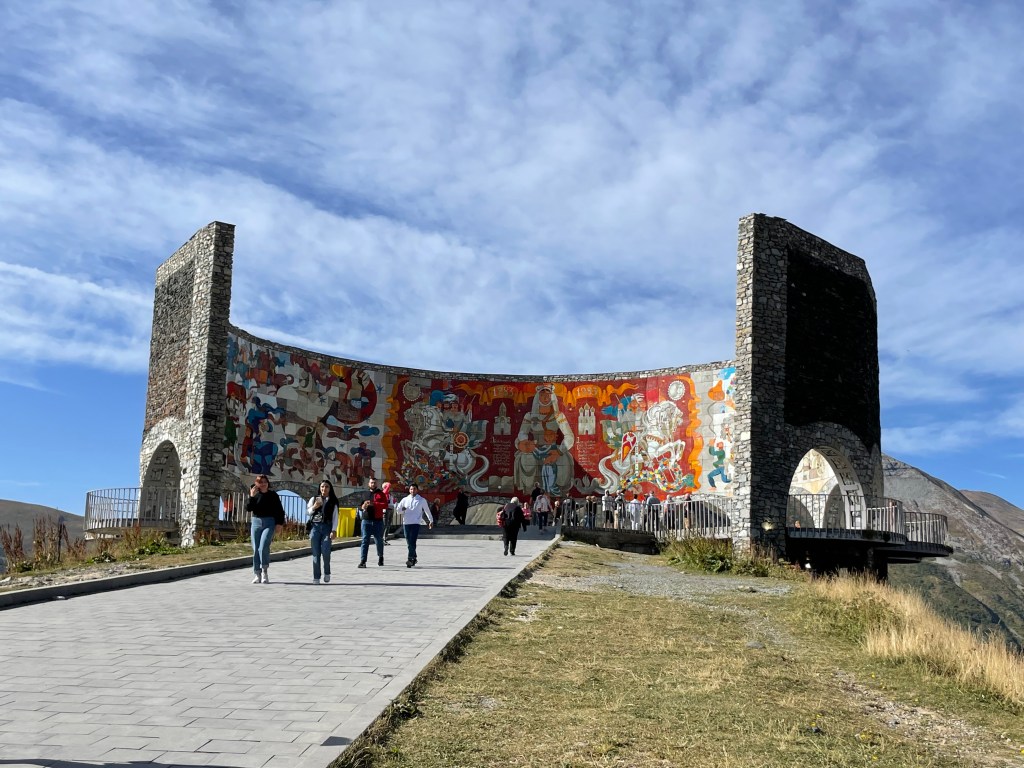
As it happens i quite like the design of the Memorial and the way it has been decorated: most unusual for a Soviet icon! Here is a vid of the paintings on the inside:
The location for the Memorial was also selected very carefully: it sits at over 7,000 feet amid some of the most wonderful scenery in this part of the High Caucasus…

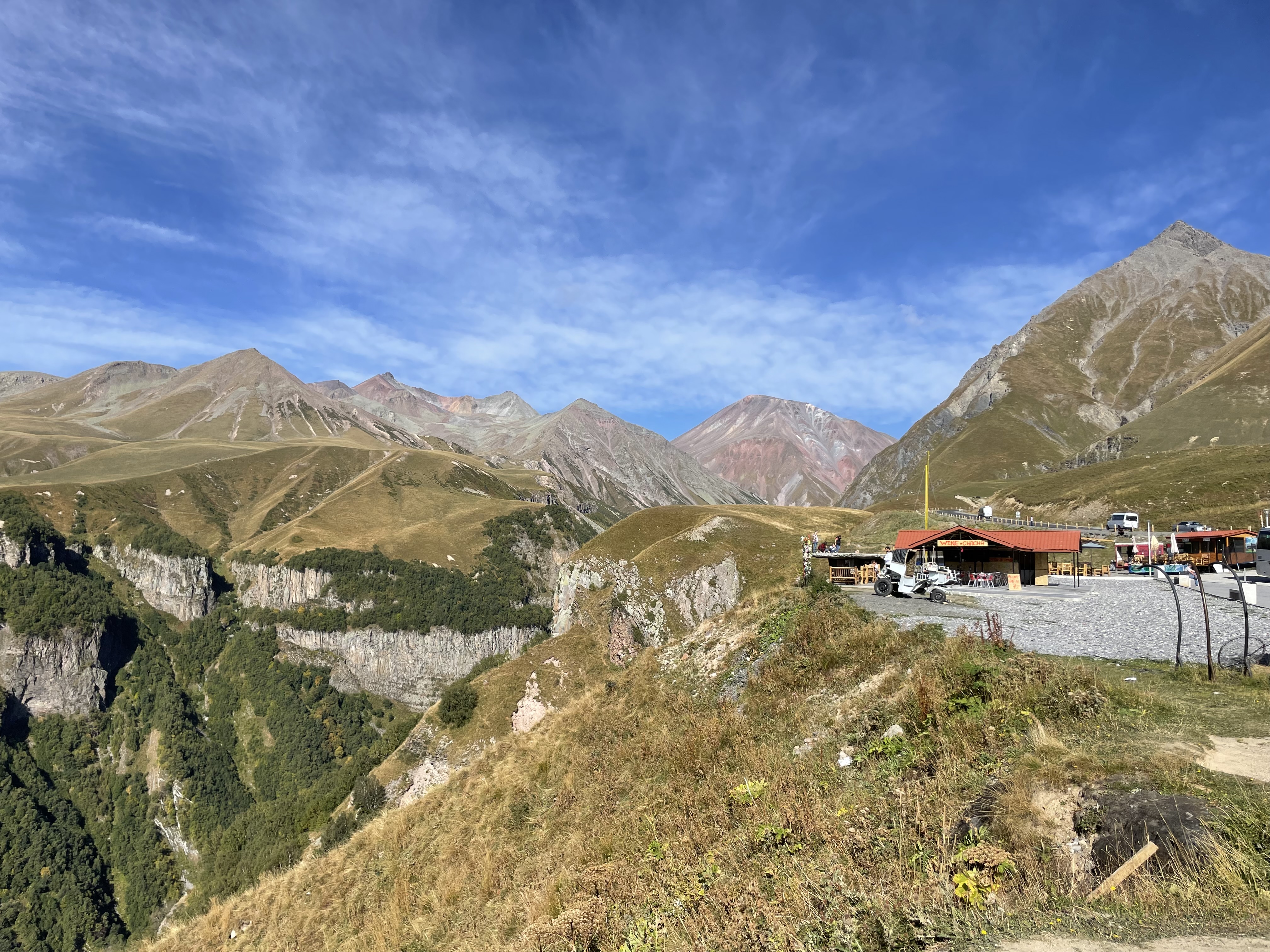
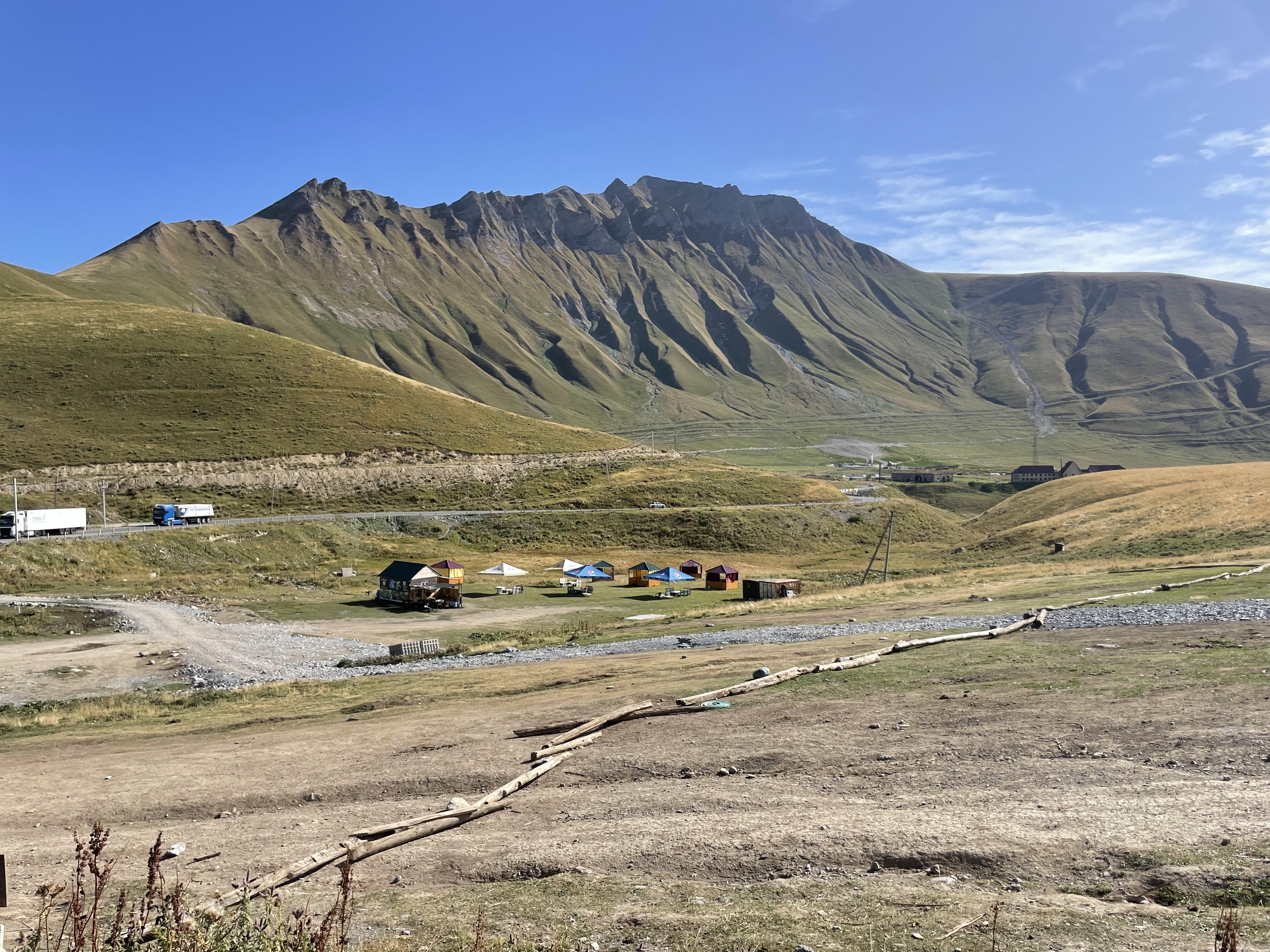
Hopefully this short vid will give you a better idea of just how dramatic it is:
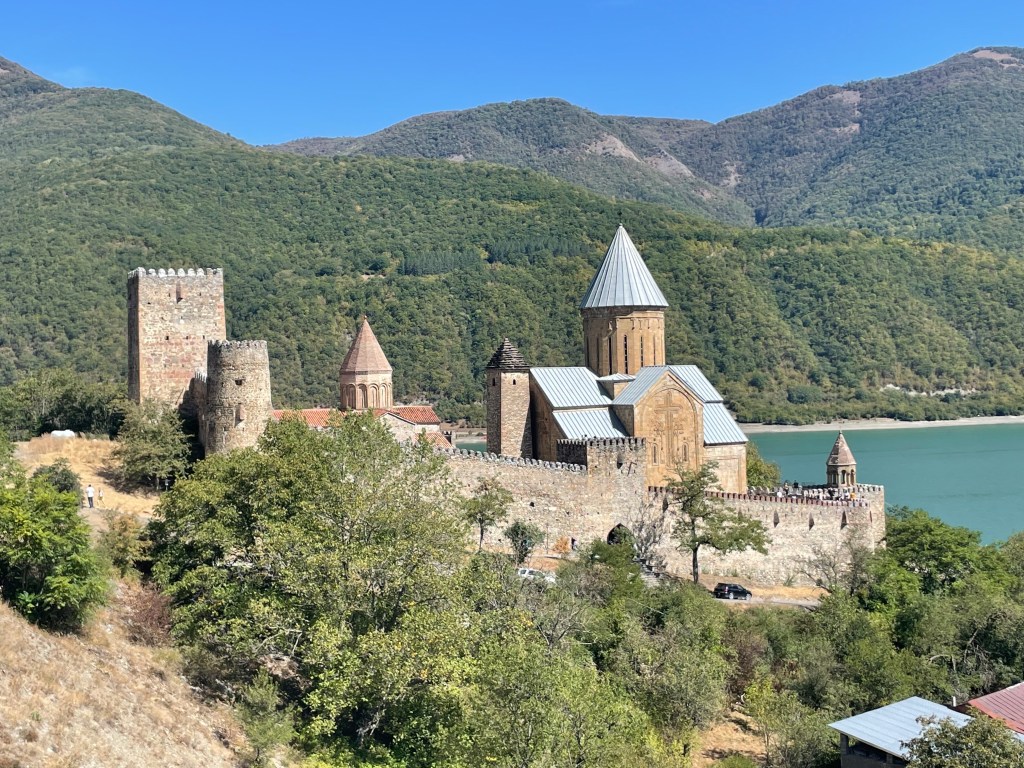
Our final stop the way south was to inspect the remarkable Ananuri Fortress Complex. Not only does it look like an authenic castle, it has also been the site of many battles over the years, mainly in the 18th century between competing duchies, until its final battle in 1812 when it was overrun by Russian troops.
The oldest element of the complex is the watch tower which dates from the 14th or 15th centuries. The castle itself was built during the 17th and 18th centuries when it was the seat of the Dukes of Aragvi.
In 1739, Ananuri was attacked by forces from a rival duchy, commanded by Shanshe, the Duke of Ksani, and was set on fire. The Aragvi clan was massacred.
The hegemony of the Duke of Ksani only lastest four years and was ended by a peasant revolt, which again resulted in the massacre of the rulers. From then until the Russians arrived in 1812 the place was ruled by King Teimuraz II who lastest until 1746 when yet another peasant revolt saw the castle having to be rescued by King Erekle II of Kakheti. Following the Russian takeover the castle declined in importance.
When the castle was under siege, it was not defeated because a secret tunnel led to the water and thus provided a way to get food and water to the people who had taken refuge in the castle. The enemy finally captured a woman named Ana, who was from Nuri, and tortured her to reveal the location of the tunnel. But she chose to die rather than giving the secret away. Hence the castle was called Ananuri, and she became a legend.
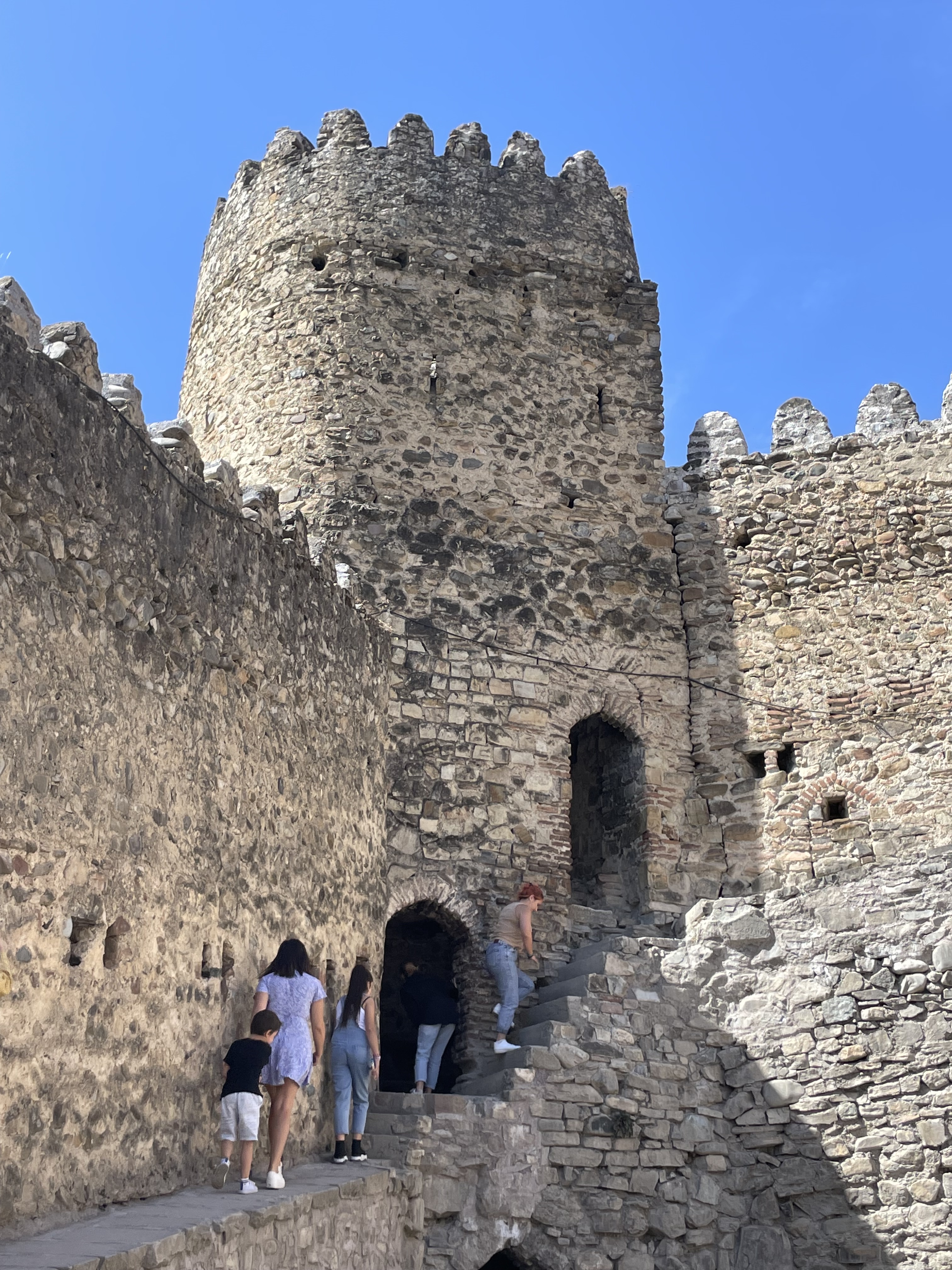
Here are some pics of the castle’s still formidable defences:
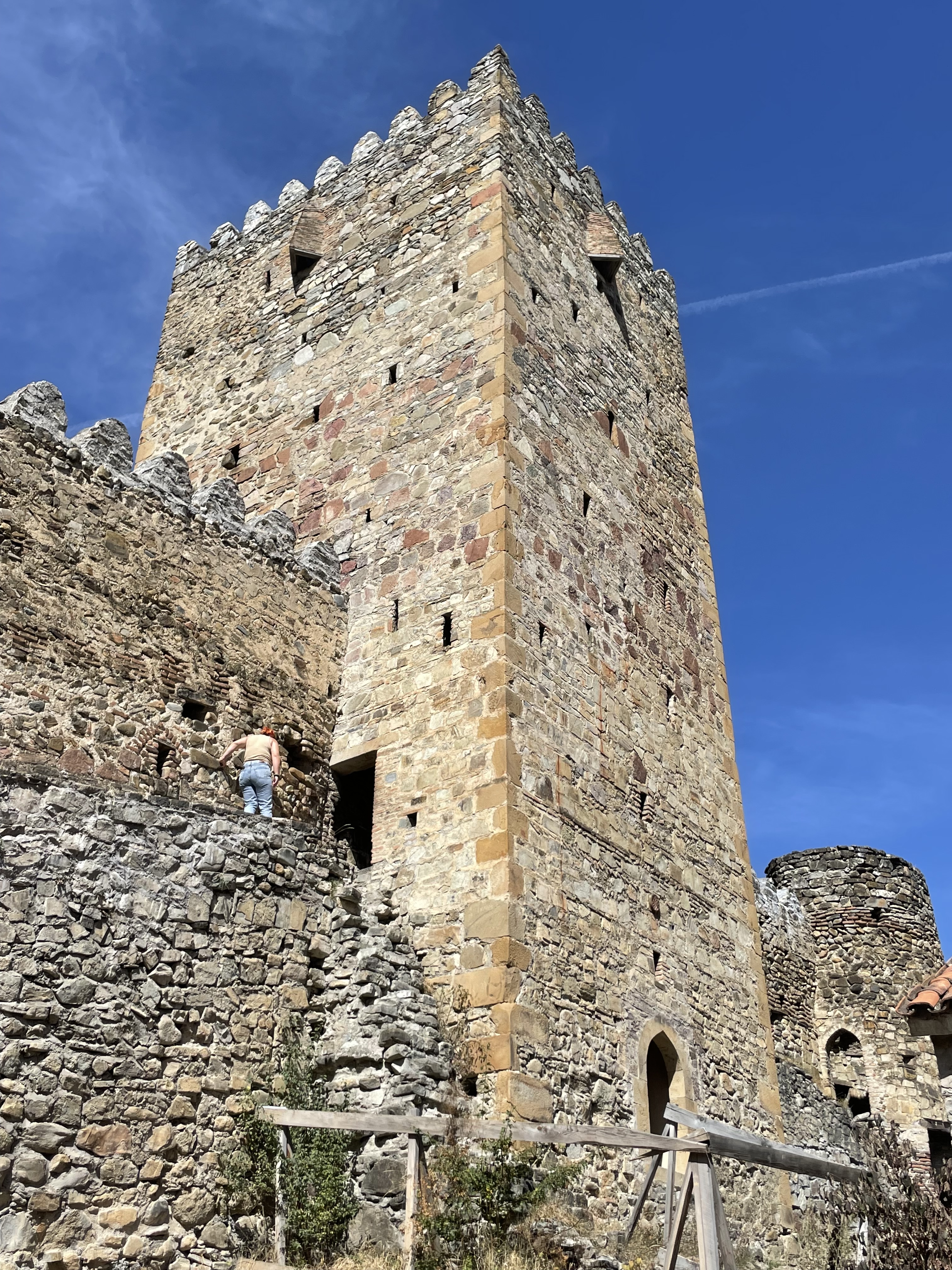
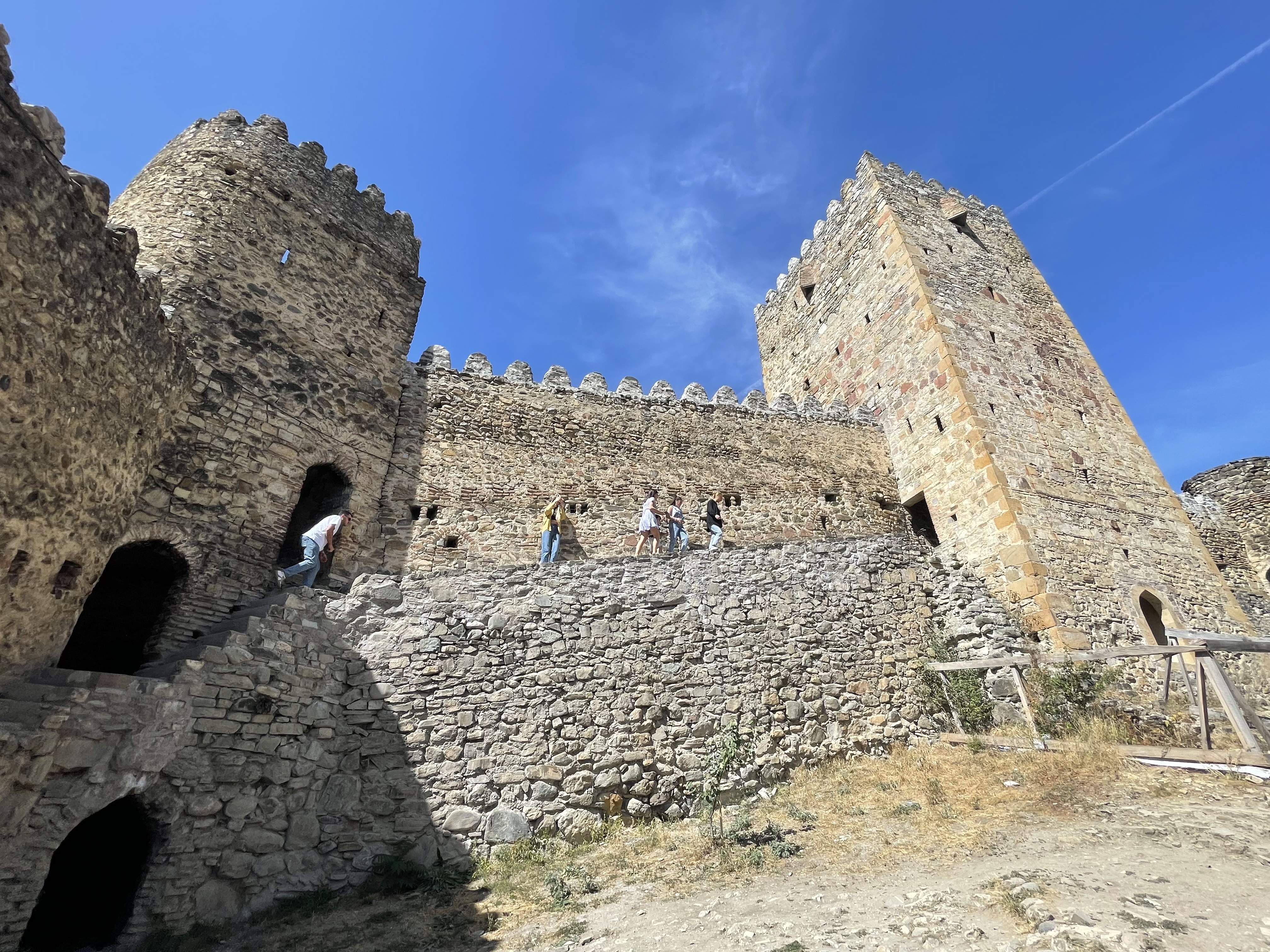
In its heyday 2 churches were built Inside its walls. The smallest one; the Church of the Virgin, was built in first half of the 17th century. The larger one; the Church of the Mother of God, was built in 1689 for the son of Duke Bardzem.
Here are some pics of the Church of the Virgin:

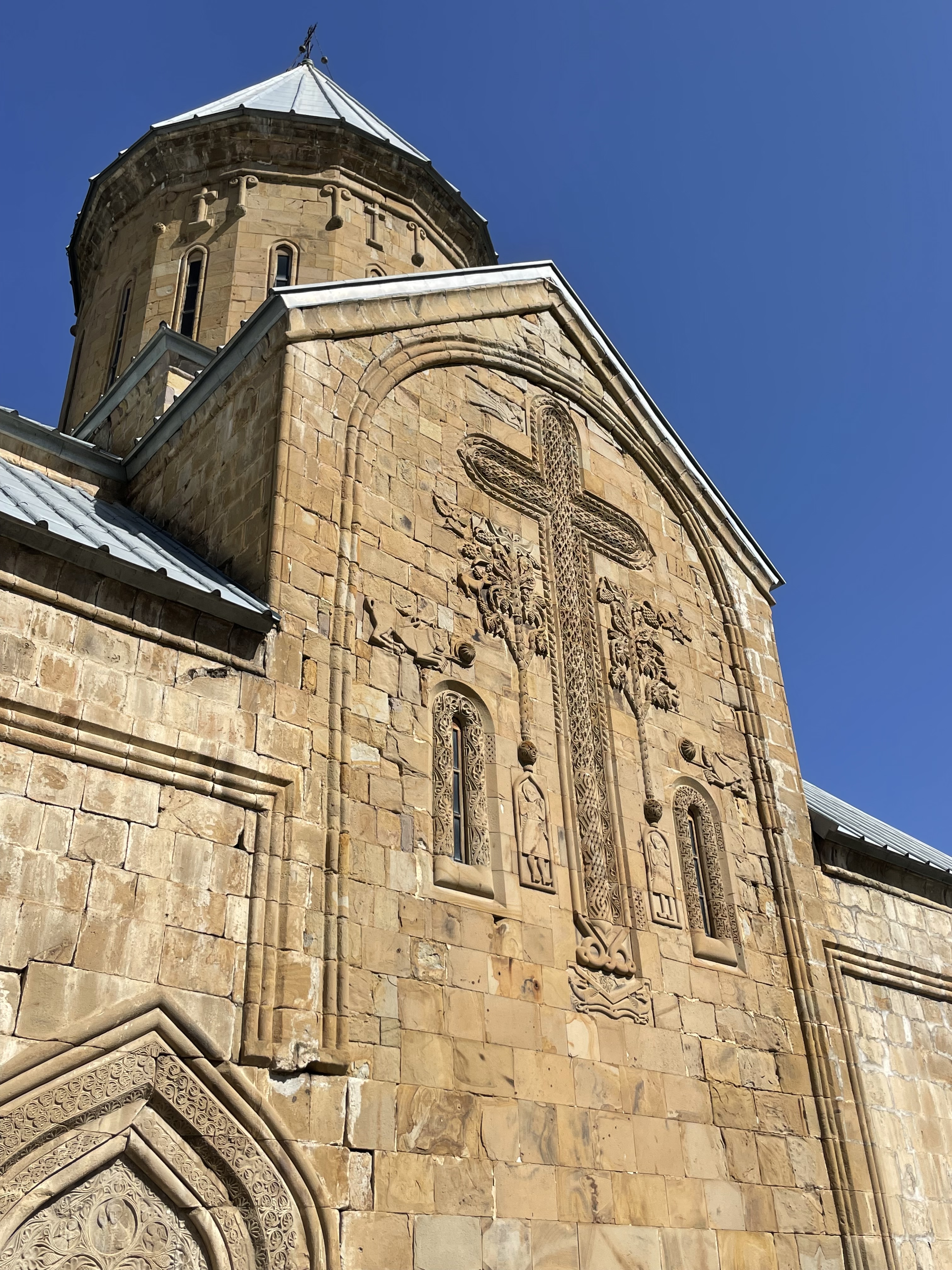
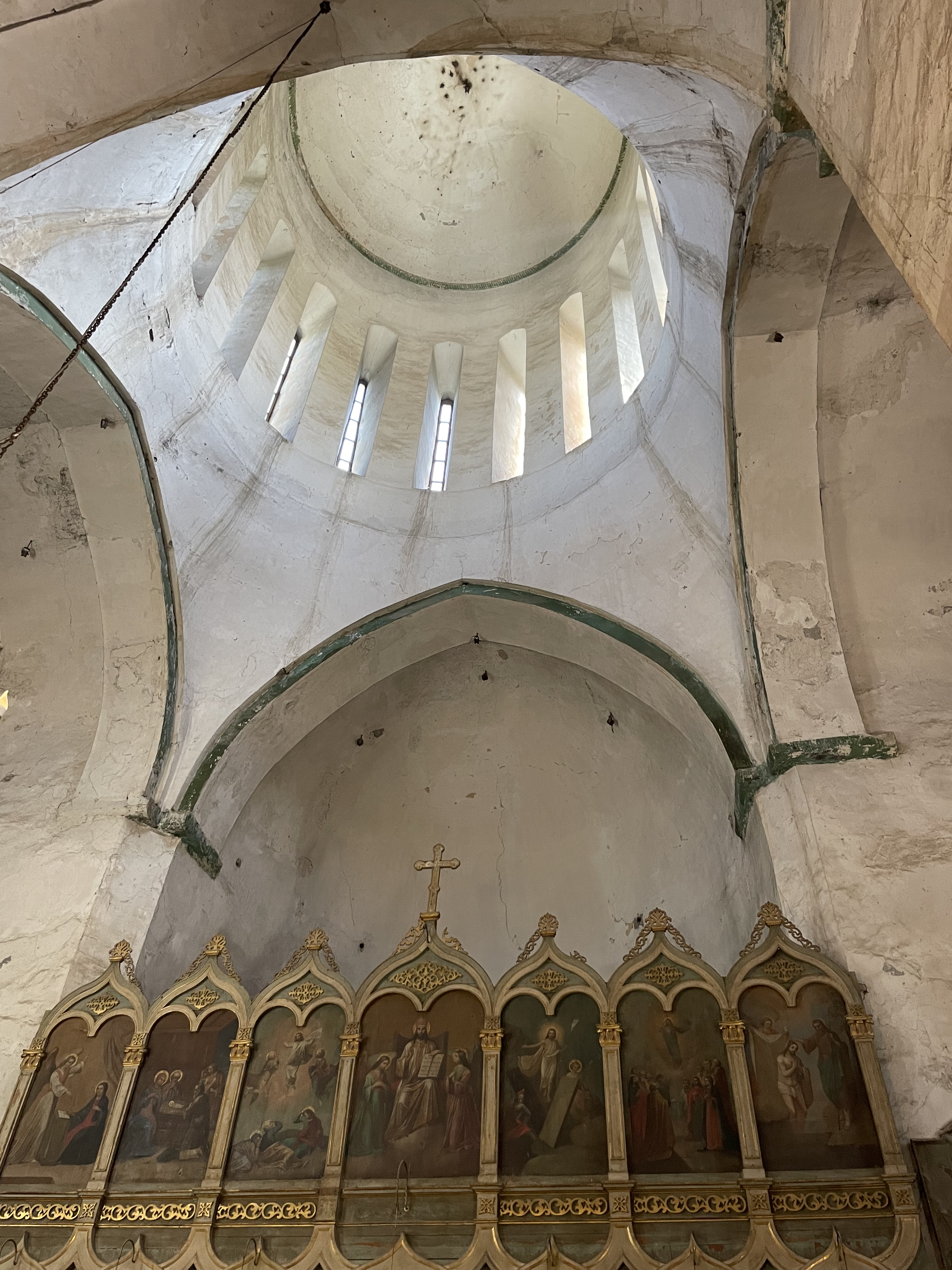
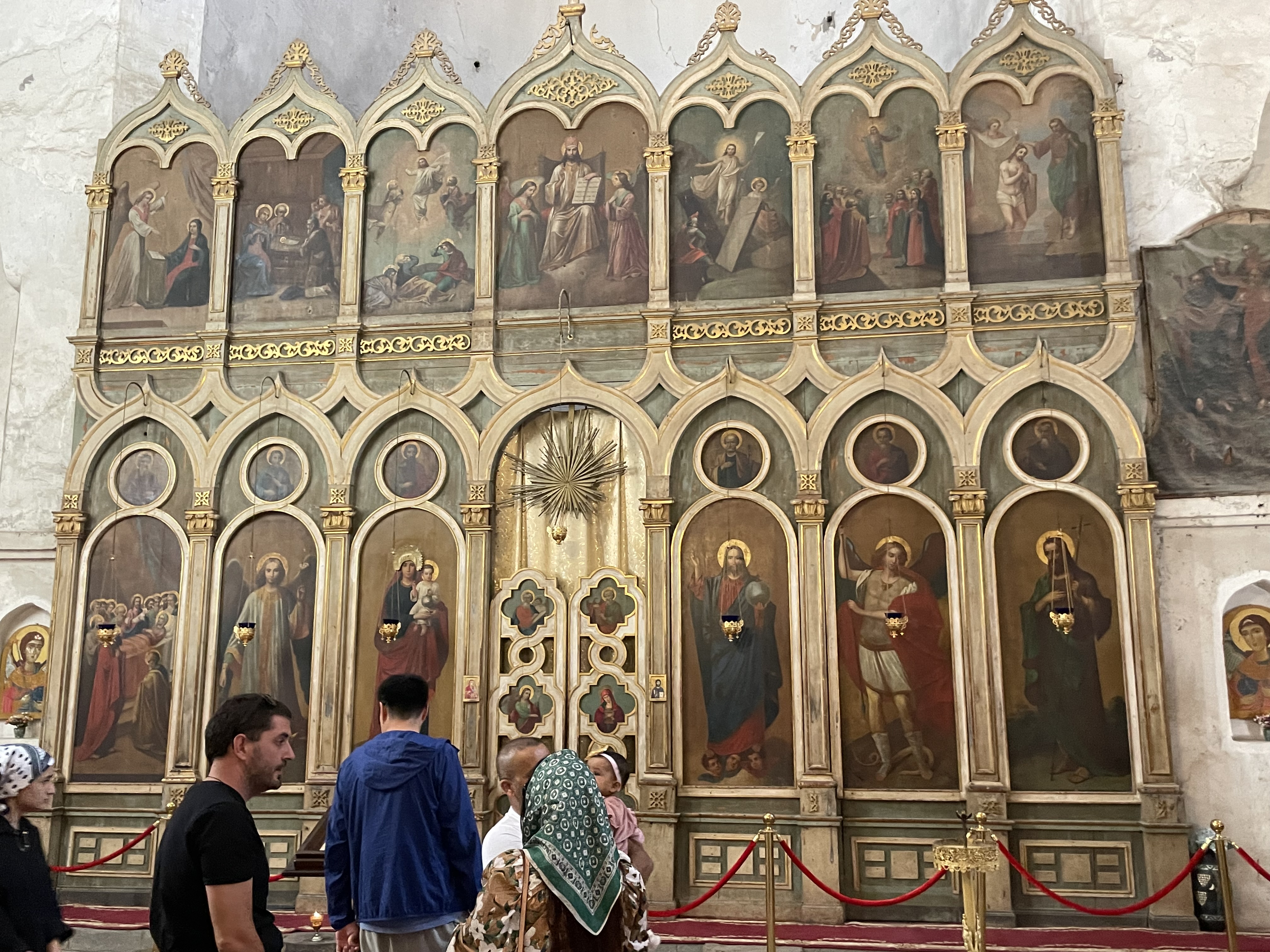
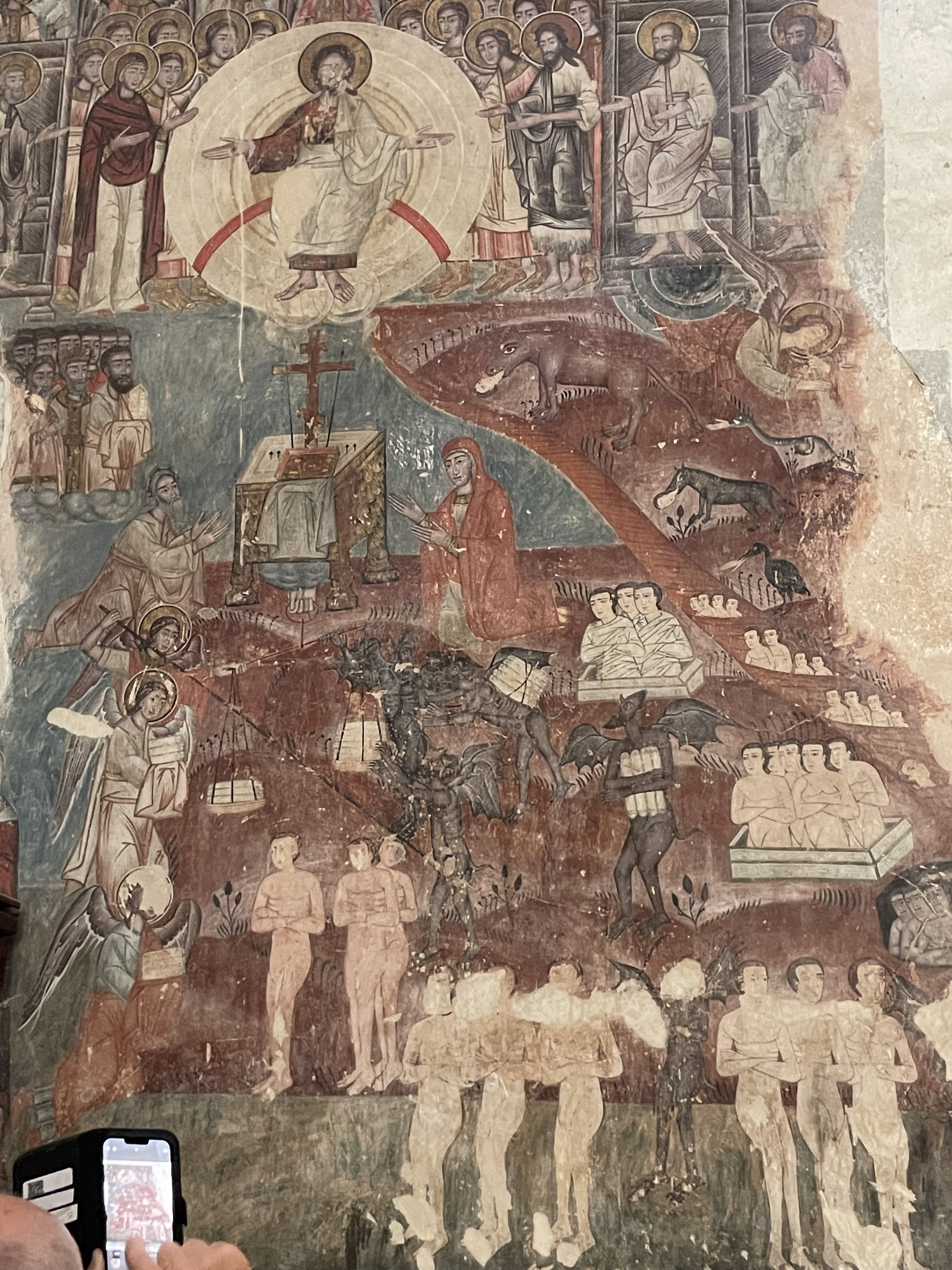
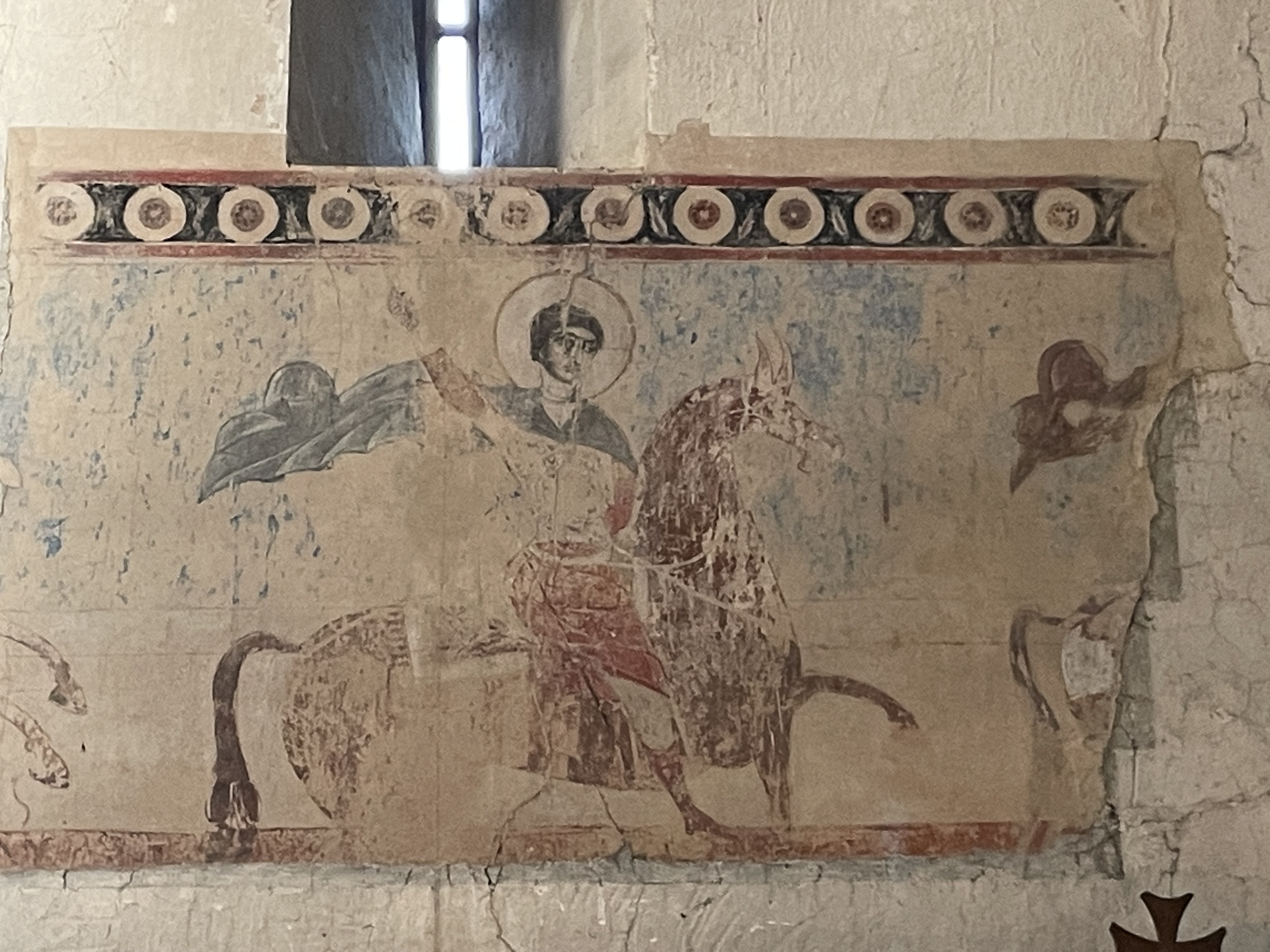
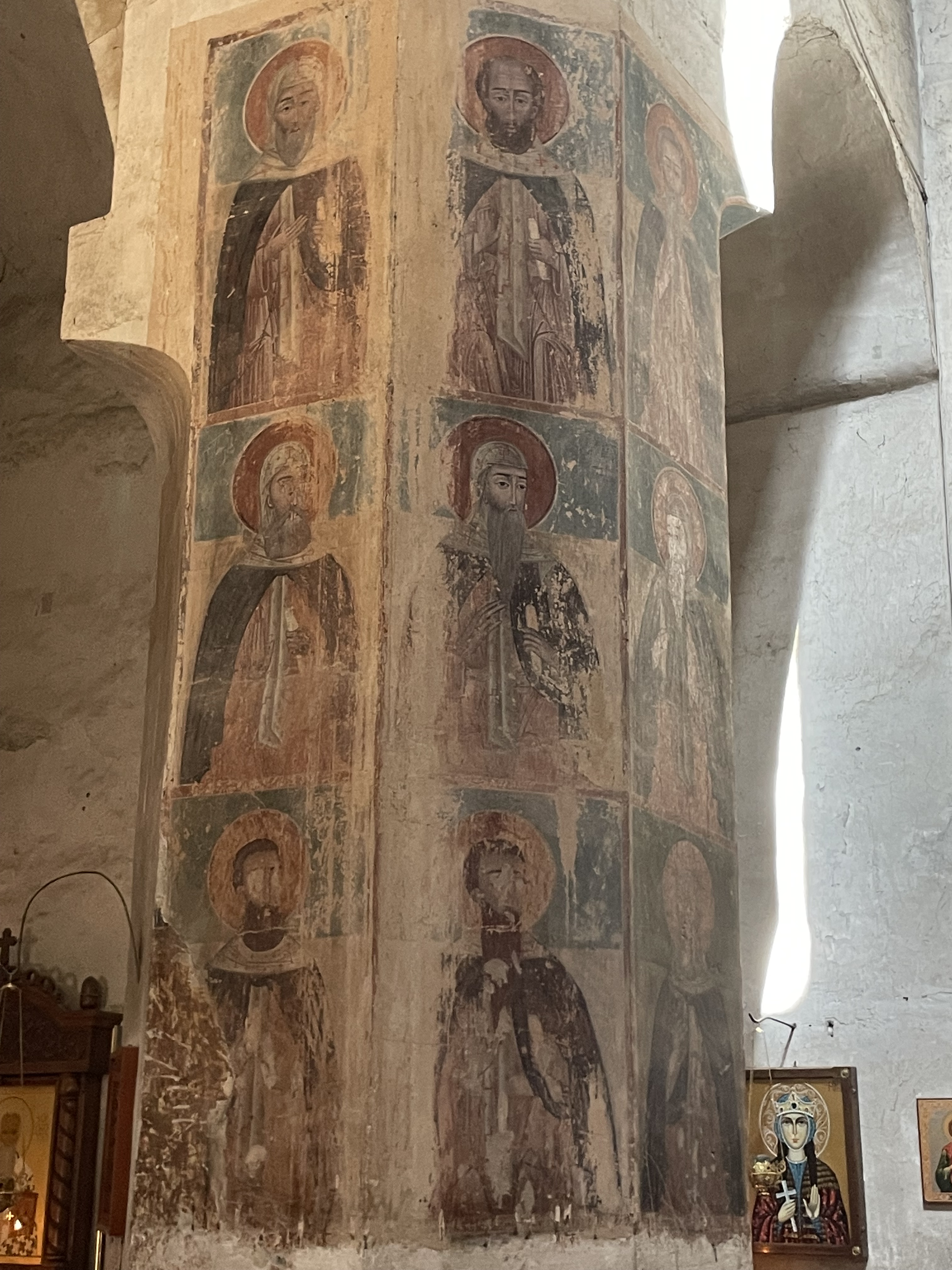
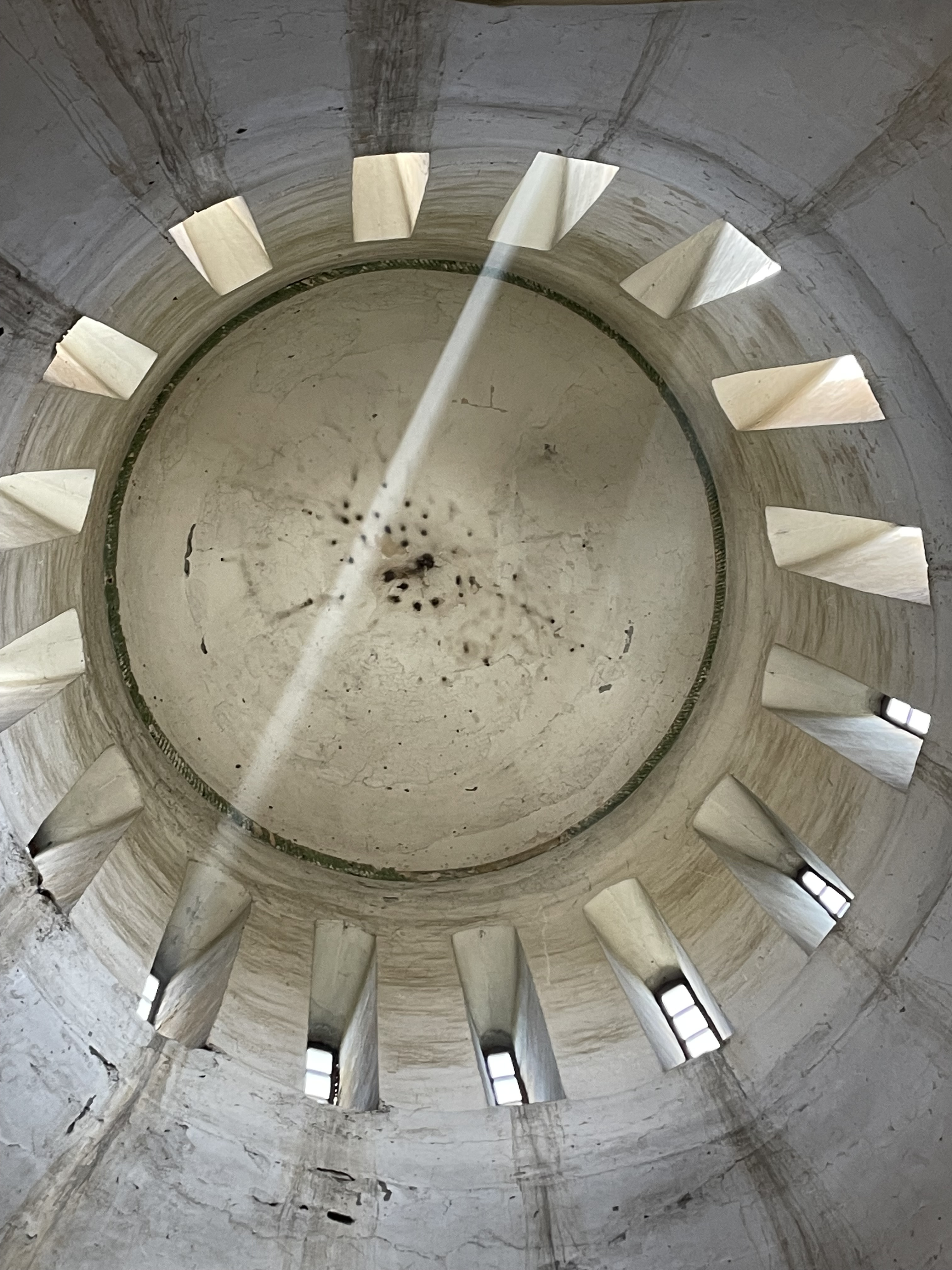
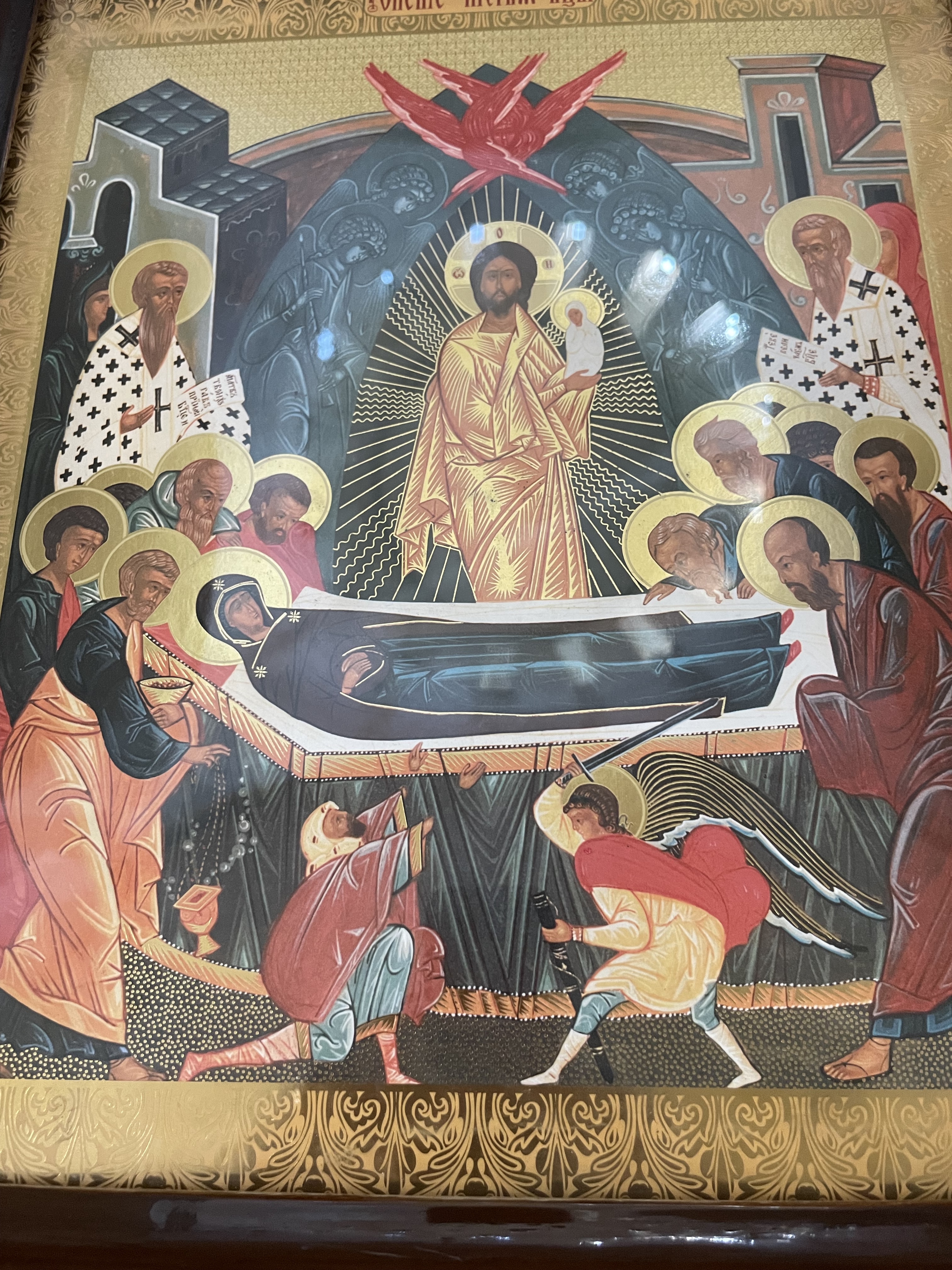
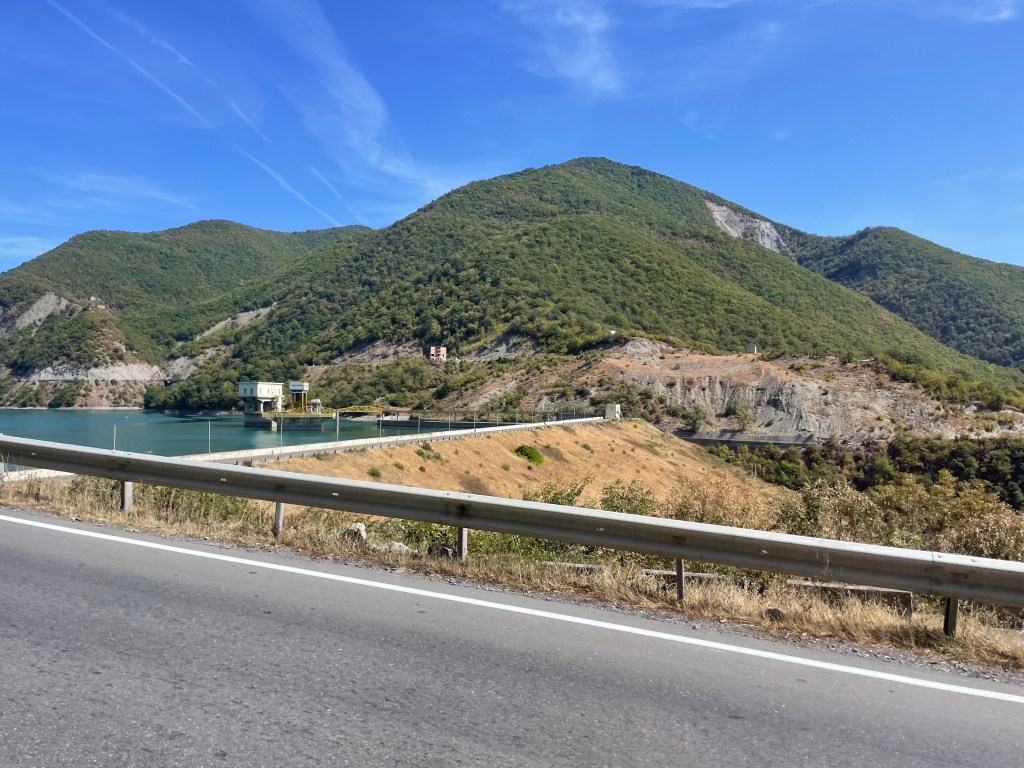
The Ananuri Castle Complex lies on the south shore of the large Zhinvali Reservioir: here is a pic of the dam that led to its creation.
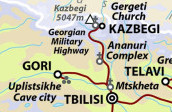
As you can see from the map we turned west just before reaching Tbilisi to head off to Gori and the Josef Stalin Museum.
The museum was something of an anti climax for me: lots of memorablia from his life and times, nothing about the 20 million or so deaths for which he was responsible. I said in an earlier Post that museums are difficult for a blog like this because they consist of thousands of individual items and that is certainly true of this one: so here are just a few external pics for you:
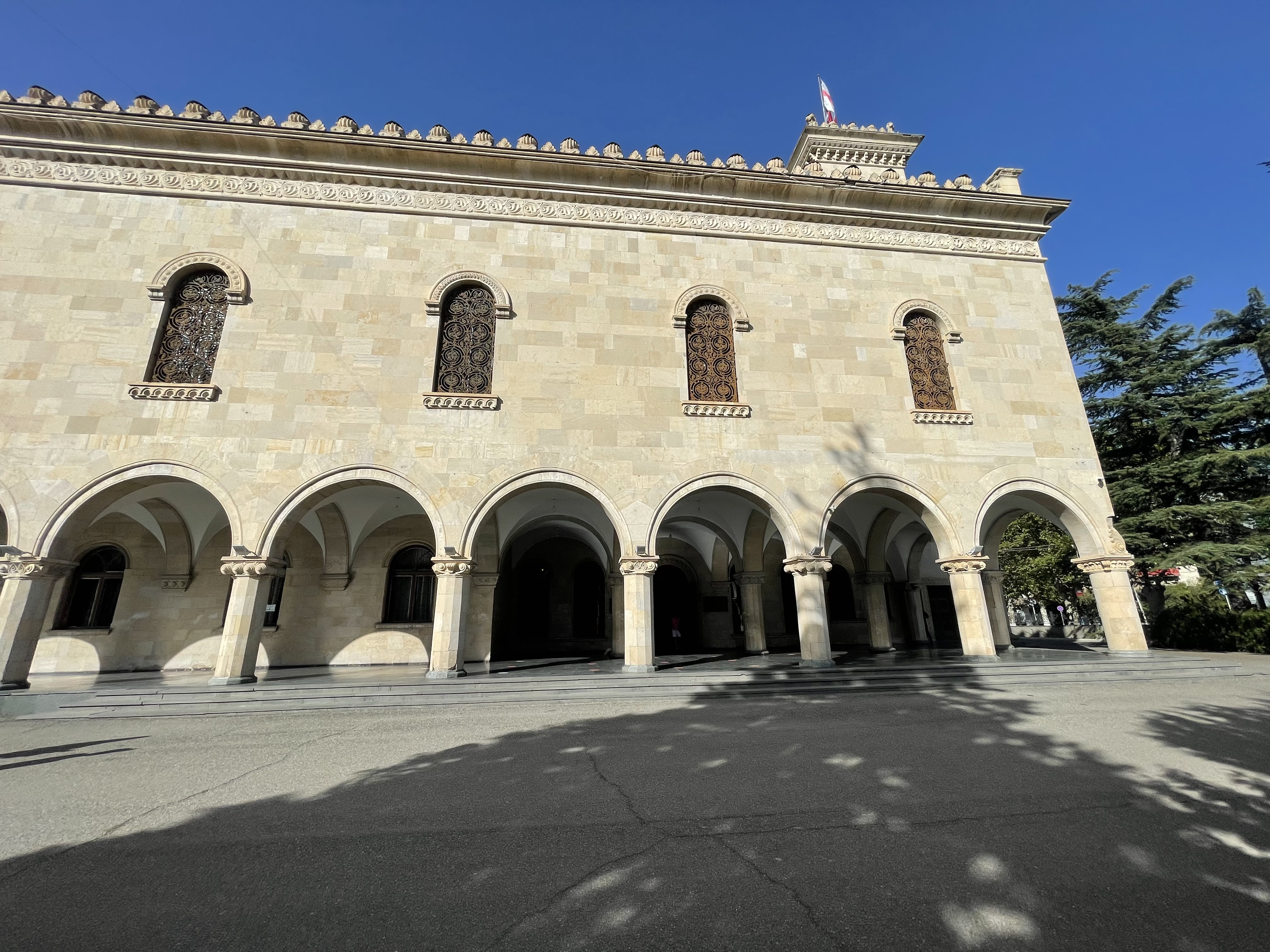
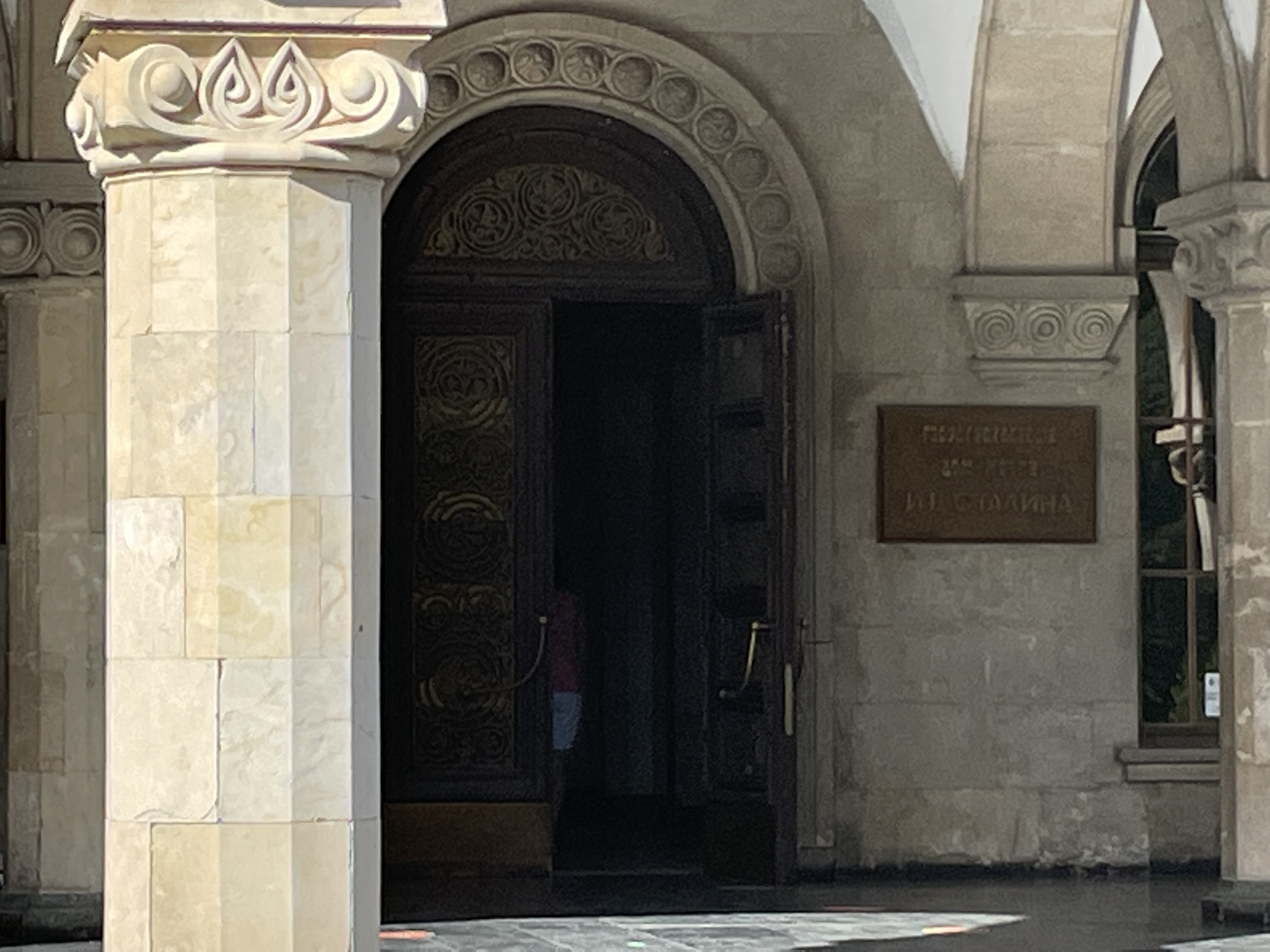
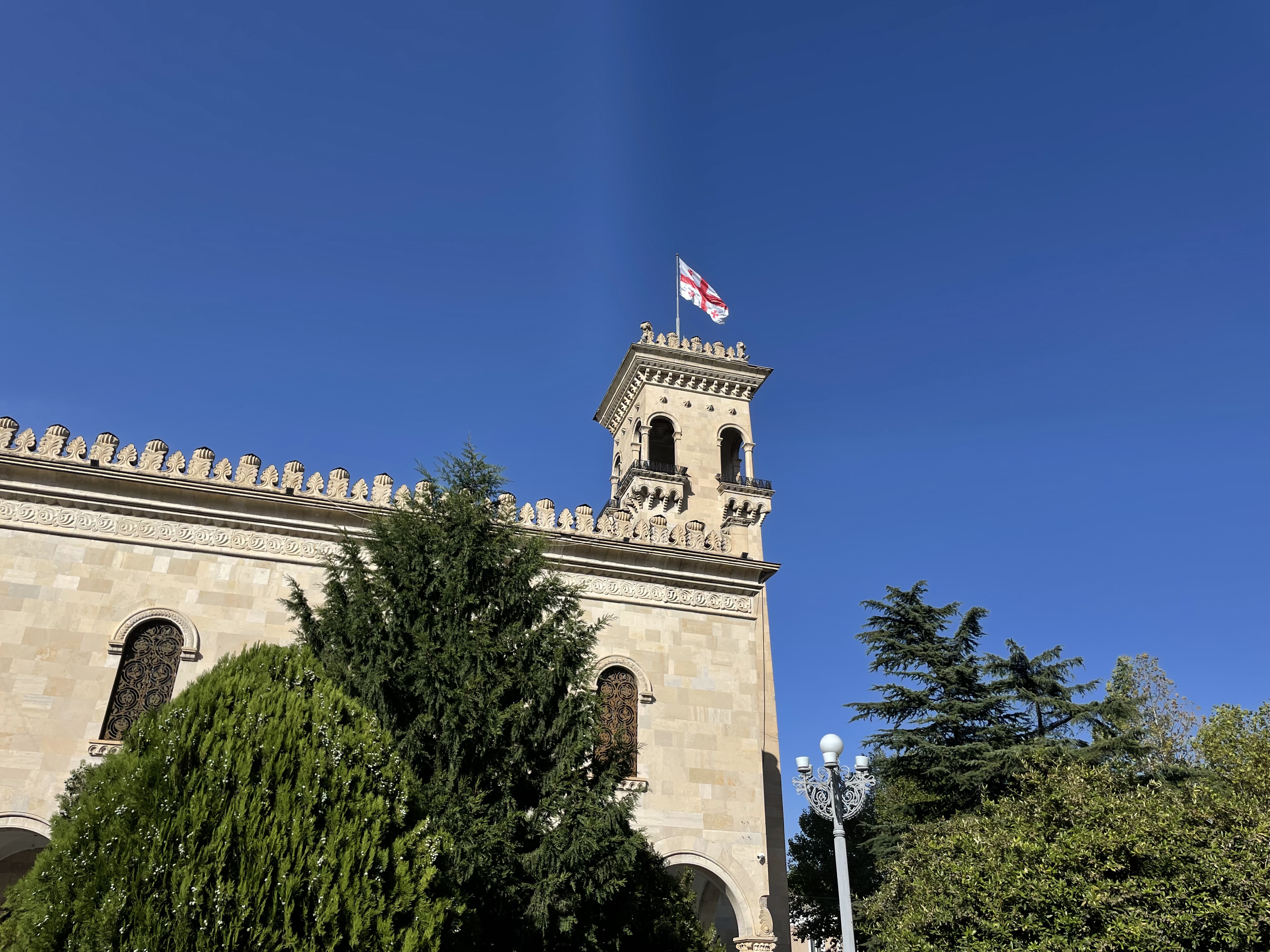
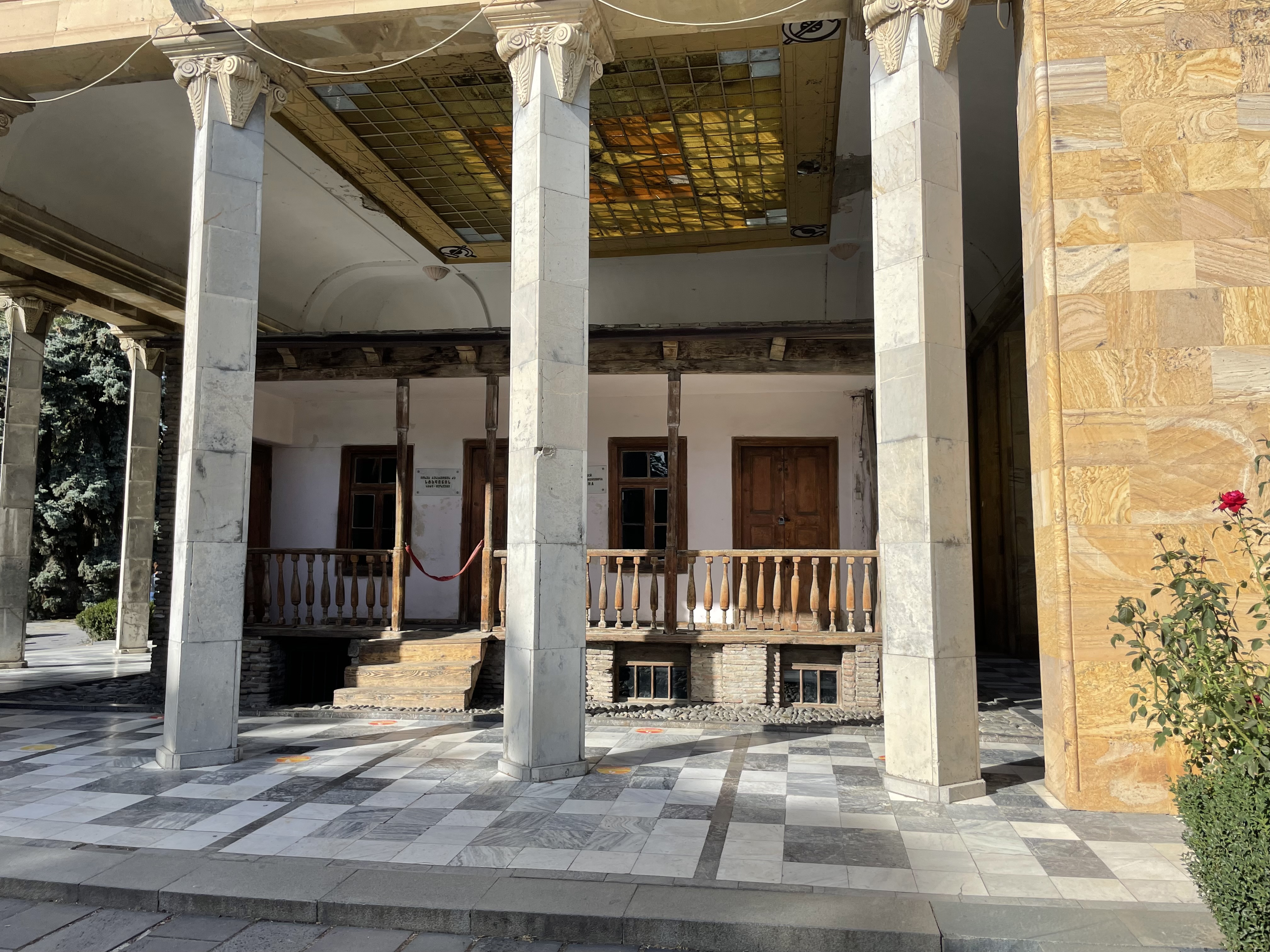
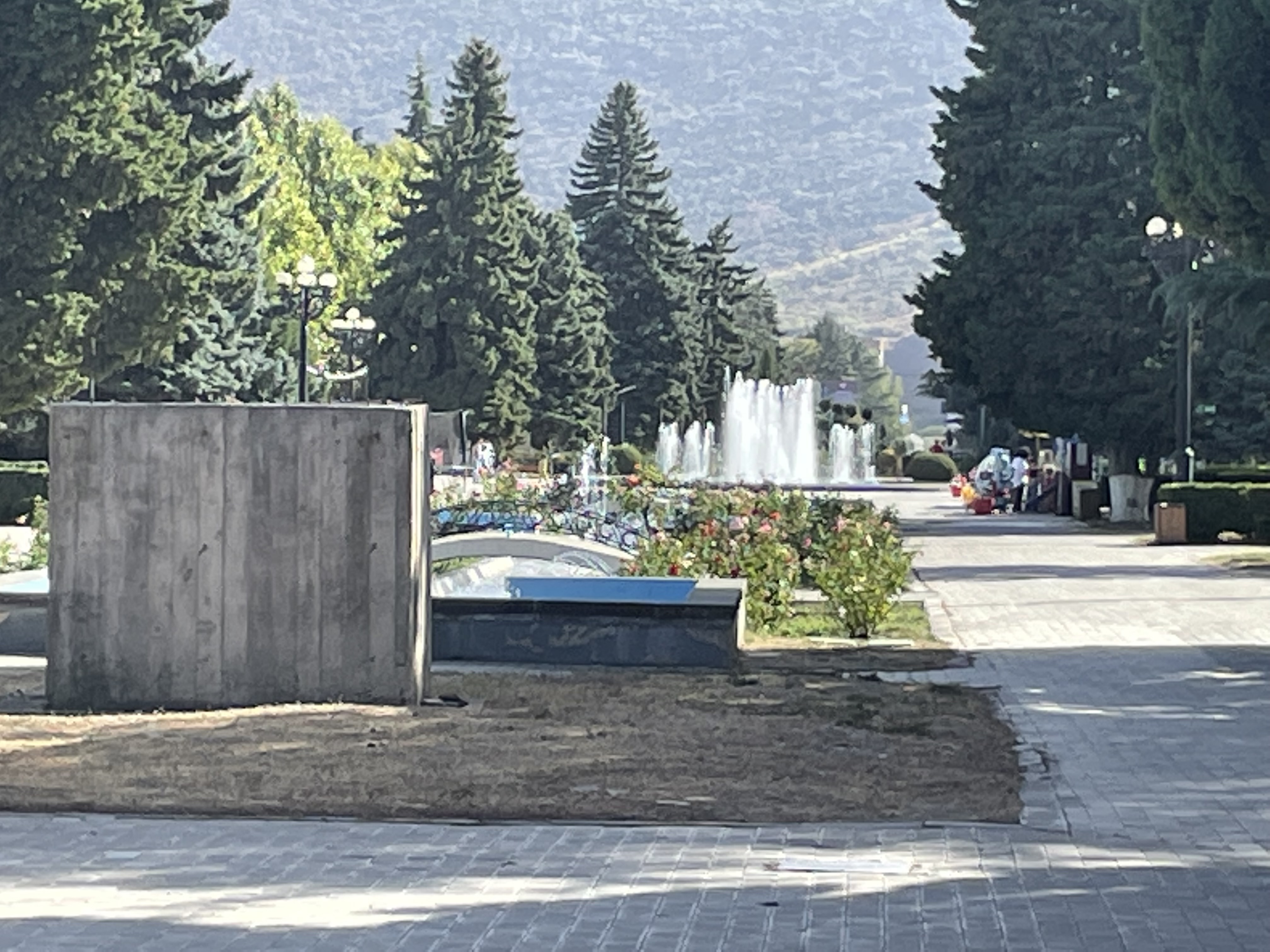
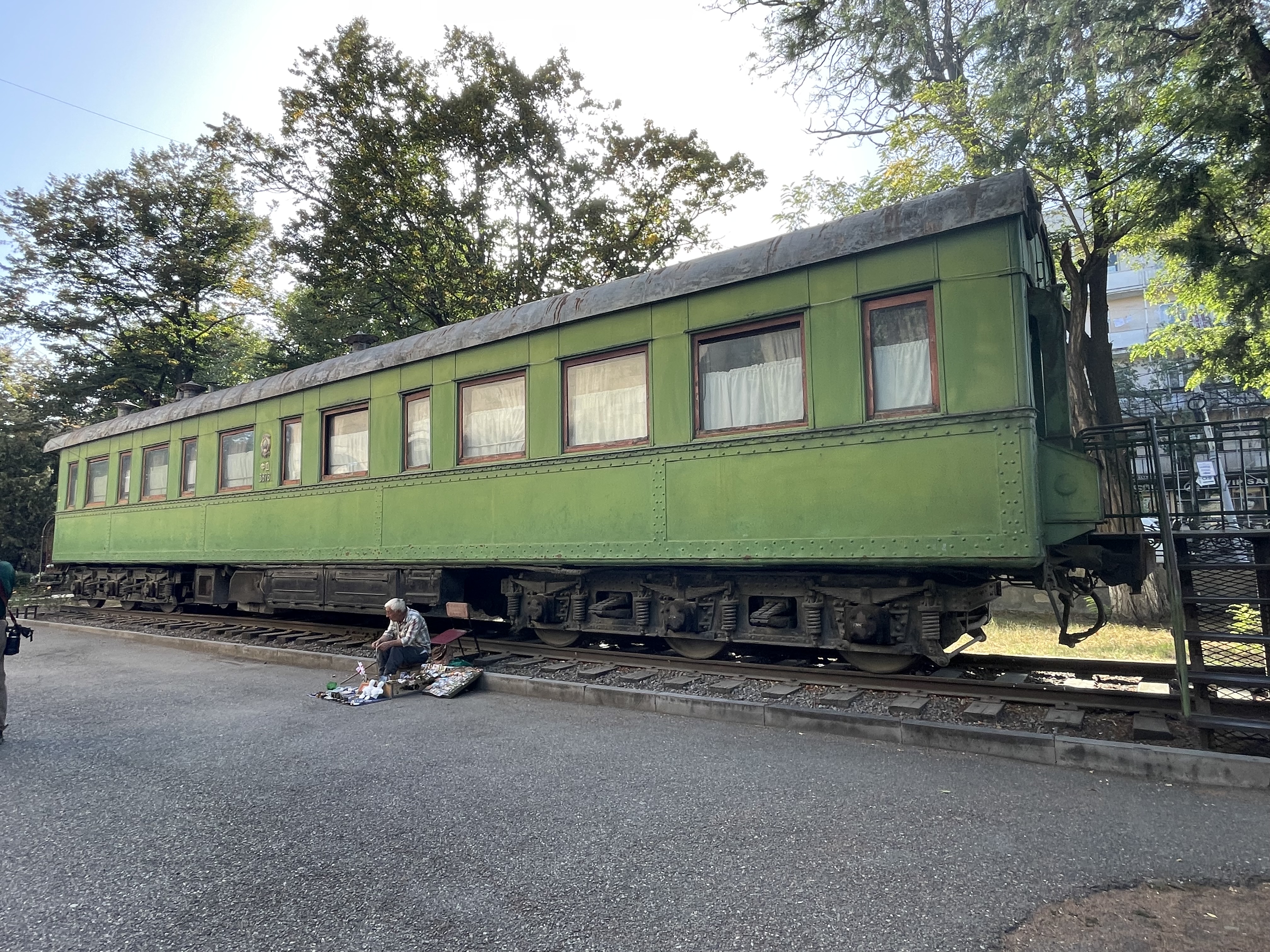
The first pic on the bottom row is of a mock up of the house in which Stalin was born. Third pic you will probably have guessed is of Stalin’s personal railway carriage.
What shook me most about the museum itself was the terrifying similarity between the techniques used by Stalin to retain power and those being used by Putin today. Putin destroys his enemies just as ruthlessly as Stalin did his: slightly more sophisticated with folks supposedly commiting suicide by jumping from windows or being poisioned. Scary.
Final visit before checking into our hotel today was to the unique Uplistsikhe Cave City. Uplistsikhe is a long abandoned Cave City founded in about 1,000 BC and pretty much continuously inhabited until the 13th century AD when the Mongols wrecked it completely.
Throughout its existence Uplistsikhe has always been an important religious centre, but what is especially interesting is that this was originally as a paganistic centre and many artifacts have been found that support that finding. However, although the Christianization of Kartli [Iberia] early in the 4th century AD led to the decline in the importance of Uplistsikhe as residents moved to other Christian centres such as Tbilisi and Mtskheta, both the old religions and Christianity co-existed in Uplistsikhe for many hundreds of years. You will perhaps be able to see from the pics that the Christian church that forms part of the complex – the Church of the Prince – does rather look as if it has been cobbled together on to the rest….
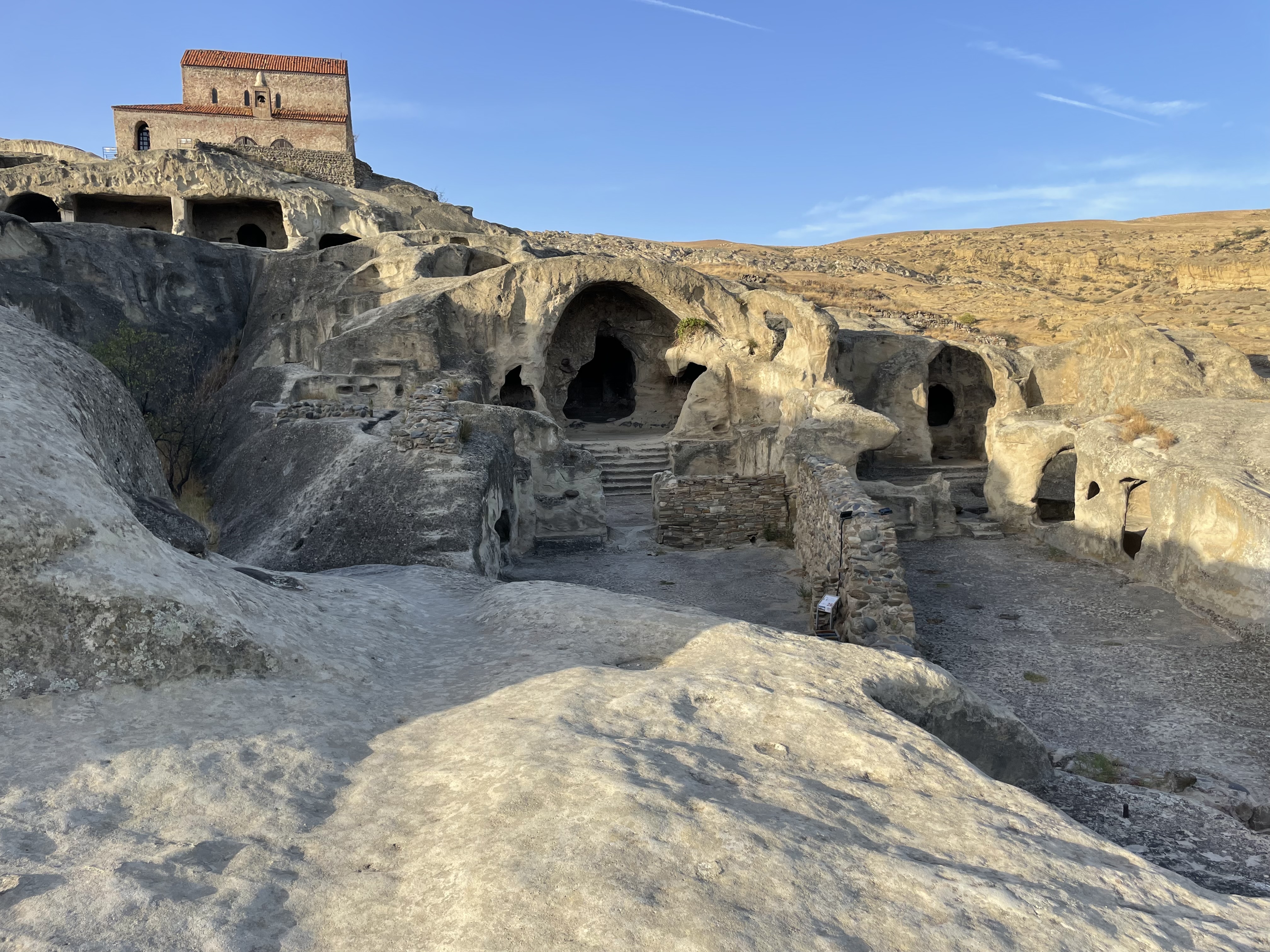
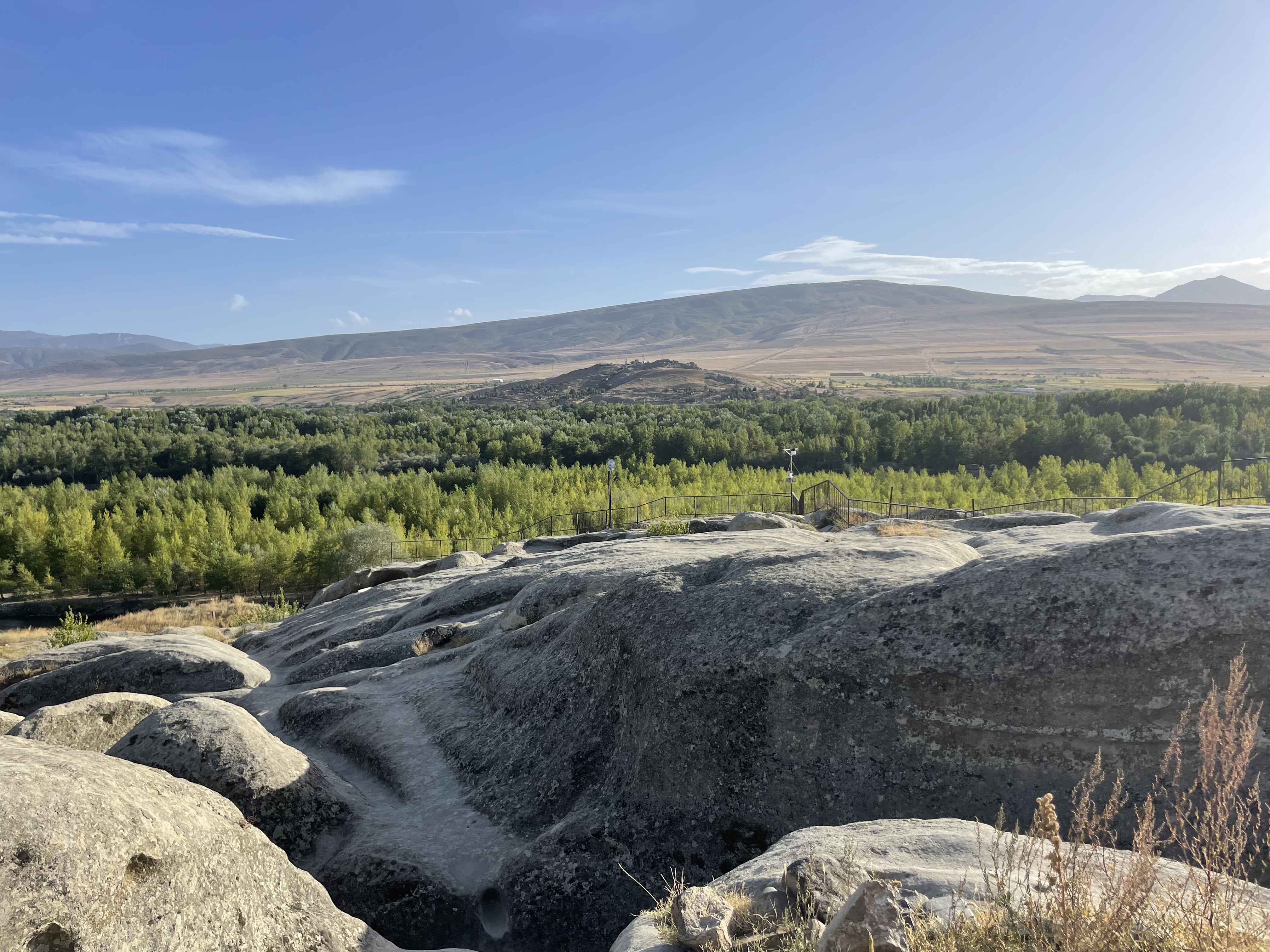
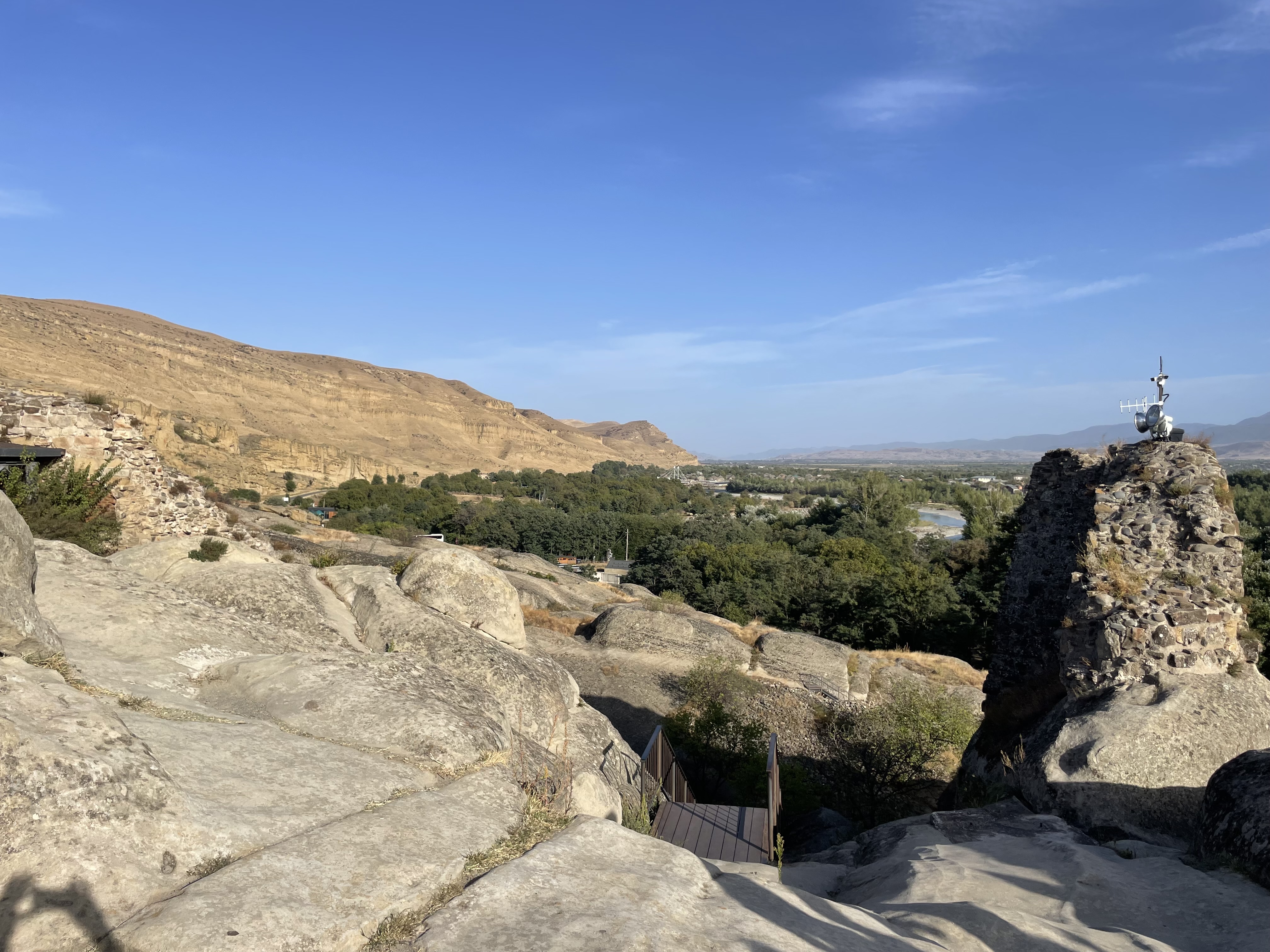
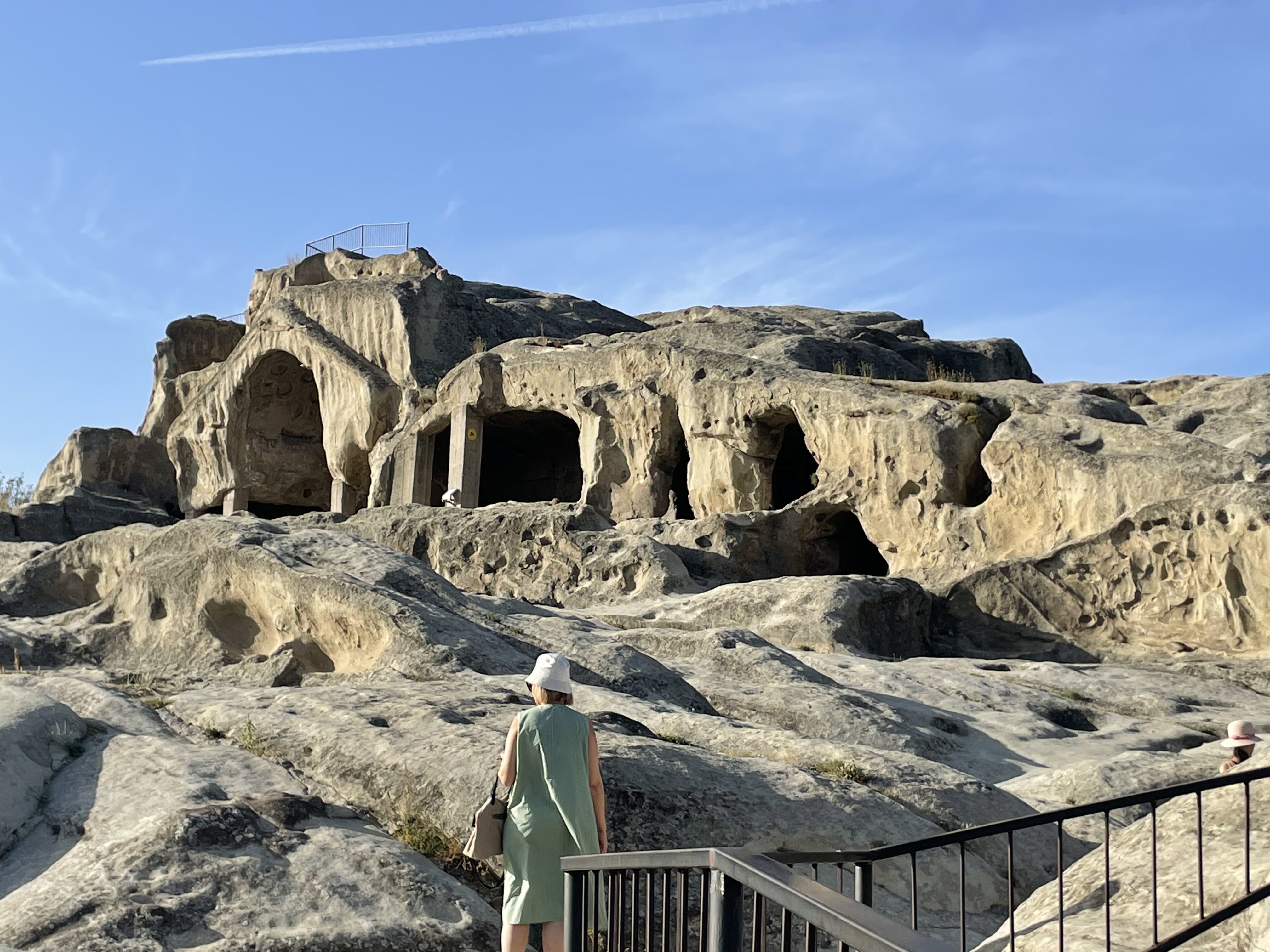
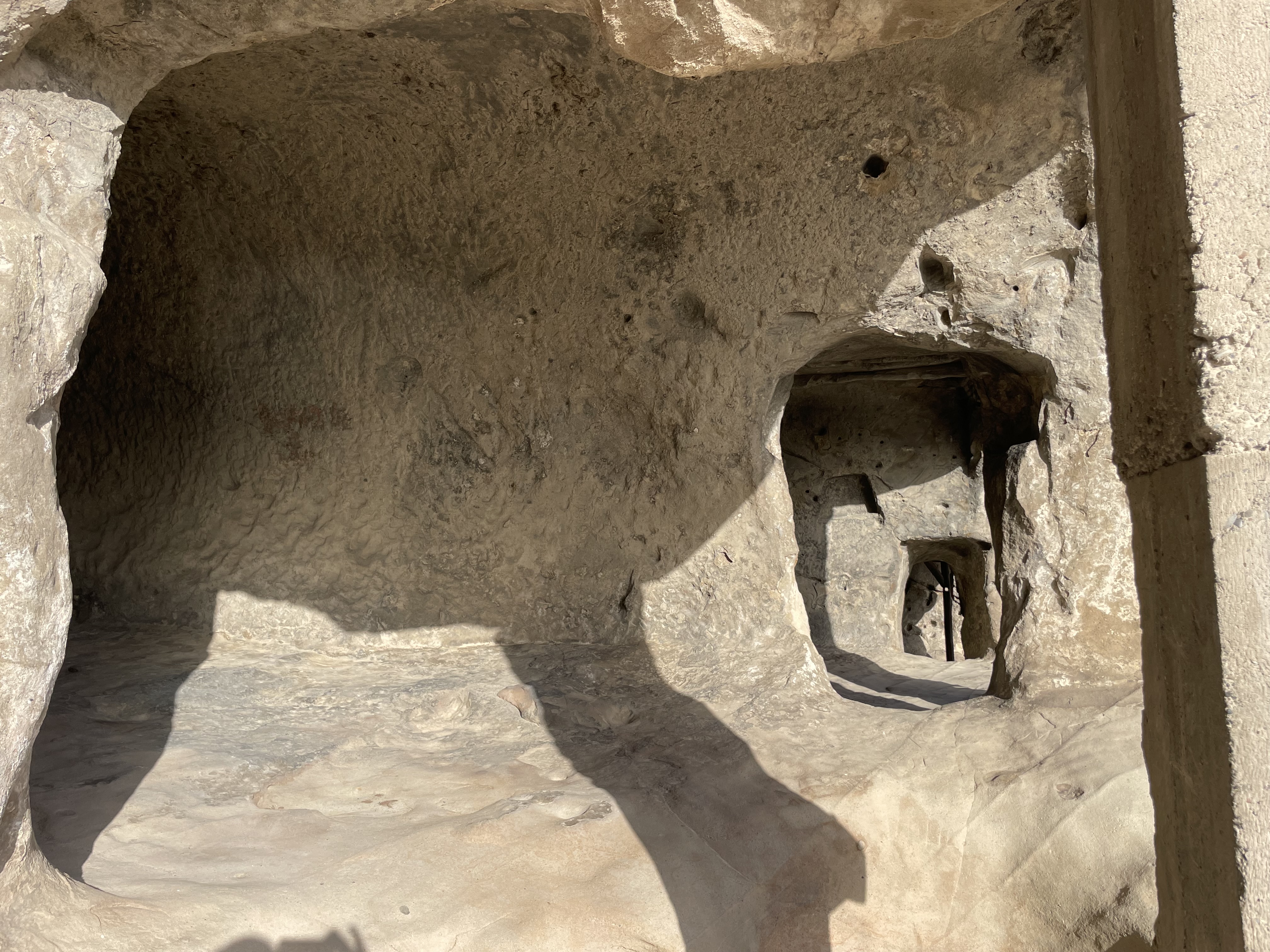
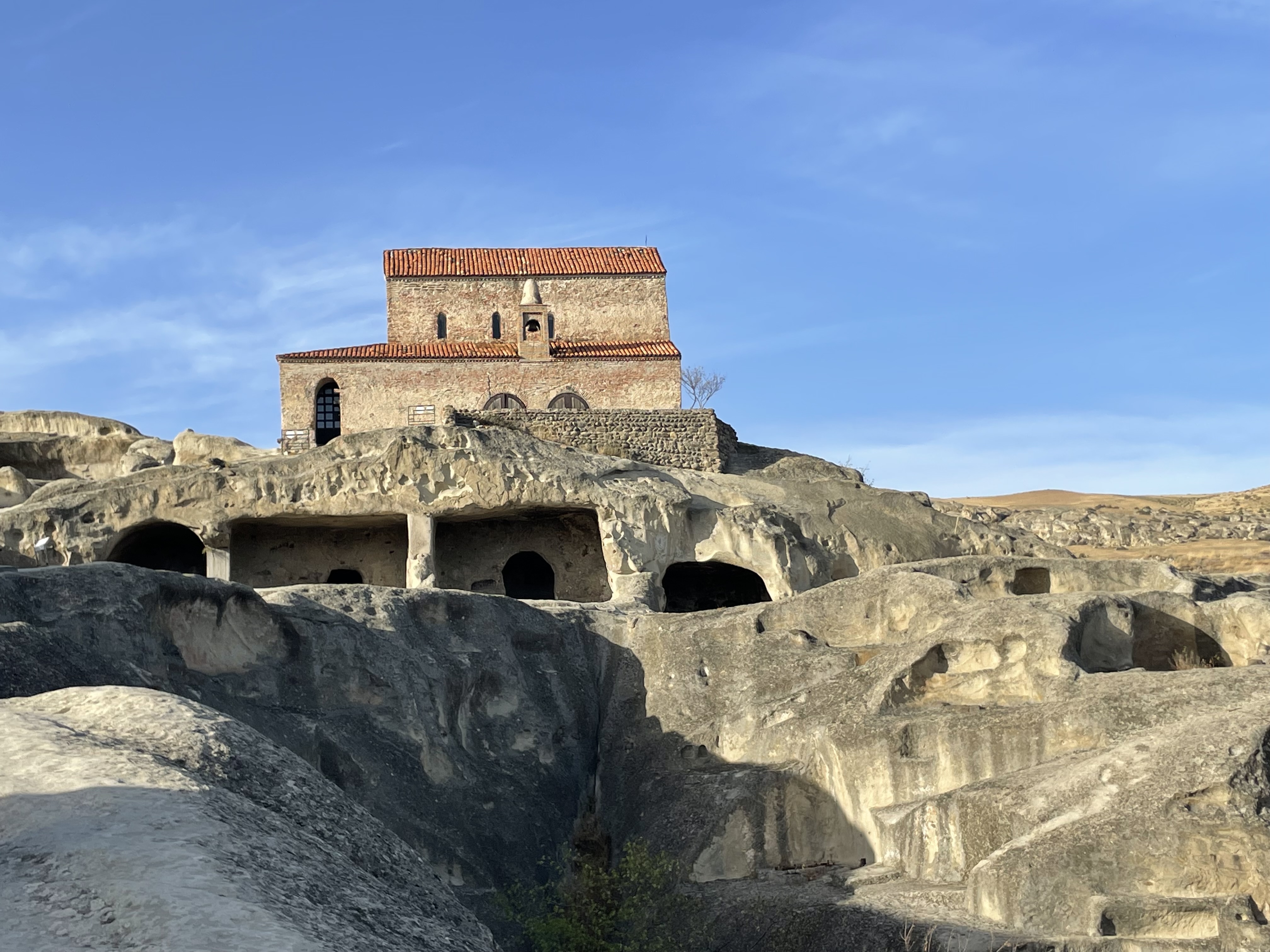
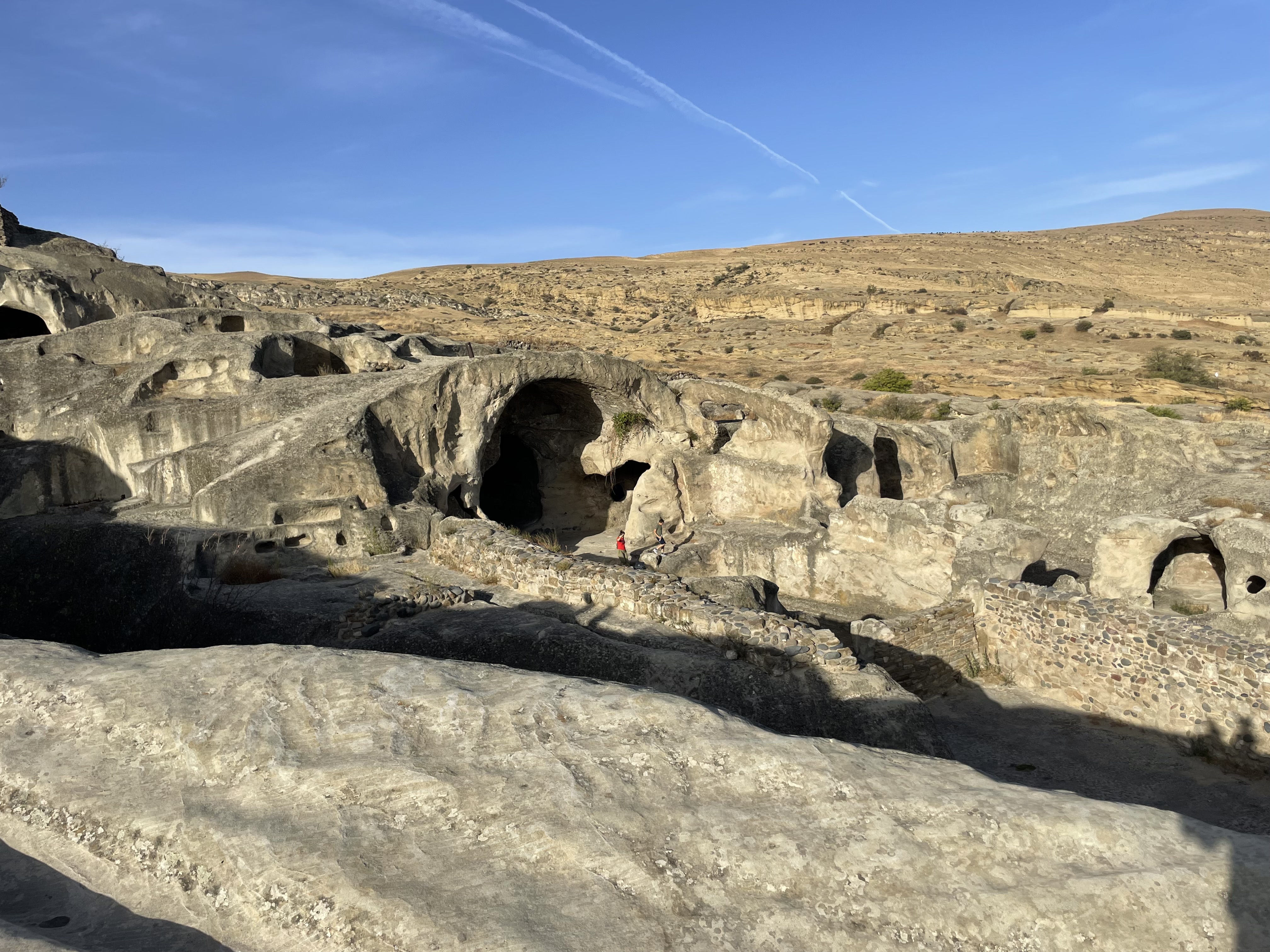
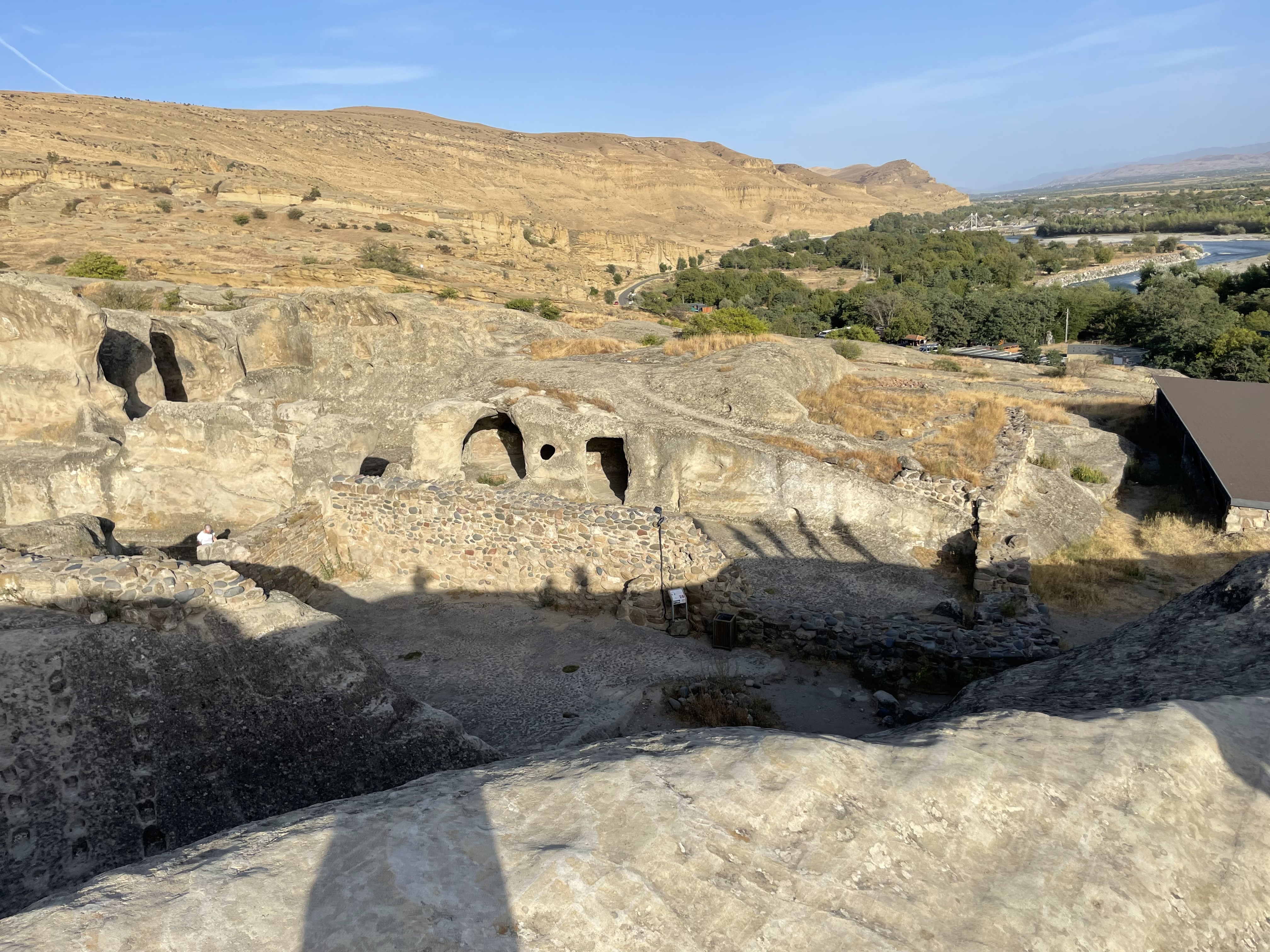

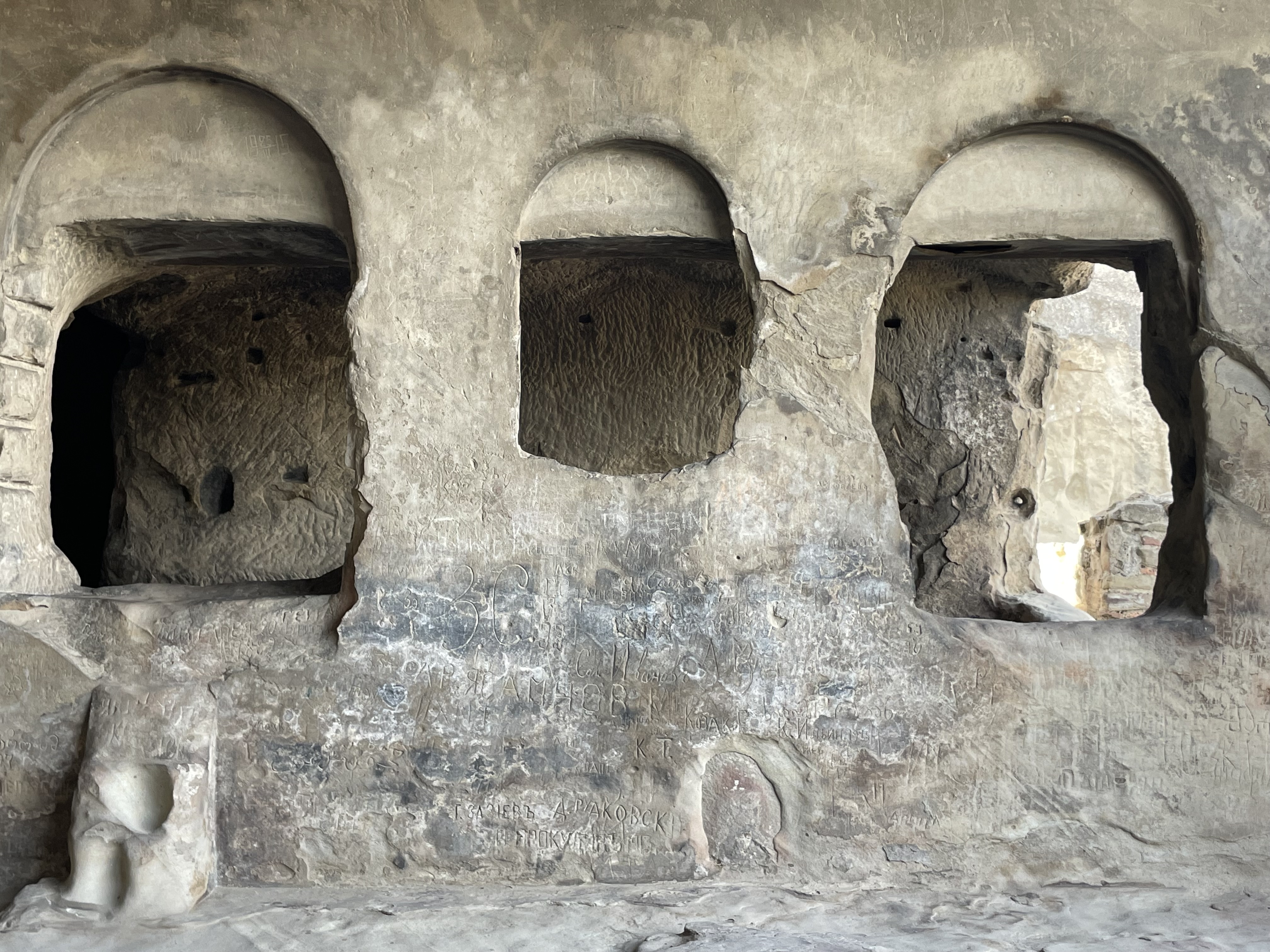
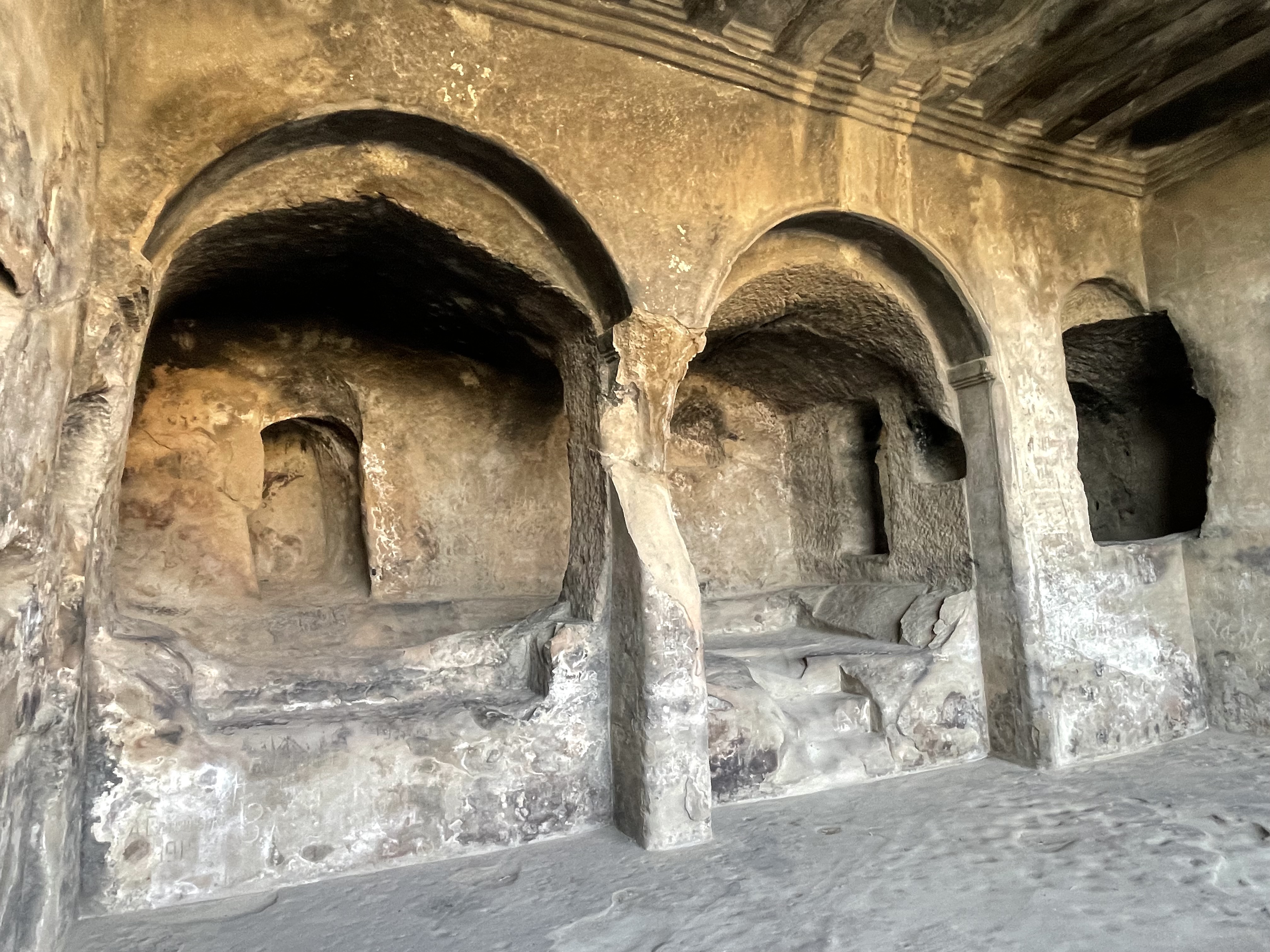
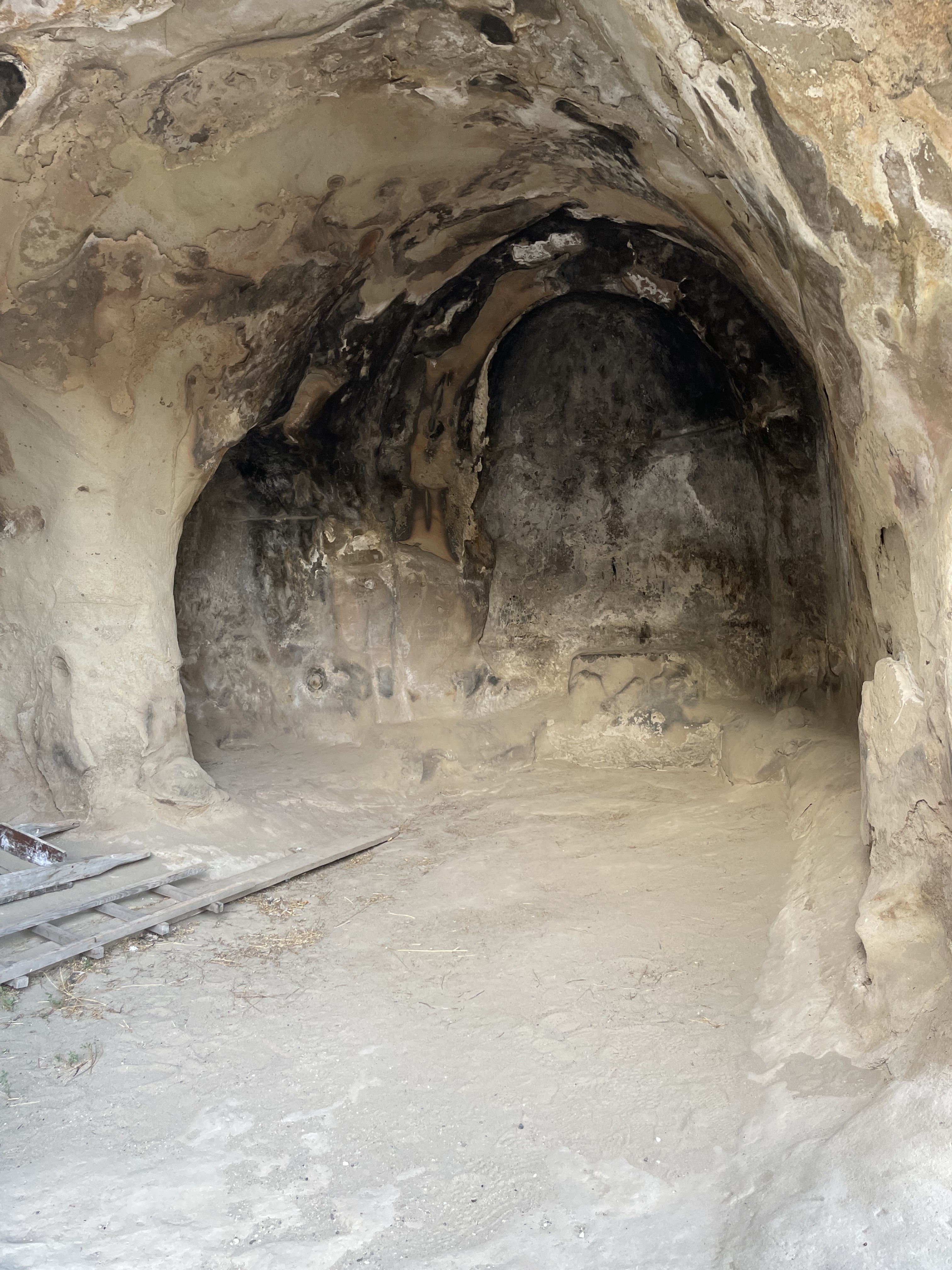
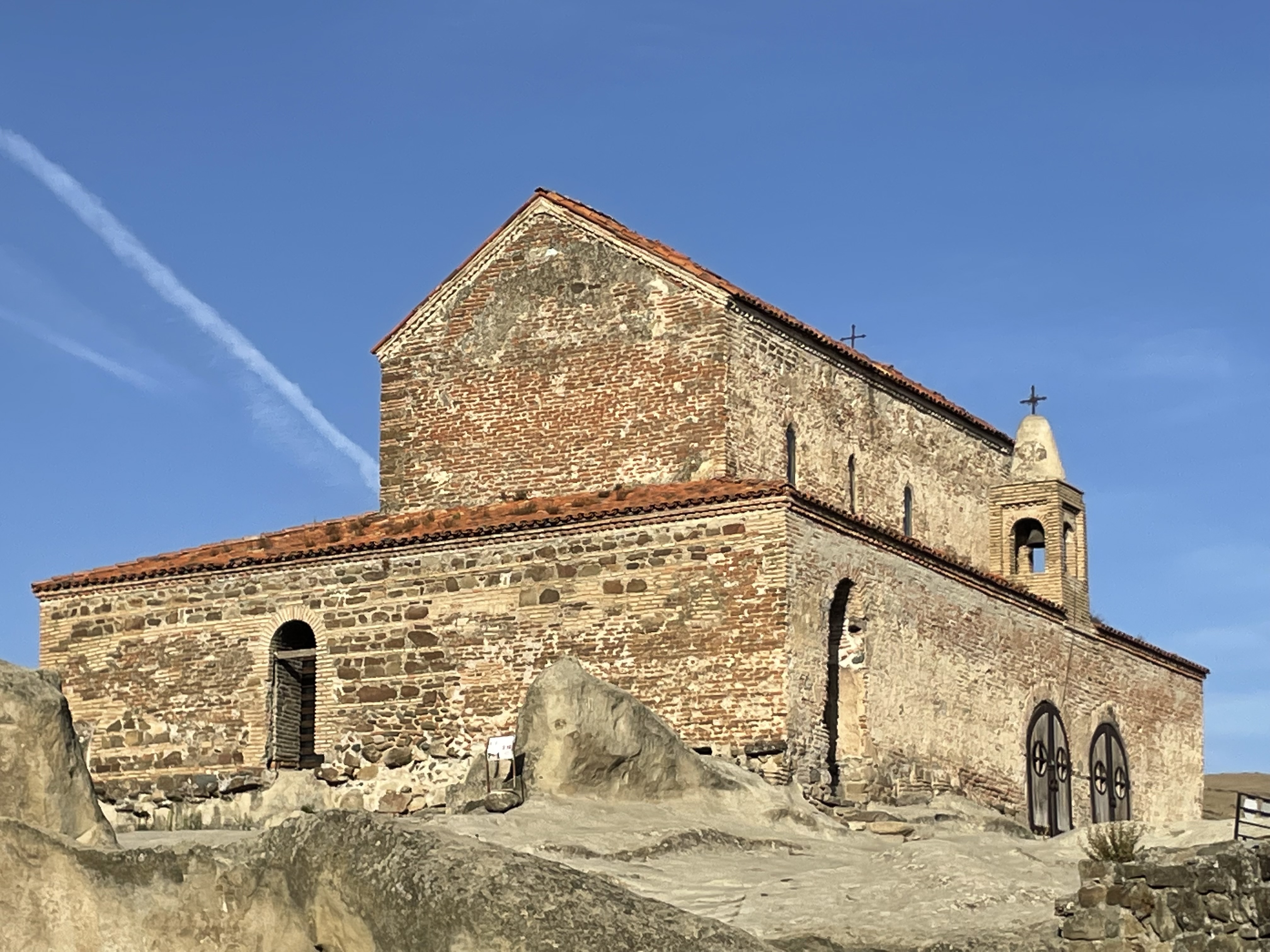
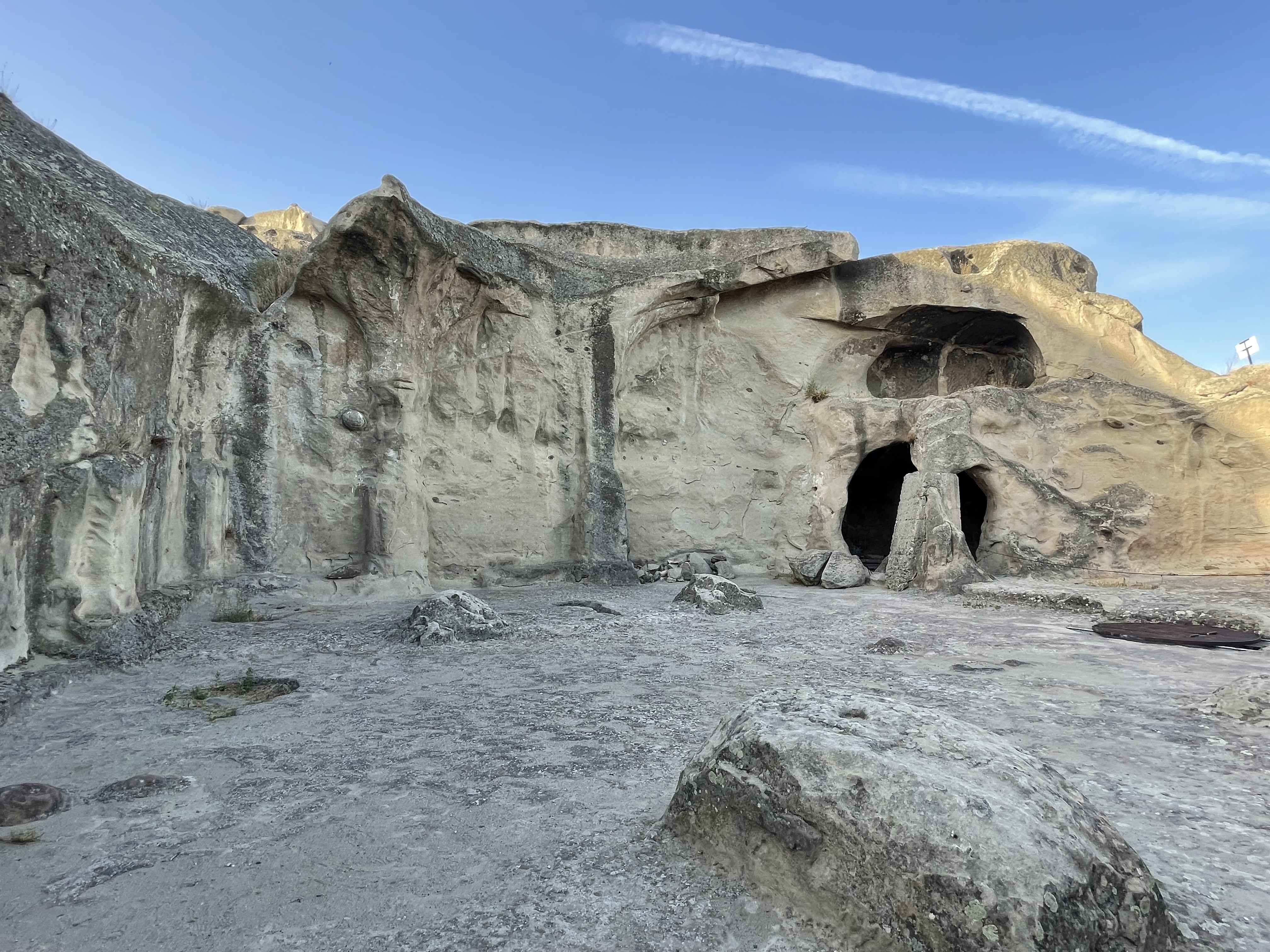
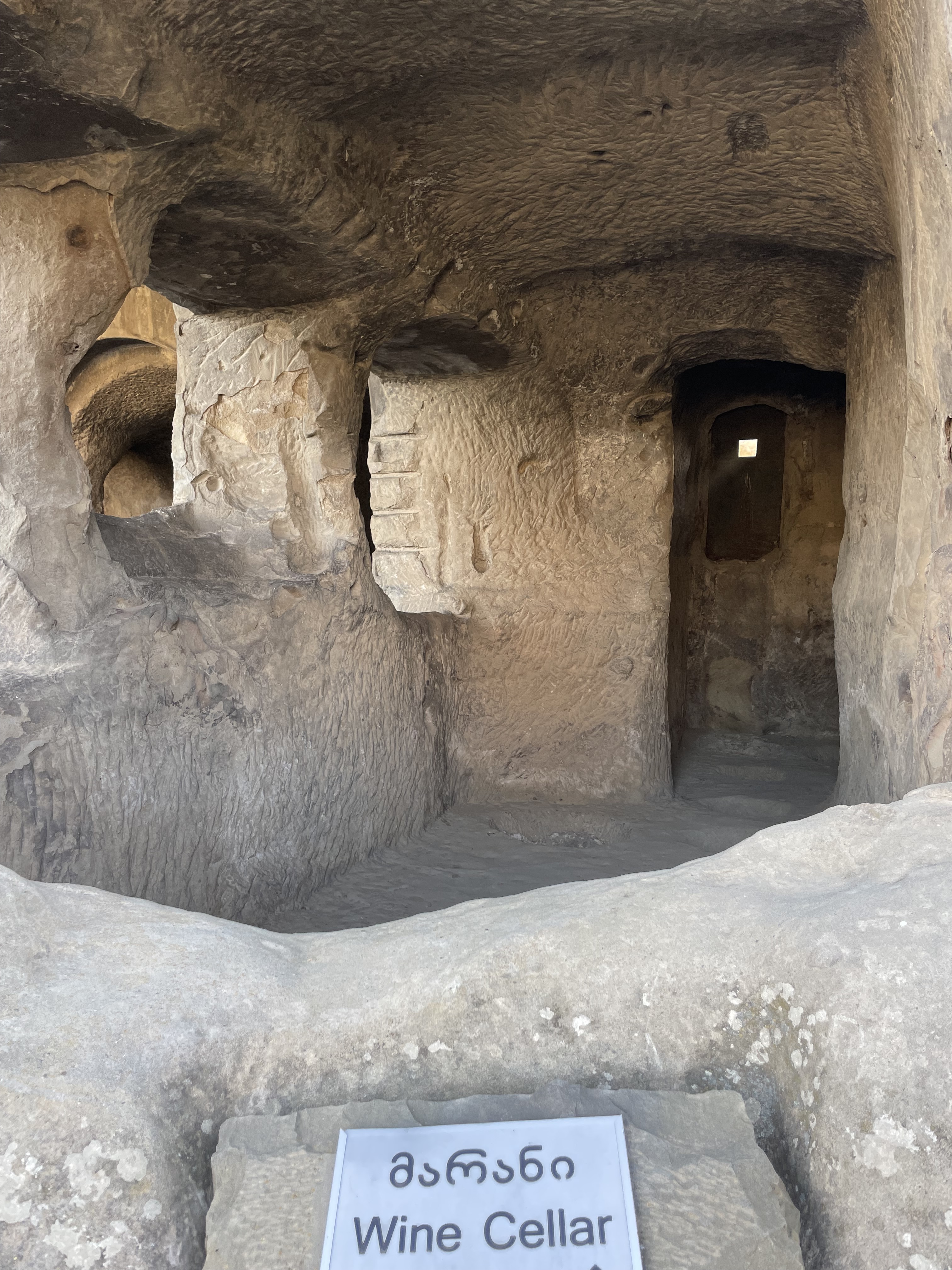
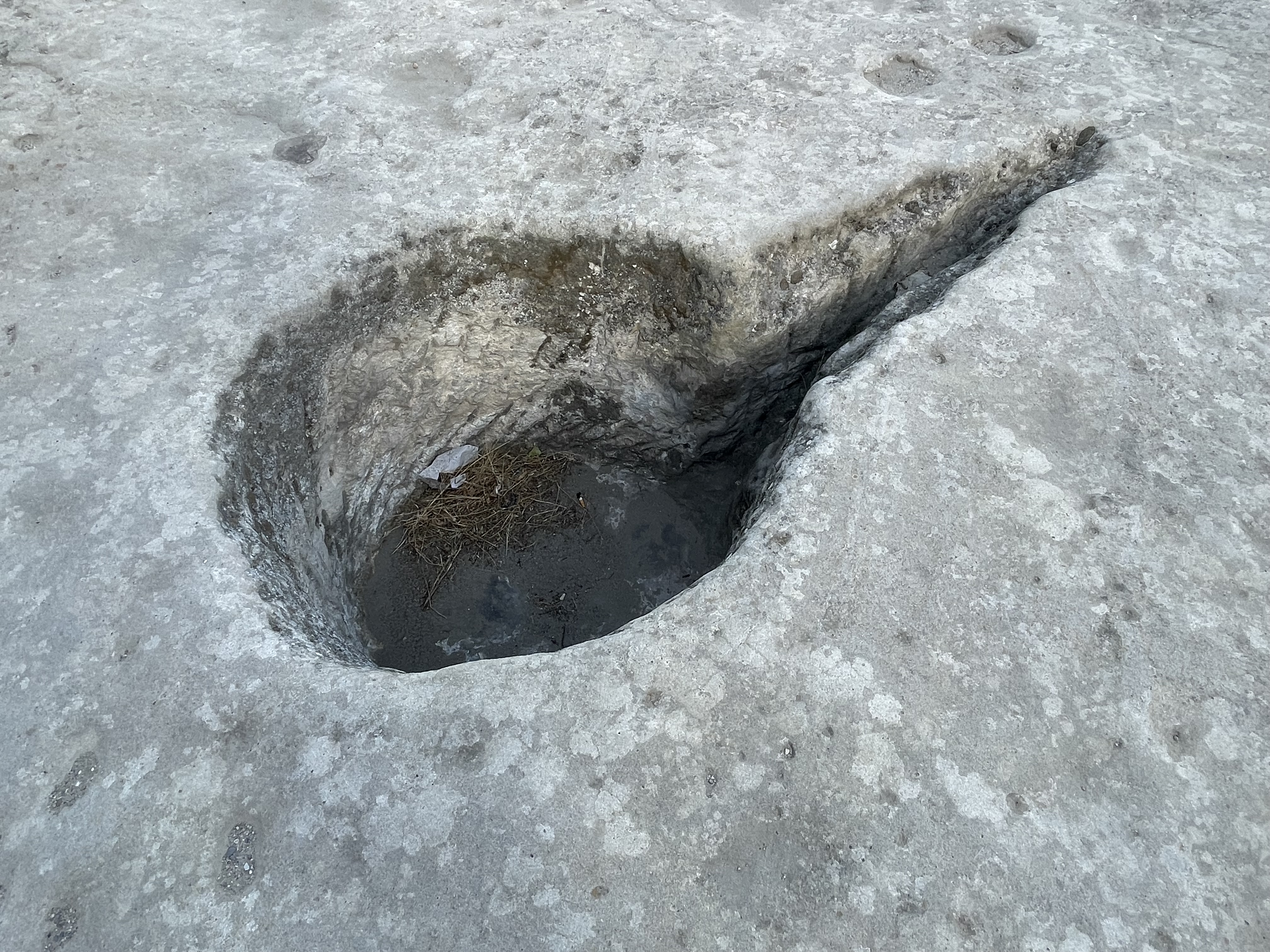
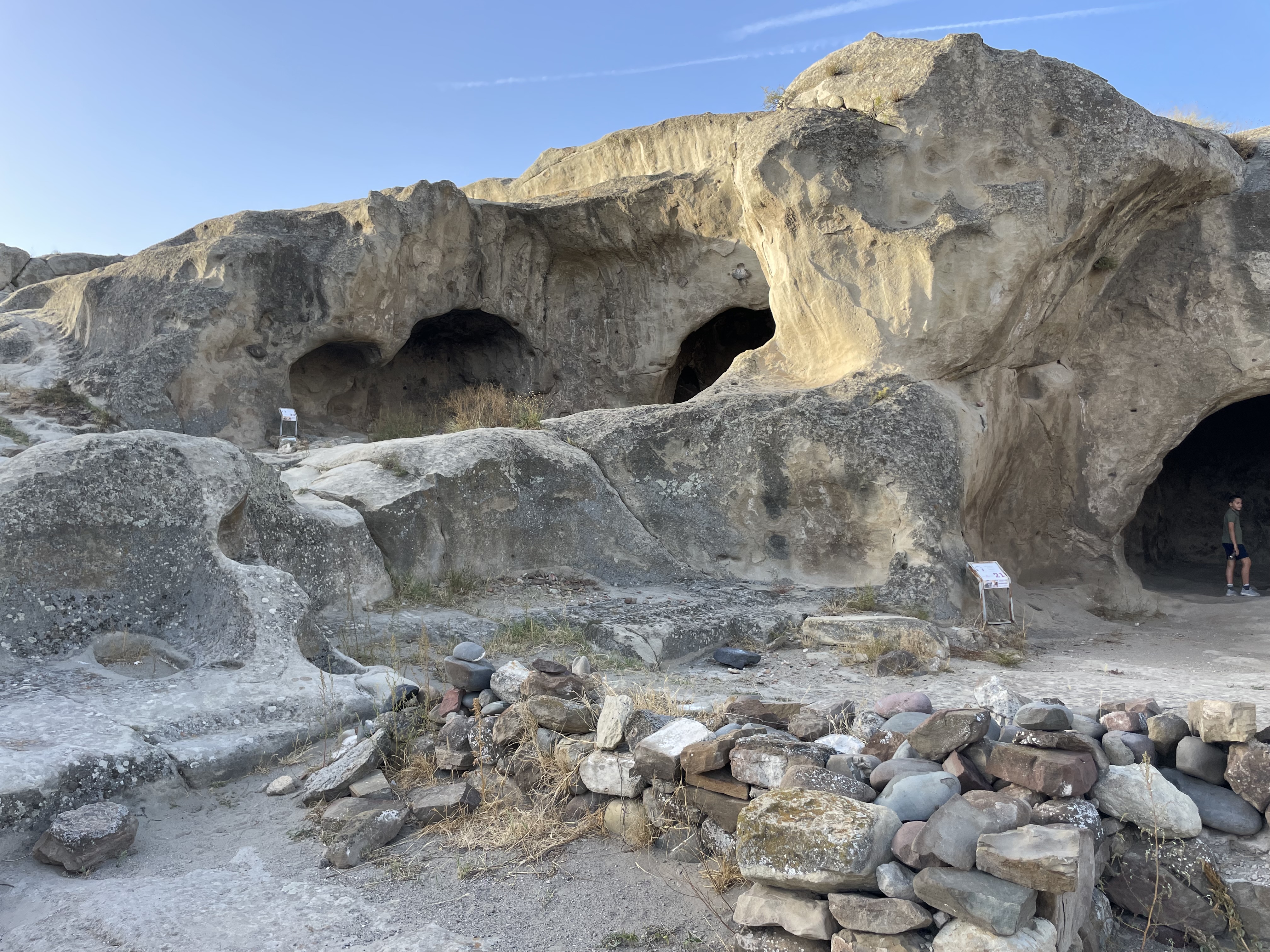
The first pic on the top left is one of the most interesting: it shows the Cave City Main Street and the Ravine, with the Church of the Prince sitting rather awkwardly on top of everyting!
The labelled picture of the Wine Cellar is next to the pictures of Queen Tamar’s Hall: one of the most striking parts of the whole complex. The amazing Queen Tamar became so powerful and successful that she was given the designation “King Tamar”, despite her gender. She ruled the country from 1184 to 1213, presiding over the apex of the Georgian Golden Age.
Tamar’s reign is associated with a period of marked political and military successes and cultural achievements. This, combined with her role as a female ruler, has contributed to her status as an idealized and romanticized figure in Georgian Arts and historical memory. She remains an important symbol in Georgian popular culture.
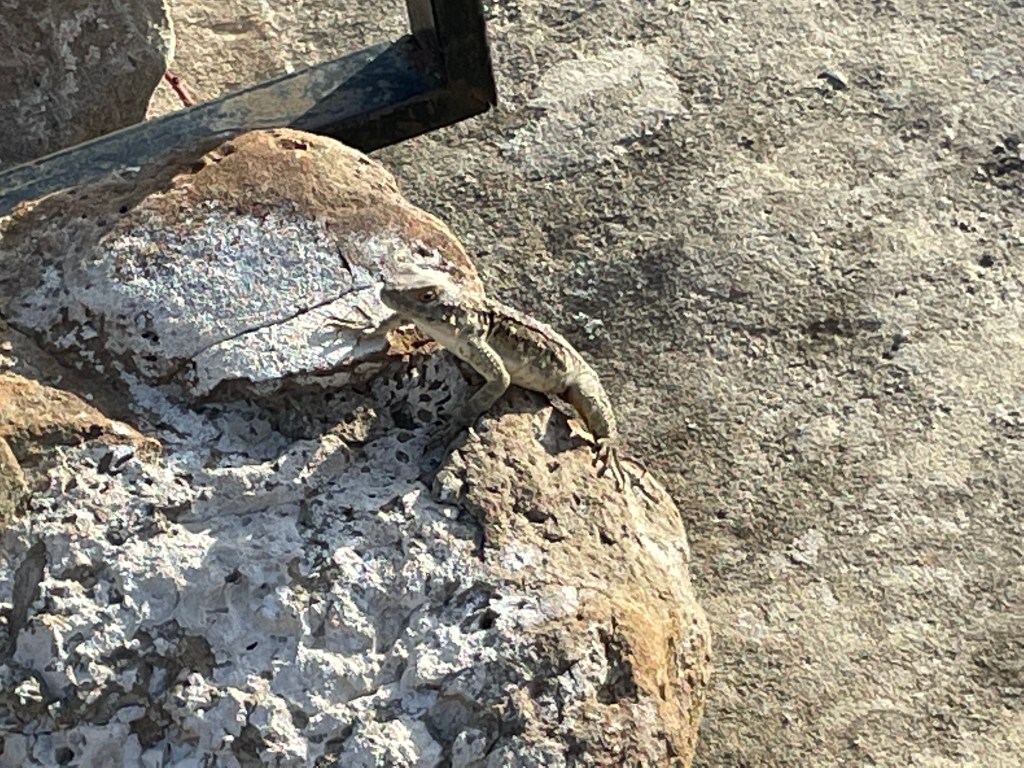
To close, here is a pic for you of a sizeable Georgian Lizard which didn’t seem at all fazed by my attention..
Tomorrow we travel from Gori to Telavi, close to the border with our final country Azerbaijan – more of that tomorrow including details of our Plan B to get into Azerbaijan given the the road border from Georgia is closed!
Adventure travel……!!!
 Tony's Geriatric Adventures
Just awesome!
LikeLike