Day 5: Sunday 10th September: Hong Kong to Beijing
Another drama-free Cathy Pacific flight… Despite the frenetic pace of Hong Kong, it does all seem to work smoothly.
Can’t say the same for Beijing: huge queue at immigration but never stopped moving. Long queue to get into the car park, even longer to get out. Beijing traffic lives up to its appalling reputation despite four concentric ring roads. No big deal, everybody very easing going, just allow plenty of time!!
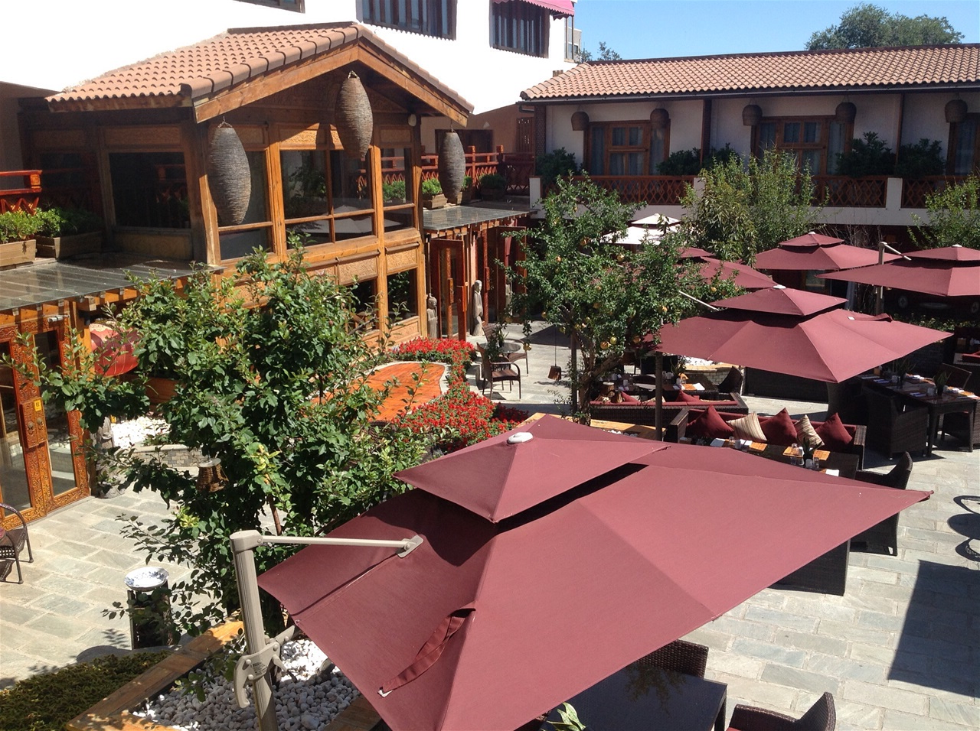
Wifi and Internet a bit sporadic here at the mo’, so the only pic I can provide for now is of our rather lovely and beautifully furnished hotel based in a converted hutong in the centre of Beijing. Chinese staff a little reserved at first and embarrassed if they don’t speak English, but soon crack up and full of smiles and friendly helpfulness given any encouragement at all!
Day 6: Monday 11th September: Beijing and The Temple of Heaven
I borrowed one of the Hotel’s push bikes this morning and went for a pedal around Beijing. Great fun provided you understand that traffic lights are regarded as purely advisory and folks ride and drive pretty much on whichever side of the road they fancy! What makes it work is that nobody actually wants to kill anybody else…..
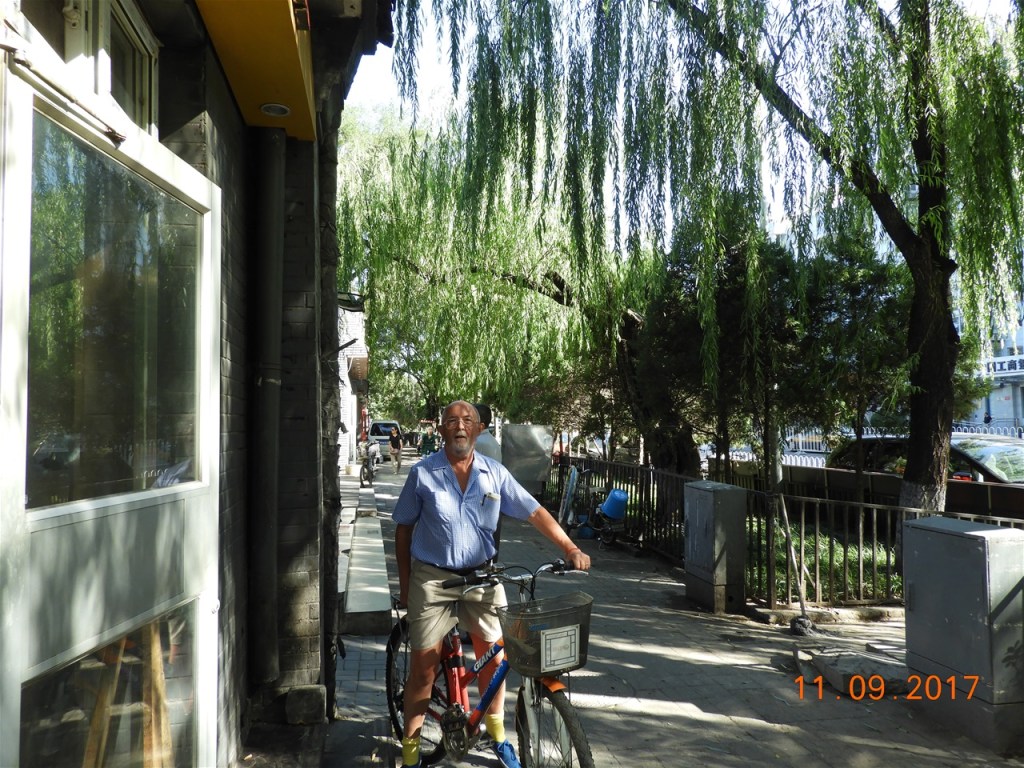
The real reason for the excursion was that the Iranian officials don’t like Men In Shorts and I realised when I unpacked today that I had not brought enough long trousers, so bought a couple of pairs at a local supermarket!! I knew there was a good reason why I always leave the packing to Margie!!!
Met up with the rest of the gang at lunchtime. Mostly Brits, a couple of Cousins, a lady from Fiji, two ladies from Oz and two folks from Switzerland. There followed a well behaved lunch but things livened up in a promising way over a slightly chaotic dinner…..
In between feeding we paid a visit to the super impressive early 15th Century Temple of Heaven. Built between 1406 and 1420 by the Yongle Emperor who was also responsible for the Forbidden City which we will see tomorrow. Much extended and refurbed over the years and much neglected after the downfall of the Qing, The Temple of Heaven complex is now all beautifully restored….
More pics of Beijing and the Temple of Heaven
Day 7: Tuesday 12th September – Beijing: Tiananmen Square + The Forbidden City
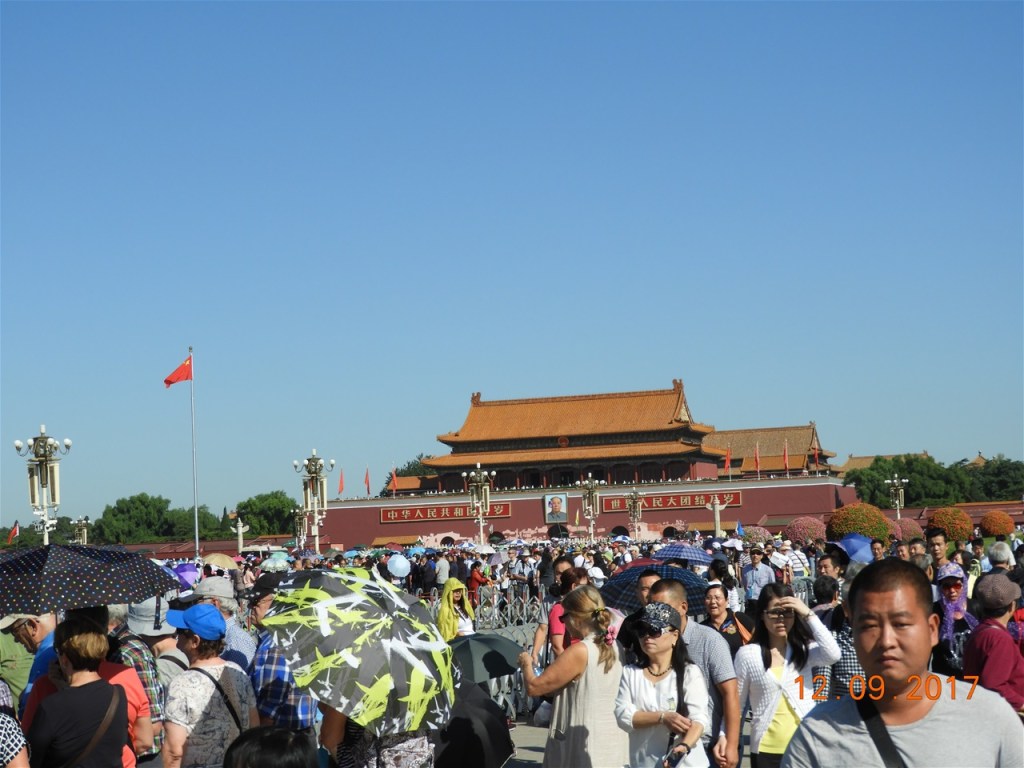
Epic crowds, of course, easily enough people to fill Wembley Stadium – probably twice over!!
It’s not difficult to complain about that , but the crowds do simply reflect the profound historic importance of what we are privileged to witness: The Forbidden City with its several hundred palaces and temples as the manifestation of the greatness and sophistication of the Chinese Imperial Dynasties and Tiananman Square the focus of the Long March the Chinese people have made since 1909. It also reflects the enormous material and economic progress the country has made over the last couple of decades.
And for us simply the words ‘Tiananmen Square’ convey the reality that it has not been an easy journey and how much different their concept of democracy is from ours…..
More pics of Tiananmen Square and The Forbidden City: soon come!!!
Day 8: Wednesday 13th September – The Great Wall of China
Long day today: up at 5:00 for the 90 minute bus ride to Mutianyu for the first real energetic element of the trip: climbing up The Great Wall Then back to Beijing for our two hour flight to X’ian.
This very impressive section of the Great Wall is about 50 miles north of Beijing, built to defend the capital and the Imperial Tombs. It runs through spectacular and beautiful mountainous country thick with pristine green forest.
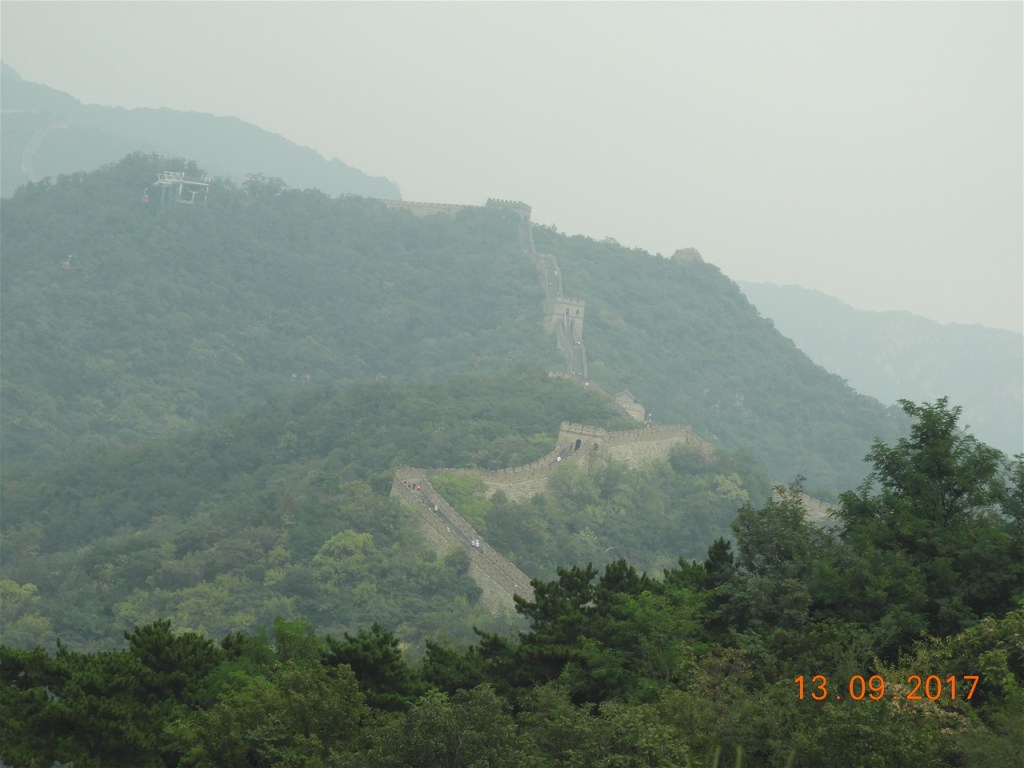
This section of the Wall was first built in the 6th Century during the Northern Qi but the present massive granite construction was created by the Ming Dynasty during the 14th Century.
Having worked up an appetite we then sat down to a gargantuan Peking Duck lunch before heading off to the airport. 90 minute delay for take off. So by the time we got to the rather splendid hotel in X’ian at 10:00 pm I just fell into bed and slept very soundly indeed……
See Pics here of The Great Wall at Mutianyu: Soon come!!!
Day 9: Thursday 14th September – X’ian: Big Wild Goose Pagoda and the Great Mosque of X’ian
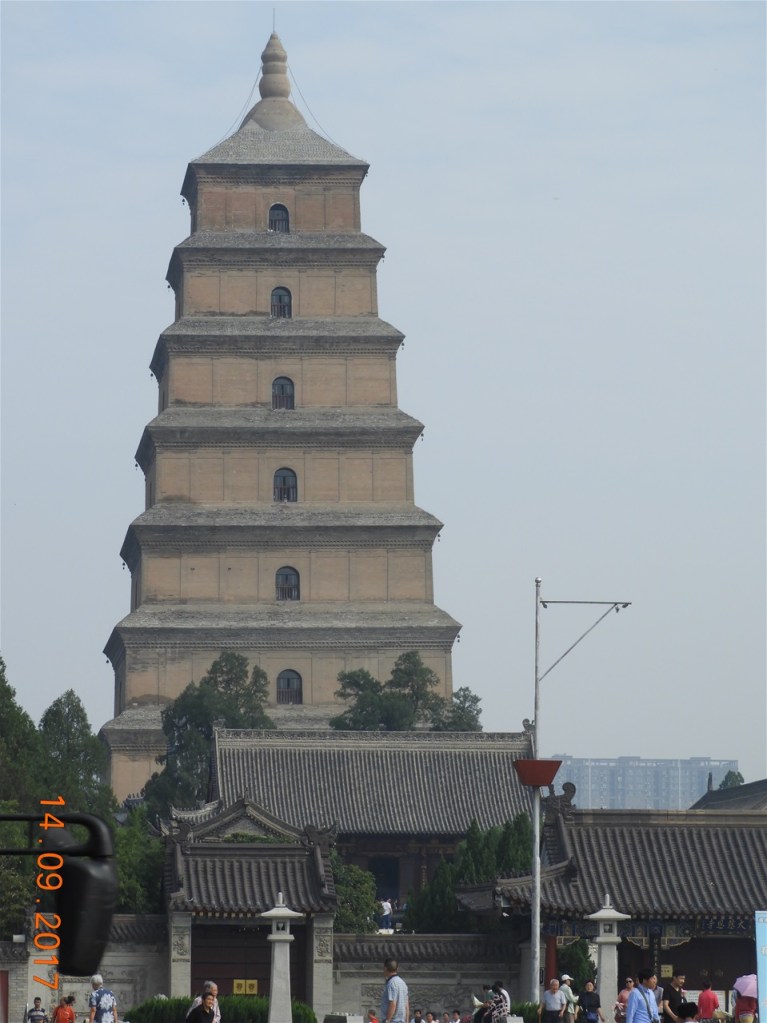
X’ian is one of the ancient capitals of China and was founded by Qin Shi Huang Di the First Emperor, he of Terracotta Warriors fame. It was the start point of the ancient Silk Road which stretched all the way through Western China, Central Asia and the Middle East to the Mediterranean Sea.
The Big Wild Goose Pagoda was built in 652 by the Emperor Gaozong of the Tang Dynasty and originally had five stories. It was rebuilt by Empress Wu Zetian in 704 to ten stories, but an earthquake in 1556 reduced it to its current seven stories.
Although at 210 feet tall it’s a physically impressive building in itself the most rewarding parts of the Pagoda complex are the maps and manuscripts of the journeys of the Bhuddist translator and traveller Xuanzang. He became famous for his seventeen year overland journey around India during the 7th century. He returned to China and spent the rest of his life translating Indian Bhuddist texts into Chinese and vice versa. Xuanzang had a profound influence on the development of Bhuddism in China.
The Great Mosque of X’ian is the largest Mosque in China built in 742 during the early Ming Dynasty. It remains an active place of worship within the X’ian Muslim Quarter and now houses more than 20 buildings in its five courtyards and covers 130,000 square feet.
More pics of:
The Big Wild Goose Pagoda
Great Mosque of Xian…..Soon Come!!!
Day 10: Friday 15th September – X’ian: The Terracotta Army
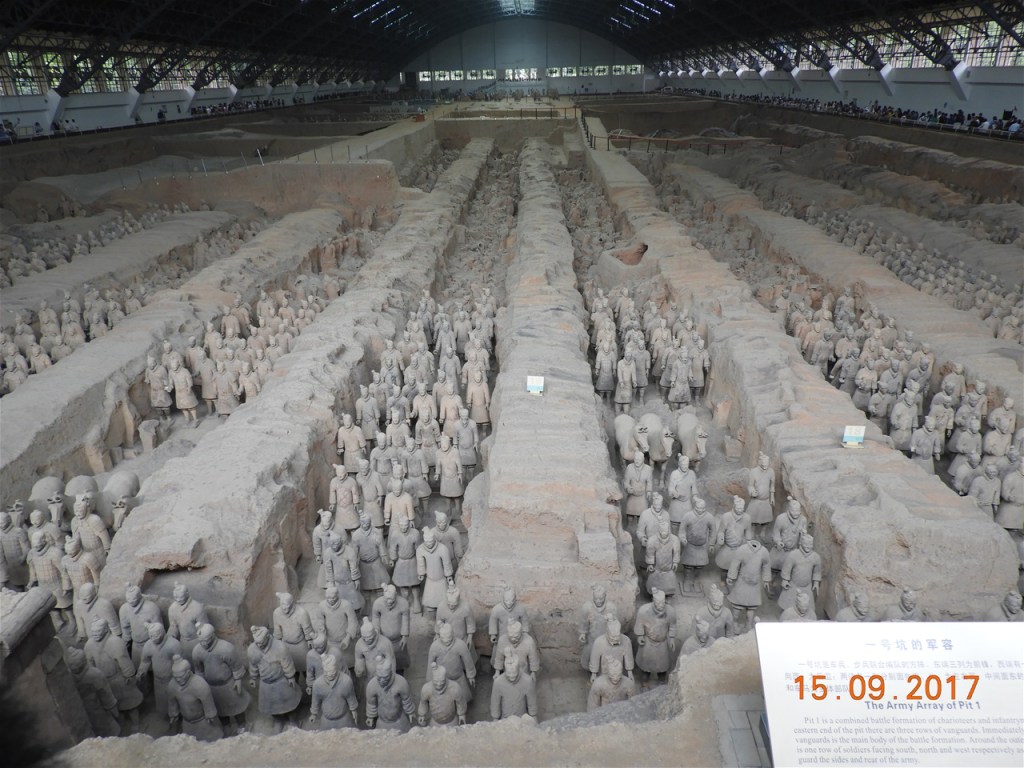
Qin Shi Huang was 13 years old when he ascended the throne and by the time he was 38 he had conquered all the other Warring States to unify China for the first time in 221 BC. As a result of his exploits he became the First Emperor of China.
As soon as he ascended the throne work was started on his mausoleum which over time evolved into a life sized Imperial Palace that he would inhabit after his death.
The Terraccotta Army at least 6,000 strong was created to guard him in that palace after his death. When he died prematurely in 210BC at the age of 50 the work was not complete but what we are left with is an awe inspiring testament to the wealth and power of his Empire.
It is also rather sad and ironic that Qin spent all his adult looking for the elixir of life that would make him immortal….
See more pics of The Terracotta Army: Soon Come!!!
X’ian as a city is a great deal more than the stop off point for the Terracotta Warriors – it is a major cultural centre in it’s own right with an astonishing city wall that befits its status as a former capital of China. The city wall was originally built in the 14th Century and is claimed to be the longest complete city wall in the world at eight and a half miles enclosing an area of 5.4 square miles and with a proper moat all the way round!
See more pics of Xian + its City Wall: Soon Come!!!
Day 11: Saturday 16th September – X’ian to Labrang Monastery via Lanzhou
Our next adventure was a nine hour sleeper train journey from X’ian to Lanzhou about which a couple of pages could be written!! However, a straw poll suggwests average actual sleep time was a couple of hours…. I’m feeling pretty smug because my deafness contributed to a reasonable night’s sleep for me!
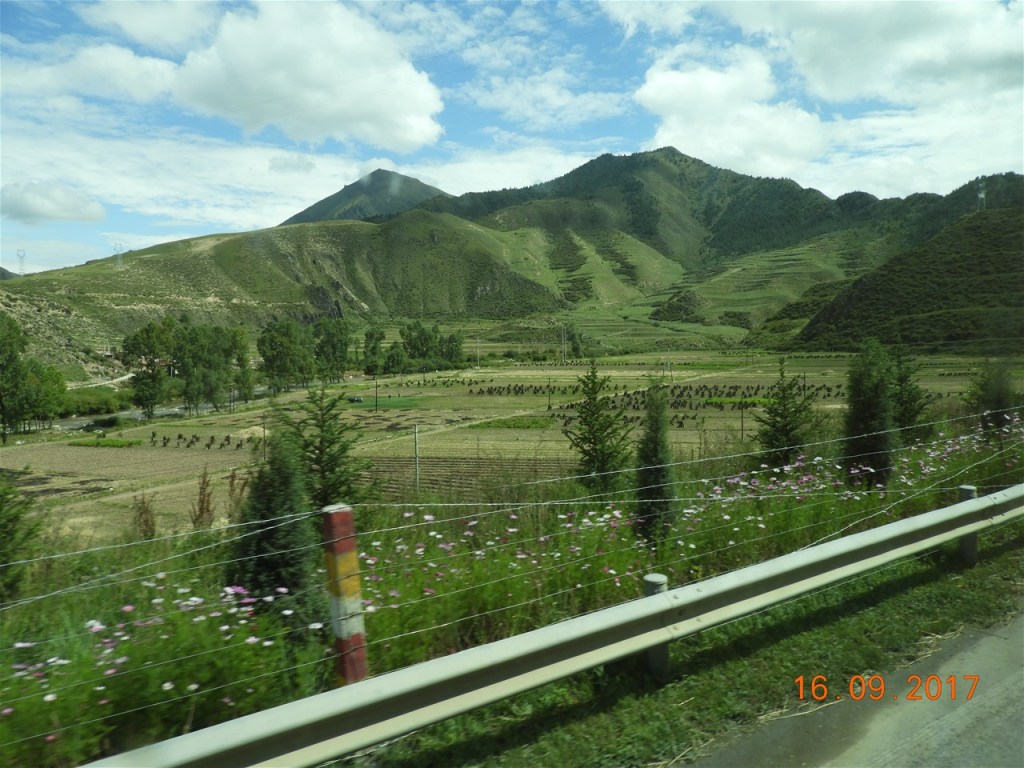
Final part of our journey was a three hour bus ride to Xiahe through stupendous mountain scenery for our visit to the Labrang Monastery scheduled for Sunday. The actual journey time was longer because we stopped off in Linxia for a look at the Da Gongbei mosque, HQ of the Qadiriyyah school of Islam.
Xiahe is at about 10,000 feet, so lots of breathlessness after lugging bags up the stairs of our hotel!!!
Everywhere we looked on our bus ride from Lanzhou to Labrang we saw spectacular scenery and lots of wild flowers.
For more pics of our journey: Lanzhou to Xiahe: Soon Come
Day 12: Sunday 17th September – Labrang Monastery
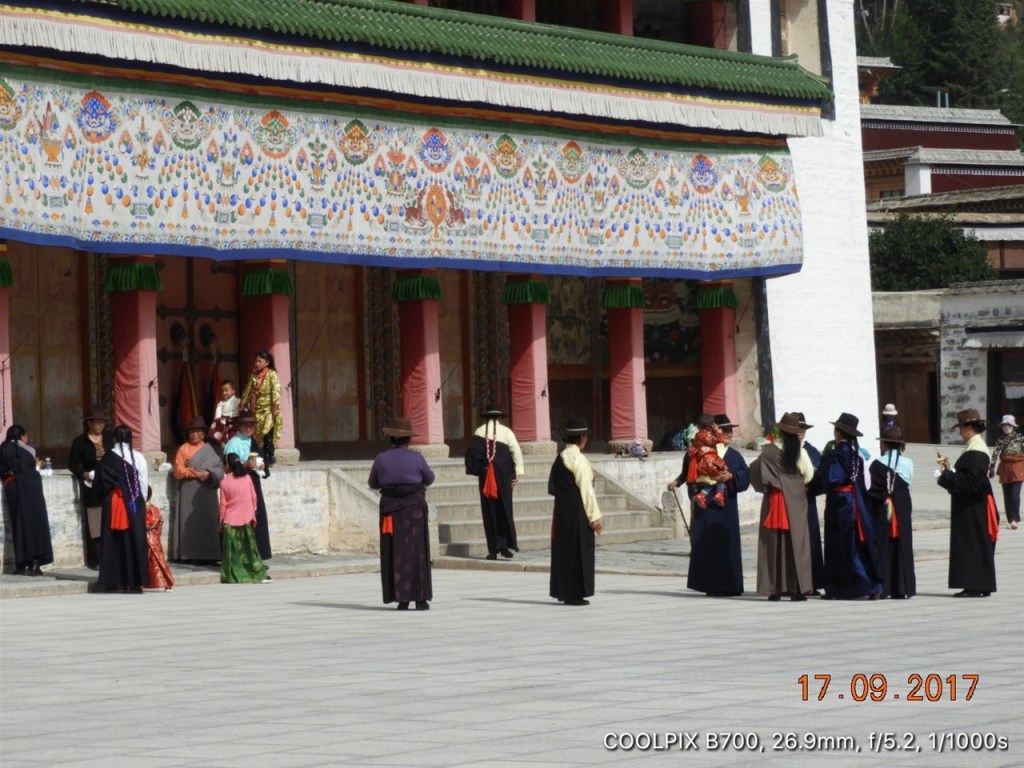
Tibetans in tradional dress outside the Prayer Hall in Labrang Monastery complex.
Labrang is one of the six most important monasteries of the Gelug (Yellow Hat) school of Tibetan Buddhism and the Monastery with the largest number of monks outside of the Tibet Autonomous Region (the PRC’s name for the former country of Tibet). The Monastery is located in the Gannan Tibetan Autonomous Prefecture in Gansu Province about 700 miles north west of Tibet itself.
Despite lots of tourist activity Labrang retains the air of calm you would expect given its breathtaking location up in the mountains alongside the Daxia River a tributary of the Yellow River. Our experience was enhanced by the young monk who acted as our tour guide. His combination of gentle humour and unshakeable belief in his faith affected us all. If you had to spend your whole life in a single place Labrang would be a great choice!!
Click here for pics of Labrang Monastery: Soon come!!!
Day 13: Monday 18th September – Xiahe to Jiayuguan via the Binglingsi Caves
100 feet tall Maitreya Buddha at the Binglingsi Temple and caves on the banks of the Yellow River.
Having spent two nights at about 10,000 feet in the Gannan Tibetan Autonomous Prefecture we headed off back to Lanzhou to pick up our second Sleeper Train to travel west to Jiayuguan the most westerly gate in the Great Wall of China.
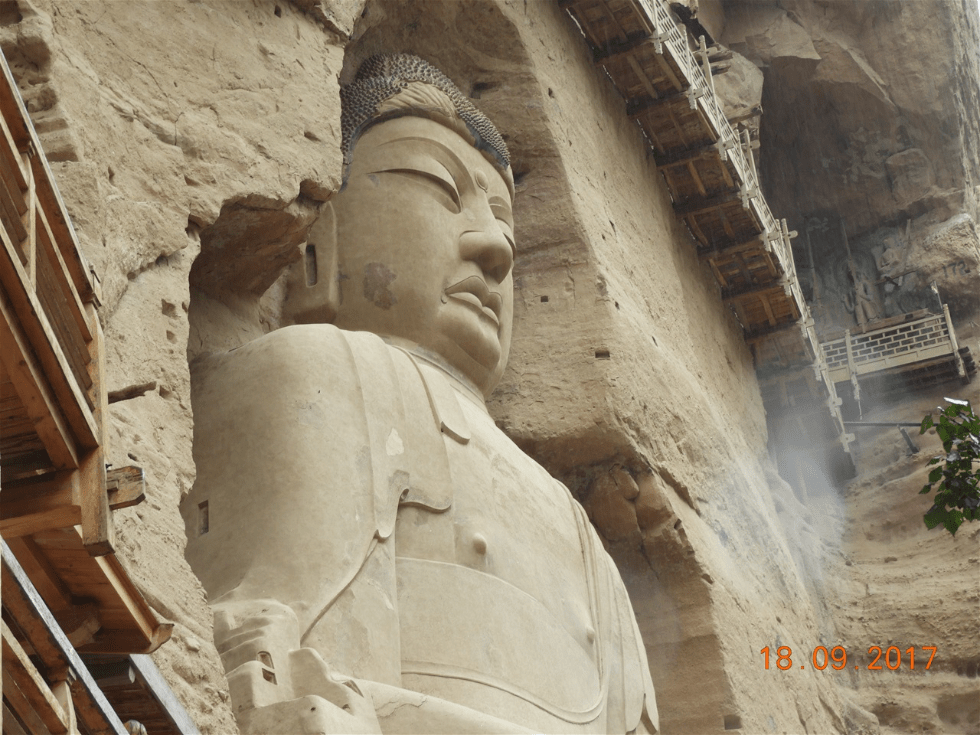
Along the way we were lucky enough to fit in a visit to the Binglingsi Caves which are a series of grottoes carved into the rock in a canyon along the Yellow River just north of where it empties into the enormous Liujiaxia Reservoir.
The first of the grottoes was begun about 420 AD and the site can only be accessed via a 40 minute speedboat ride across the lake.
Have a look at the pics which include the Yellow River gorge: Binglingsi Caves: Soon Come!!!
Day 14: Tuesday 19th September – Jiayuguan and the The Great Wall
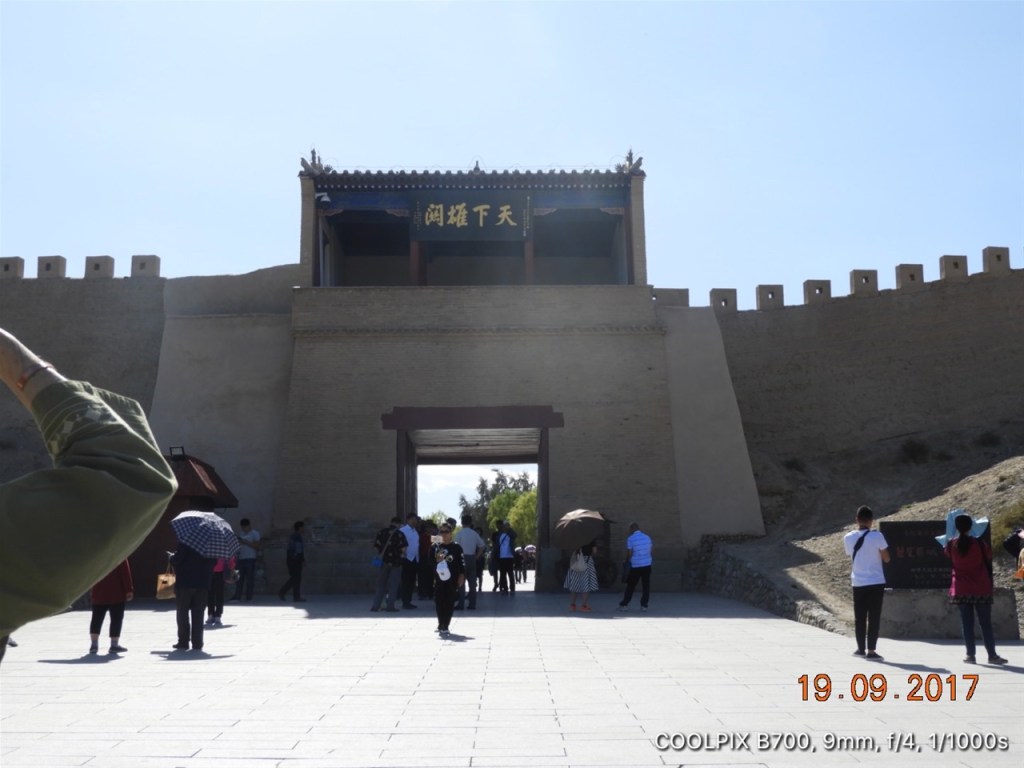
Modestly known in Chinese as ‘The First and Greatest Pass Under Heaven’ the fort at Jiayuguan is the largest and most complete structure still standing on the Great Wall. Construction started during the Ming Dynasty sometime about 1372. Much extended and strengthened over the years of the Silk Road the fort covers an area of 361,000 square feet and the external walls have a total length of 2400 feet and are 36 feet high. The fort guards a pass in the Hexi Corridor that is just 3.7 miles wide.
Eastern entry gate to the Jiayuguan Fort on the Great Wall of China.
See pics of The Jiayuguan Fortress: Soon Come!!!
In many ways there is an even more impressive artefacts of Ancient China near Jiayuguan: the 1400 or so tombs dating from the Wei and Jin Dynasties in the 3rd to 5th Centuries. The PRC has adopted a policy of protecting these sites and only a handful have been excavated and only one is open to the public. If you can imagine a small hillock of sand in the middle of the vast expanse of the Gobi Desert which has lieing beneath it something akin to a Pharoah’s tomb in the Valleyof the Kings then you will not be far out. No photography is allowed in the tombs but I hope the pics provided will give you some idea of the magnificent colour sketches the tomb contains. A real treasure.
See pics of Wei and Jin Dynasty Tombs: Soon Come!!!
Onward: driving for four hours through the Gobi desert may not be your idea of fun, but trust me, it was fascinating! We had the snow topped Qilian Mountains (7800 metres) on our left and the more modest Black mountains on our right as we journeyed through the Hexi Corridor.
What was most amazing was the apparent determination of the PRC to grow stuff in the Gobi Desert! We saw many acres of very heavily irrigated farmland dotted around the vast expanse of the desert. What seemed more logical were the thousands of acres of wind farms and the miles and miles of giant electric pylons carrying the power to places where it is more useful.
Day 15: Wednesday 20th September – The Overhanging Wall at Jiayuguan and the Crescent Moon Lake at Dunhuang
Our first really energetic day on the tour saw us walking up the Overhanging Wall part of The Great Wall so called because from a distance it supposedly appears like a dragon overhanging the slope. This part of the Wall is four miles to the northwest of the Jiyajuguan Fort and the climb is the equivalent of 55 flights of stairs made easier by the excellent views of the Gobi Desert and the glittering snowcapped peaks of the Qilian Mountains. All the members of our little team managed to complete the climb!!
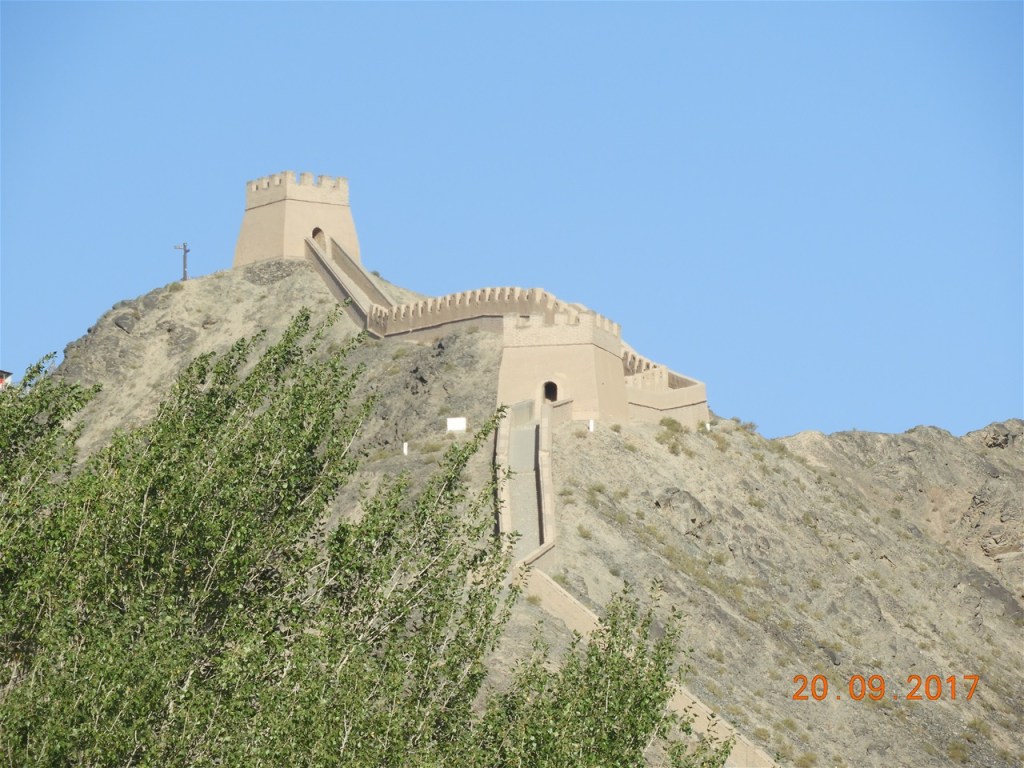
The Overhanging Wall at Jiayuguan
Onward….. Driving for four hours through the Gobi desert to Dunhuang may not be your idea of fun, but trust me, it was fascinating! We had the snow topped Qilian Mountains (7800 metres) on our left and the more modest Black mountains on our right as we journeyed through the Hexi Corridor.
What was most amazing was the apparent determination of the PRC to grow stuff in the Gobi Desert! We saw many acres of very heavily irrigated farmland dotted around the vast expanse of the desert. What seemed more logical were the thousands of acres of wind farms and the miles and miles of giant new electric pylons carrying the power to places where it is more useful.
Dunhuang itself has a long history back as far as 2000 BC. More recently it became one of four frontier garrison towns established by the Emperor Wu after the defeat of the Xiongnu in 121 BC and was fought over many many times after that until it was sacked and destroyed by the Mongols in 1227 AD. Having prospered greatly from its advantageous position at the crossroads of the Silk Road it went into decline when the Silk Road was abandoned as the Southern sea-routes took over during the Ming Dynasty. It was retaken by China in 1715 during the Qing Dynasty and the present day city of Dunhuang was established east of the ruined old city in 1725.
See pics of The Overhanging Wall: Soon Come!!!
We then made the obligatory visit to the highly touristic Crescent Lake and the Singing Dunes along with many thousands of others most of whom could not resist the opportunity to ride one of the several thousand camels available for the purpose: despite my cynicism there did seem to be a certain romance in trekking out into the desert on a camel a la Lawrence of Arabia. That said camels are in my experience nasty, smelly, bad tempered creatures which most of us had ridden before so we gave it a miss to the evident disappointment of our guide….. We didn’t hear the reputed ‘Singing Dunes’ either – probably it was too noisy! Still, the dunes themselves were very impressive at up to 500 feet high and the much reduced Crescent Lake does still retain a certain charm.
See pics of Crescent Moon Lake: Soon Come!!!
Day 16: Thursday 21st September – The Mogao Caves near Dunhuang and the Bullet Train to Turpan
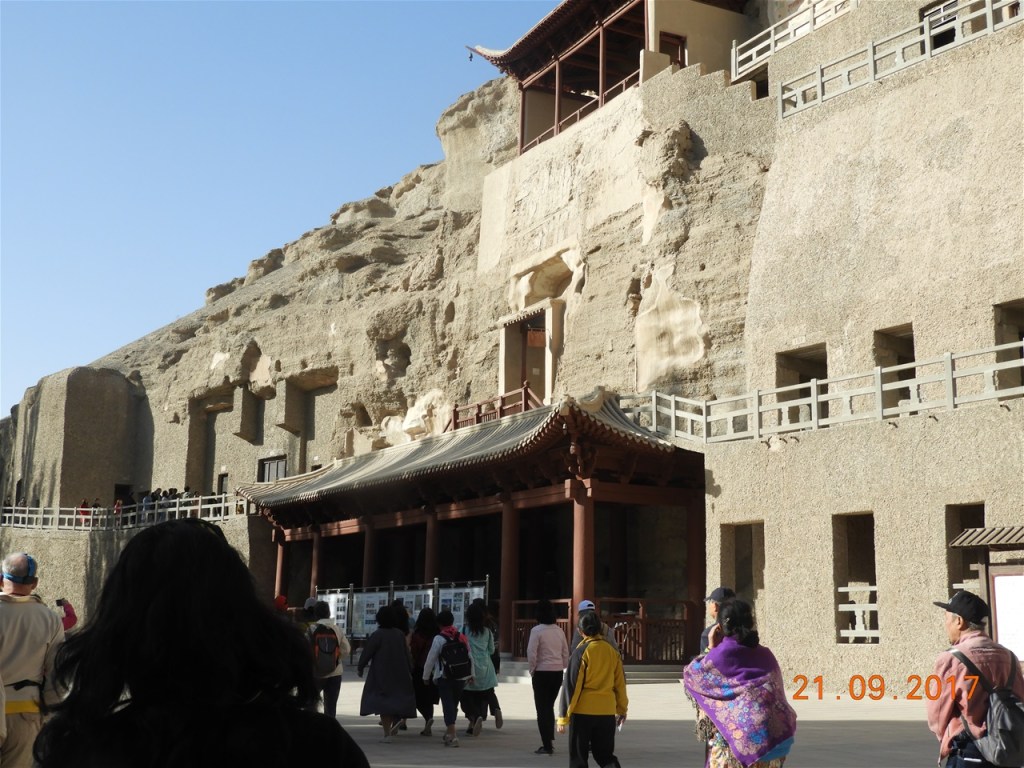
There are several Buddhist cave sites in the Dunhuang area but the most impressive and important of these are the Mogao Caves located 16 miles southeast of Dunhuang. There are 735 caves in Mogao noted not only for their Buddhist art but also for the hoard of vitally important manuscripts found hidden in a sealed up cave. Most of these caves are covered with murals and contain many Buddhist statues. Taken altogether the whole thing was pretty overpowering in terms of scale, numbers of statues and images and the beauty of much of the work, spanning over 1,000 years of Buddhist art. Photography is not allowed inside the caves so I am a bit limited in what I can show you in the pics.
See pics of Mogao Caves: Soon come!!!
For me what was very impressive was the organisation of the whole thing: there were two high quality film presentations before being whisked off on a shuttle bus to the caves themselves. The second 360 degree movie was particularly impressive and helped to compensate for the inability to take photographs. The murals and Buddha statues in the caves were brilliantly well lit and presented.
Some of our gang were disappointed by the apparent disneyfication at Mogao, as well as The Crescent Lake and less so at other places. However, with their gigantic domestic market, the desire of the PRC to make the history of the country as accessible as possible to all its people, the colossal amounts of money generated by these attractions and the well known appetite of the Chinese for all things Disney it is maybe not surprising!
The next element of our journey west was the Bullet Train from Dunhuang to Turpan. Unfortunately the PRC had a couple of nasty accidents with the Bullet Trains so for a while they were taken out of service. Now back on the rails their speeds are steadily being allowed to increase and we managed a little over 200 km an hour. The journey was spot on time and everything was very well managed but the accommodation was slightly more cramped than in Economy on Easyjet! Add to that all the stations are for some reason located in the middle of the desert and are a a bit short on escalators so the whole thing was not quite as congenial as we had expected!
This was another journey across a desert landscape, this time the Taklamaklan Desert. This seemed to me if anything even more desolate than the Gobi – covered in black sand and gravel with lots of rocky ridges which all made it clear why Silk Road travellers used to by pass it either to the north or the south with the two arms of the Silk Road coming together again at Turpan. We also saw thousands and thousands of wind farms, with endless newly constructed gigantic electricity pylons marching across the desert. And lots of huge construction projects with new motorways on stilts turning the One Belt One Road vision of China’s paramount leader Xi Jinping into reality.
Day 17: Friday 22nd September – Turpan: The Jiaohe Ruins and the Emin Minaret
Turpan was another important staging post along the Silk Road, in particular because it was where two of the main threads came together after having avoided the risks associated with driving straight through the desert.
Our first point of interest in Turpan was the Uyghur Mosque and its famous Emin Minaret named for the Qing Dynasty General Emin Khoja who defeated the Dzunger Mongols in the 1750s. The minaret is 144 feet tall and is said to be the tallest in China and was built in just 12 months of wood and sun dried yellow bricks. Both the mosque and the minaret have suffered earthquake damage as can be seen from the pics showing the steel band wrapped around the minaret. Although the Minaret is the major attraction here, primarily because of its height, the Mosque itself seemed to a model of understated beauty with its clean geometric lines and wonderful natural lighting There are no images or colour to distract the committed worshipper -in marked contrast to other Chinese Mosques and Temples and in particular Buddhist Temples.
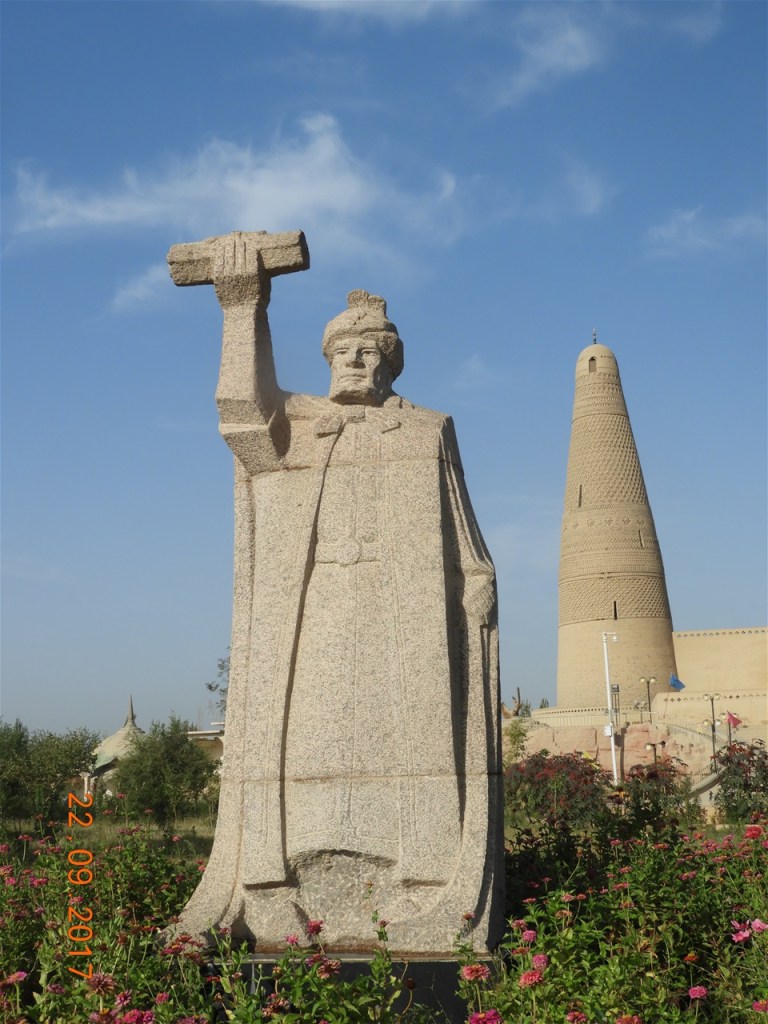
See pics of Emin Minaret: Soon come!!!
The Jiaohe Ruins sometimes more theatrically named Lost City of Jiaohe sits on a large islet in the middle of a river in the Yarnez Valley a few miles west of the city of Turpan and is thought to date back some 2000 years. If you think about the Isle de la Citie in Paris, located in the middle of a desert you will not be far out! It is one of the few cities of its era that did not have a city wall. The steep clffs about 90 feet high on all sides were reckoned to be sufficient defence. Not against the Mongols of course and it was the city’s destruction by Ghengis Khan that led to its abandonment in the 13th Century.
Today the ruins are a remarkable fragment of the history of the Silk Road: having been a thriving entrepôt with a population said to have been 7000 and located at an important crossroads for the Silk Road merchants and those who did business with them. The buildings were mostly carved out of the loess soil, with three substantial Buddhist Temples the walls of which remain today. The place has a ghostly, eerie air about it despite the scorching temperatures and is a truly dramatic place to visit.
See pics of The Jiaohe Ruins: Soon come!!!
Day 18: Saturday 23rd September – Xinjiang Autonomous Region Museum at Urumqi and the flight to Kashgar
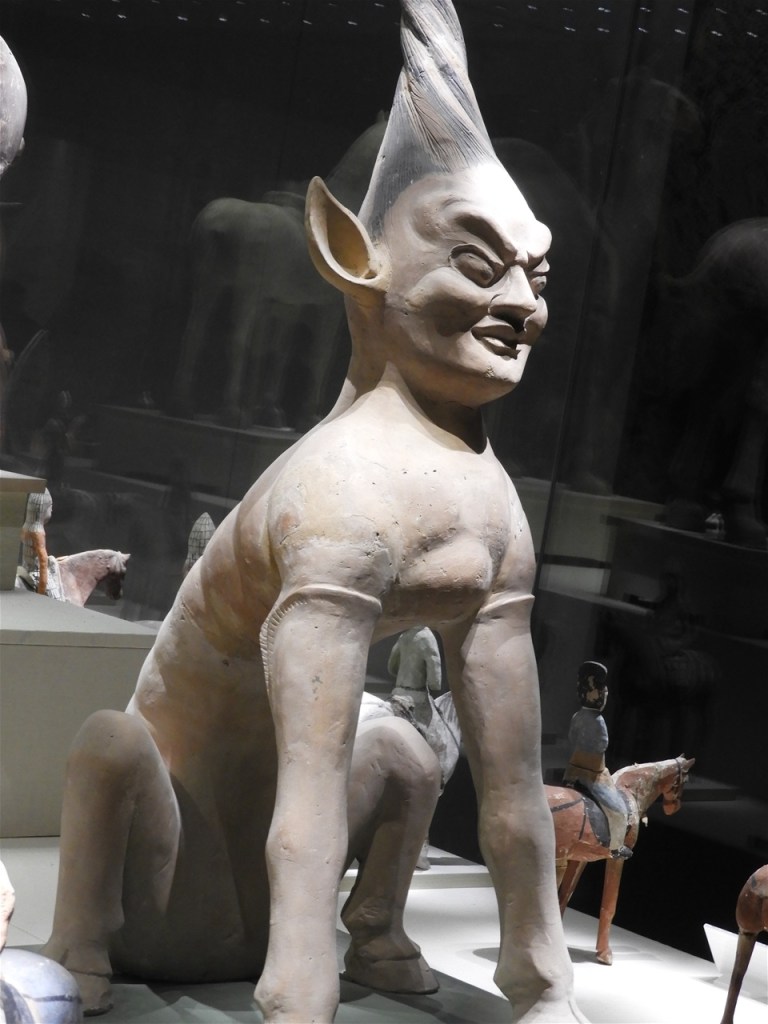
This adorable creature with a single boob and ears like mine own is a Tomb Guard attributed to the Tang Dynasty [618-907AD]. She was probably my favourite exhibit in a wonderful collection all beautifully presented.
Some of the most interesting sets of exhibits were those describing the clothing, traditions and lifestyles of the many ethnic minorities that live in Xinjiang the most westerly of all China’s Provinces. 46% of the population is ethnic Uighurs who are Moslems. Next largest group are the Han Chinese 40% many of whom were originally shipped west by the PRC, allegedly with the specific intention of ‘watering down’ the ethnic dominance of the Moslem Uighurs.
Other races include Kazakhs, Hui, Tajiks, Russians, Mongols, Han and Kyrgyzs: many of these minorities live in their own Autonomous Prefectures and Counties. Unfortunately my camera battery died and i was unable to capture any pics of this part of the Museum :((
More pics of Xinjiang Autonomous Region Museum at Urumqi: Soon come!!!
The flight on to Kashgar was smooth and incident free, but we had superb views over the snow capped mountains on the way across. I did manage to get a pic of that!
Day 19: Sunday 24th September – Kashgar: Animal Market
Most of the tourist guides are clear that the two markets in Kashgar – the Livestock Market and the Bazaar – are definately not to be missed! So, we finished up with a pretty busy day: the Livestock Market first thing, then off to have a look at the historic former British Consulate in Kashgar, the Kashgar Bazaar and then the Kashgar walled Old Town which has really only now begun to see some serious renovation work. Somehow we managed to squeeze in a delicious lunch in the middle of all that!!
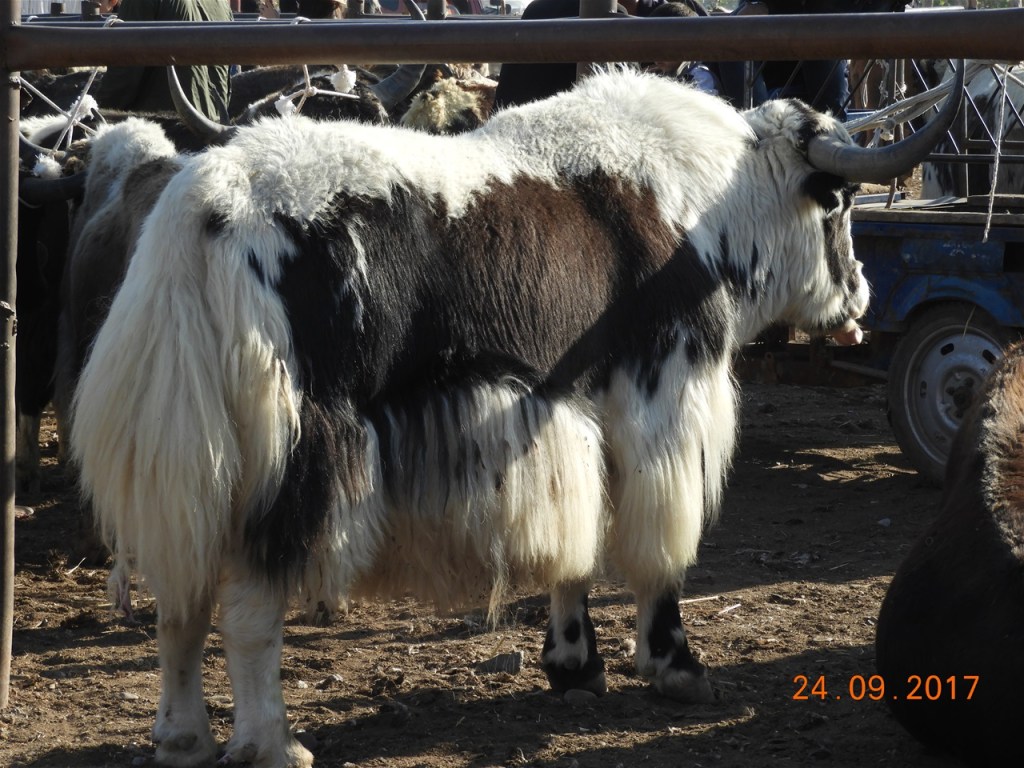
Originally the two Kashgar Markets were both located where the Bazaar still is. However, the pressure on land space of development meant that the Livestock element was moved to a new location six kilometres southeast of Kashgar City: not least because of the smell!
See pics of Kashgar, including the Livestock Market: Soon come!!!
 Tony's Geriatric Adventures