Day 40: Sunday 15th October – A tricky border crossing and the Ishak Pasha Palace
So, our fifth and final border crossing initially seemed very straightforward: getting out of Iran went smoothly but getting everybody into Turkey proved a bit more challenging. First were the cigarette smugglers – fags are dirt cheap in Iran and very expensive in Turkey. What shook us was the blatant nature of what was happening and what looked to us like the open connivance of some of the Turkish border officials!
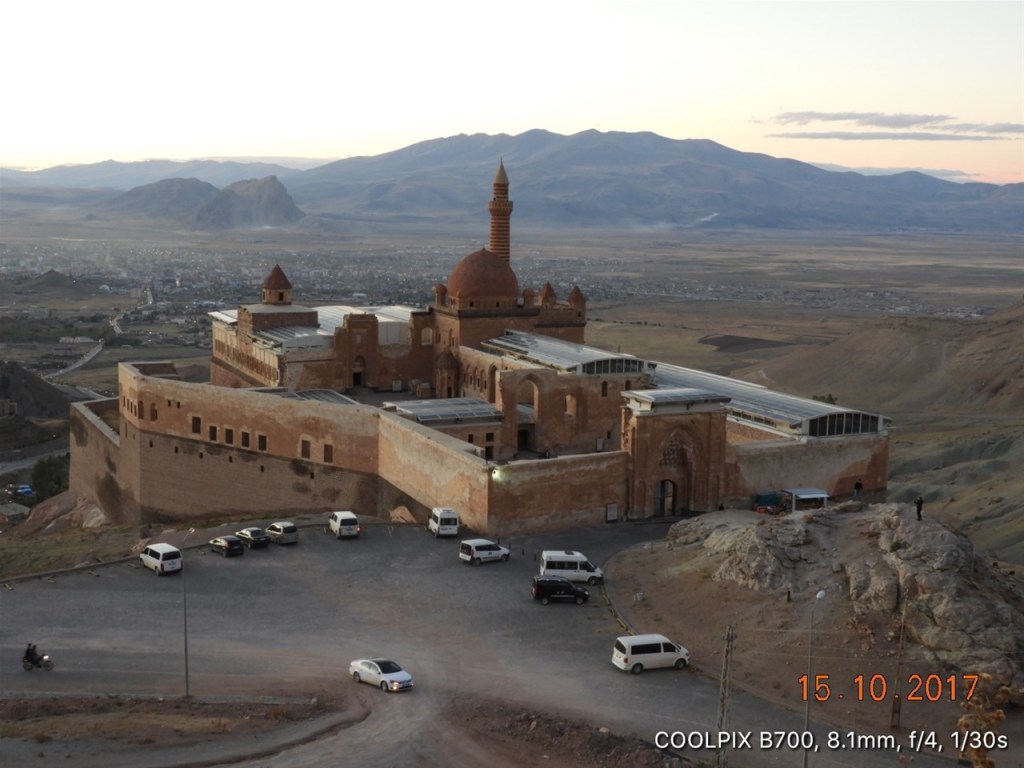
The Ishak Pasha Palace
This smuggling impacted on our crossing in two ways: first all of us were accosted pretty aggressively to carry fags through customs on behalf of the smugglers and secondly they used a kind of ‘steaming’ tactic to rush the border and get as much contraband through as they could! This of course created chaos and some unpleasantness….. The second source of delay was that our two US Citizens in the party found themselves held up for several hours while the local officials got permission from Ankara to let them into Turkey. The fact that all this was happening on a Sunday certainly did not help. As frequently happens what was needed was patience and good humour and in due course we were all reunited!!
So, while our American friends waited patiently to be allowed into Turkey, the majority of us headed off to visit the Ishak Pasha Palace which overlooks Dogubayazit about which you will find more here: Ishak Pasha Palace: Soon come!!!
Day 41: Monday 16th October – onward to Kars
The drive from Dogubayazit to Kars was interesting rather than exciting, but constantly dominated by views of Turkey’s highest mountain Mount Ararat of Noah’s Ark fame. We were also intrigued to be driving alongside Turkey’s border with Armenia which has been closed since 1993, initially as a consequence of the war over Nagorno-Karabakh and more recently due to the disagreement between Armenia and Turkey as to whether the Turk expulsion of Armenians during WW1 constituted a genocide.
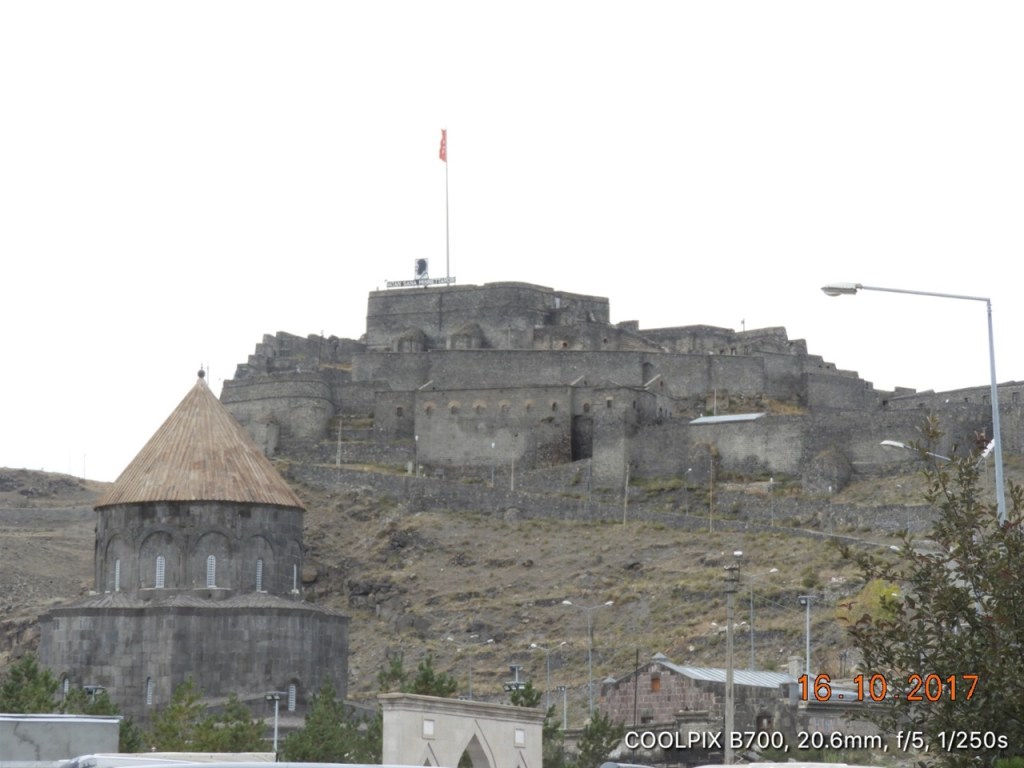
Kars Castle – British troops were besieged here during the Crimean War
This part of Turkey is deeply conservative – many restaurants do not sell alcohol for example and many of the Turkish ladies wear headscarves – and is rarely visited by tourists. However, locals were invariably friendly and always curious about who we were and where we came from. Lots of us – especially the ladies in our party – were frequently called upon to provide selfies with our hosts!!
You will find more pics of Kars here: Kars: Soon come!!!
Day 42: Tuesday 17th October – Kars and the astounding Ani
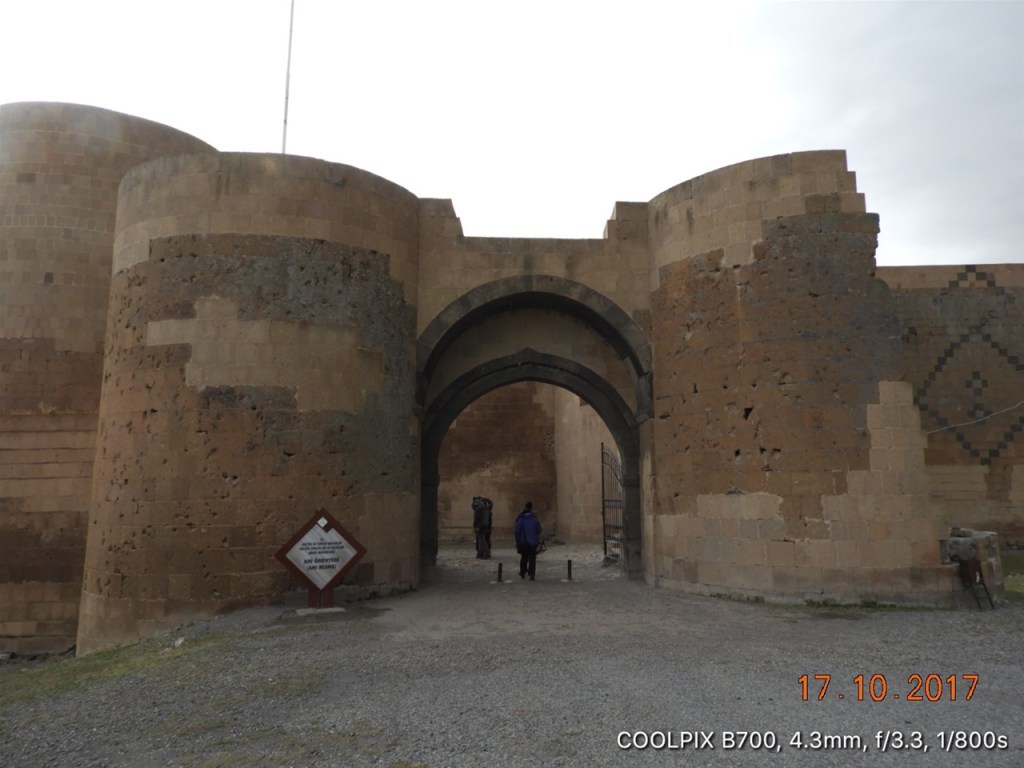
Ani is a ruined medieval Amenian City which somehow found itself just on the Turkish side of the now closed border between the two countries when the borders of the newly formed Republic of Turkey were drawn in October 1923 and is about 30 miles west of our base in Kars. Until recently Ani was completely inaccessible because it is located in an area that had been designated a closed military area by the Turks. There are still a couple of signs to that effect on the site. As you can imagine the site has been the subject of great contention between the two governments, the bottom line is that it has been very badly neglected with rumours of the Turkish Army using it for artillery target practice.
The main entrance through the Ani city wall
Fortunately those days are now past and in 2016 it was designated a UN World Heritage Site. The Turks have said that protecting and restoring the site is a priority for them, but I have to say we did not see a great deal of evidence to support that during our visit. As you will see from the pics, some basic work has been done to prevent further deterioration but there is also evidence of much crude restoration over many decades.
The city was founded in the 5th century AD and in the 10th C it became the capital of the Bagratid Armenian kingdom that covered much of present day Armenia and Eastern Turkey. Ani was situated on many important trade routes, not least the Silk Road, had many Palaces and Churches and at its height had a population of around 100,000.
You can find out more about Ani here: Ani: Soon come!!!
It really is an astonishing site and well worth checking out on Wikipedia if you find it as interesting as I do!!!
Day 43: Wednesday 18th October – Across the Anatolian Plateau to Erzurum
Our journey across the Anatolian Plateau from Kars to Erzurum was interesting rather than spectacular but as we were to learn in the following days on our journey right across Northern Turkey from the Iranian border to Istanbul would soon become very dramatic indeed!

Interior of the Great Mosque of Erzurim aka Ulu Camii
On our way we came across a war memorial dedicated to one of the greatest disasters to befall the Ottoman Empire during WW1: the Battle of Sarıkamış. This took place between the Ottoman Empire and the Russian Imperial Army in December 1914 and January 1915. Basically the ill-prepared Ottomans made the same mistake as Napoleon had before them and Hitler would make in WW2: taking on the Russian Army in the middle of winter without securing their supply lines. The ill-fated Ottoman troops tried to fight in summer uniforms, poorly fed and badly armed: the ships with their supplies were sunk in the harbour at Trabzom on the Black Sea. It is estimated that 33,000 Ottoman troops died, many of hypothermia while a further 17,000 were wounded or captured. The Ottoman leader Enver Pasha blamed the defeat on the Armenians fighting with the Russians and many believe this was a prelude to the Armenian massacres that followed not long after.
You will find more pics of Erzurum here: The City of Erzurum: Soon come!!!
Day 44: Thursday 19th October – A stunning drive along the Euphrates to Kemaliye
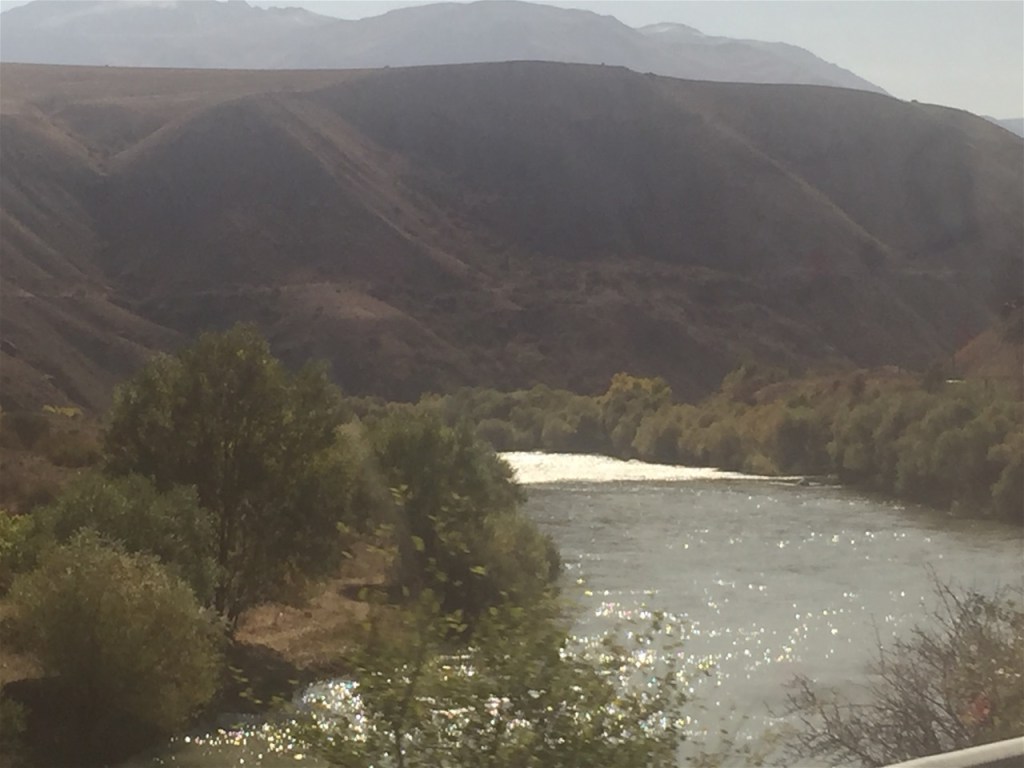
Any trepidation about another long five hour drive from Eruzum to Kemaliye was soon eradicated by the glorious, dramatic scenery along our route! A look at the pics will hopefully give you some idea of what we sawe: Across the Anatolian Plateau to Kemaliye: Soon come!!!
The Euphrates River valley slicing through the Anatolian Plateau
Kemaliye is a small town with a population of less than 5,000 but with a huge name, having in 1922 been renamed from Egin to honour Mustapha Kemal Pasha as he was then known. I cannot tell you why the small town was honoured in this way….
The place is located in a gorge in the Euphrates River valley just above the Keban Dam. The streets are very steep and cobbled, most of them pretty much like stairways! The town itself is at about 3,700 feet, but the mountains on either side of the gorge soar another 4,000 feet above the town. It’s a truly dramatic location.
Day 45: Friday 20th October – Another terrific drive: to Sivas
I am running out of superlatives really about this Anatolian Plateau scenery, each day we imagine we have seen the best of it, then the next proves even more dramatic! So it was today as we drove north until we crossed the Western Euphrates at Bagistas and then turned west towards Sivas.
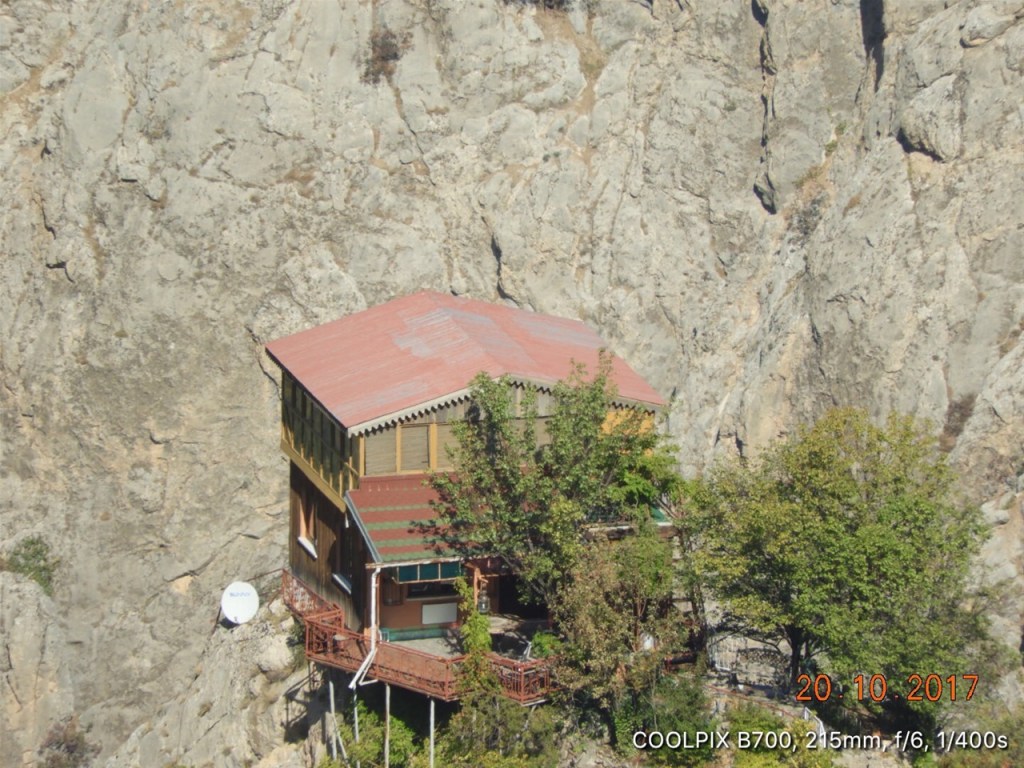
We called this house ‘The Eagle’s Nest’ on an impossibly pointed spike of rock!
We also had a couple of interesting stops today. We were privileged to visit the village of Onar to see a place of worship of the Alevi Islamic sect. Alevis don’t have mosques, but pray in private houses adapted for their religious purposes. The one we visited had a couple of trees growing from the floor and through the roof which worshippers hugged at an appropriate stage in the proceedings. Never having felt the need to hug trees myself i desisted but a couple of our number did join in…. We also enjoyed a largely vegetarian lunch in a restaurant in the nearby town of Arapgir run – as i understood it – by a ladies cooperative whose speciality seem to be a delicious desert cooked in an enormous copper tub!
You will find more pics of the astonishing Anatolian scenery we saw and few pics of the Alevi place of worship and the town of Yurkseverhere: The stunning drive to Sivas: Soon come!!!
Day 46: Saturday 21st October – The lovely City of Sivas and on to Amasya
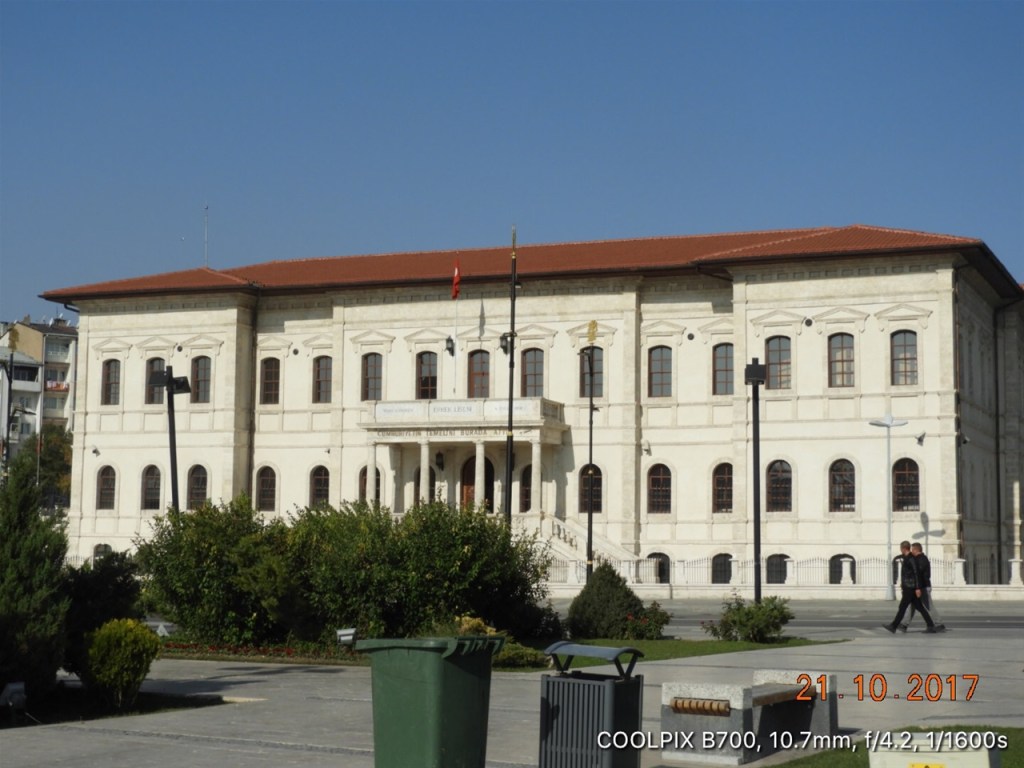
After an early breakfast we had a splendid morning in Sivas, the former Seljuk capital of Turkey during Ottoman times. The city is beautifully laid out and has a relaxed atmosphere about it. Lots of street cafes with folks sitting quietly sipping the lovely Turkish coffee which i have promised myself i will learn to make when i get home!
We then spent three hours driving on to the even more relaxed city of Amasya… Countryside less dramatic than further east on the Anatolian Plateau, but still starting at around 4,000 feet in Sivas before descending steadily to about 1,500 feet in Amasya. Steadily more fertile as we moved west, more and more evidence of all available agricultural land being cultivated more intensely. A satisfying and stimulating drive….
You will find lots of pics of Sivas here: Sivas: Soon come!!!
Day 47: Sunday 22nd October – Amasya: a charming and relaxed city
This was probably one of our most relaxed days since the start of the tour. However, no rest for the enthusiastic saw us clambering up to the top of Amasya Castle!

Beautifully restored Ottoman house in Amasya
Although Amasya is located in what is a conservative area of Central/Eastern Anatolia tourism seems to have brought a more relaxed and easy going vibe to the City. We enjoyed a great al fresco lunch down by the river before most of us headed off to the local market….
See more pics of this charming and relaxed city here: Amasya: Soon come!!!
Day 48: Monday 23rd October – The Hittite Kingdom and onward to Ankara
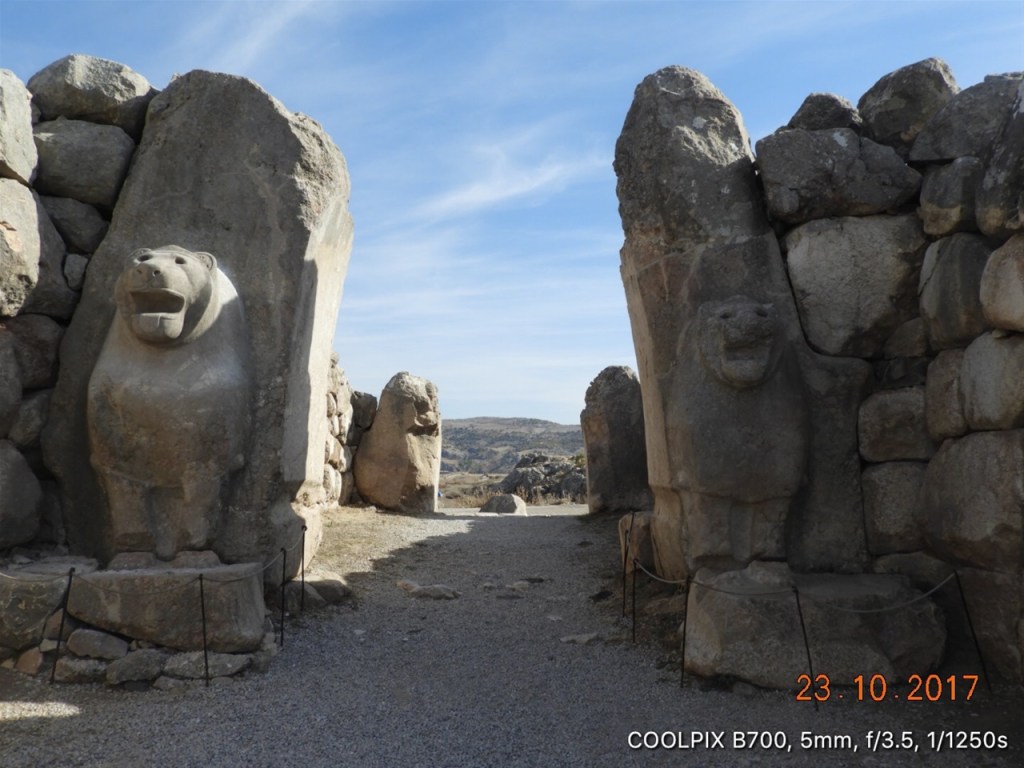
We managed 240 miles on the bus today, from Amasya to Ankara via the immense Hittite Fortress at Hattusa.
The scenery on our journey was not as spectacular as the previous couple of days, but always interesting and rarely below 3,000 feet.
The Hittites were an ancient Anatolian people who in about 1600 BC established an empire centred around the Empire’s capital at Hattusa in north Central Anatolia, mid way between Amasya and Ankara.
The Lion Gate: main entrance to the Hittite Kingdom
The empire reached its height in the mid 14th Century BC, but came into conflict with the Egyptian and Middle Assyrian Empires and the the empire of the Mitanni. After about 1180 BC the Hittites were overcome by the Assyrians and the Phrygians.
There are three main elements to the site:
1. The original Hittite imperial city, Hattus, consisting of an Inner City and an Outer City, both surrounded by a massive course of walls, still visible 3,500 years later.
2. Yazilikaya, which was a sanctuary located within walking distance of the gates of the city of Hattusa. This was formed of two main roofless chambers, formed inside a group of rocky outcrops.
3. A more modest Phrygian settlement, built by them on the same site as Hattusa around 800 BC.
Easily the most important archaeological find on the site were the 30,000 cuniform royal archives of clay tablets consisting of official correspondence and contracts as well as legal codes, procedures for cult ceremonies and so forth. One particularly important tablet details the terms of the peace treaty reached years after the Battle of Kadesh between the Hitties and the Eqyptians under Rameses II in about 1258 BC. A copy is on display in the United Nations in NYC as an example of the earliest known international peace treaties.
Have a look at more pics of the 3500 year old Hittite Kingdom at Hattusa here: Hittite Kingdom at Hattusa: Soon come!!!
Day 49: Tuesday 24th October – Ankara: Ataturk Mausoleum, Ankara Castle and the famous Museum of Anatolian Civilisations
Ankara is a relatively new city having gone from a population of maybe 20,000 at the beginning of the Republic of Turkey to several millions today. So, we had an extraordinarily busy day in the city, visiting the Kemal Ataturk Mausoleum and Museum, Ankara Castle and the famously Museum of Anatolian Civilisations. Generally Ankara is not regarded as a high profile tourist destination but we could have kept interested and busy for a couple of days at least!!
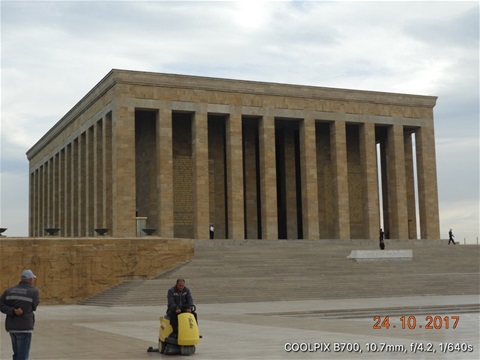
Kemel Ataturk Mausoleum
See pics of these three great venues here:
Ankara and the Castle: Soon come!!!
Ataturk Mausoleum and Museum: Soon come!!!
The Museum of Anatolian Civilisations: Soon come!!!
Day 50: Wednesday 25th October – from Ankara to Istanbul
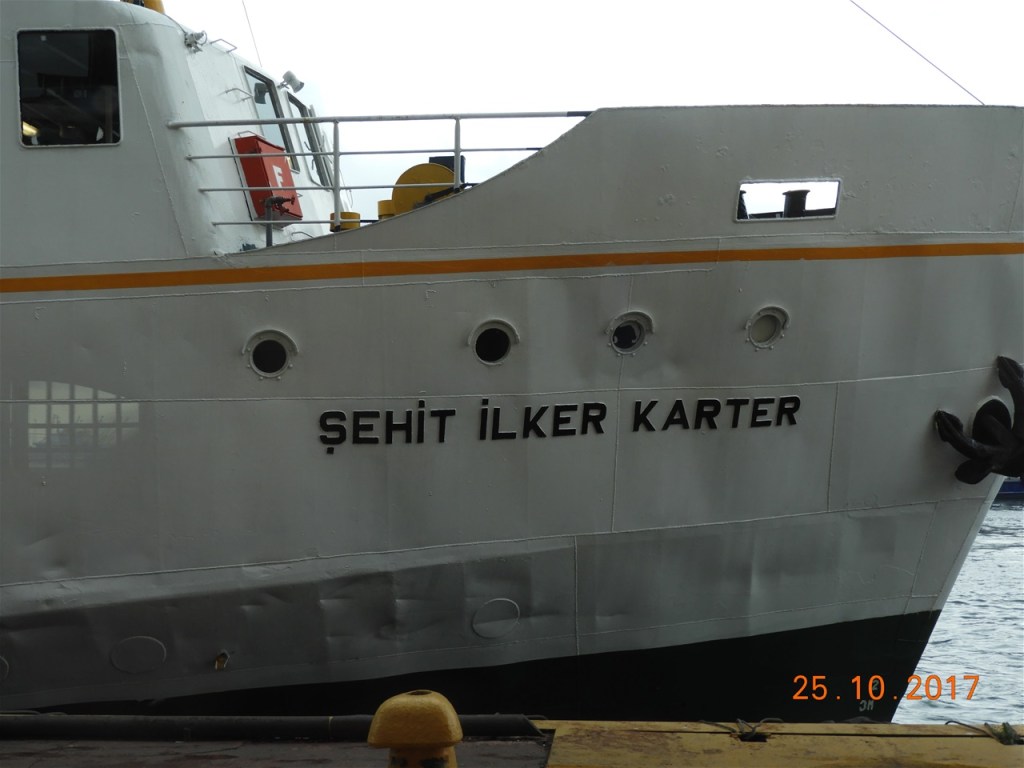
Up early today for the final leg of our epic journey – we travel from Ankara the modern capital of Turkey to its ancient capital Istanbul. Talk about multi modal travel – we take a minibus ride to the railway station in Ankara, a fast train from Ankara to a station 20 miles east of Istanbul, jump on a coach to take us to the ferry terminal, ferrry across the Bophorus from Asia to Europe, Istanbul tram to within a couple of hundred yards of our hotel, then shanks pony for the last little bit!!
Our ferry across the Bosphorus
Quick shower then out to dinner at a roof top restuarant withing walking distance of the hotel, just as well as we had only our third day of rain since leaving Beijing 45 days previously!!
You can find the pics from our journey here: Ankara to Istanbul:Soon come!!!
Day 51: Thursday 26th October – Istanbul in all its glory
So, we had pretty much a single day to take in as much as we could of Istanbul – Turkey’s most visited tourist destination! We spent our time looking the the Sultan Ahmed Mosque, also known as The Blue Mosque, the absolutely unique Hagia Sophia Museum and the Hippodrome – location of Chariot races and other Roman sports of the Eastern Empire. I also managed a trip to the Grand Bazaar to do a little last minute shopping…..
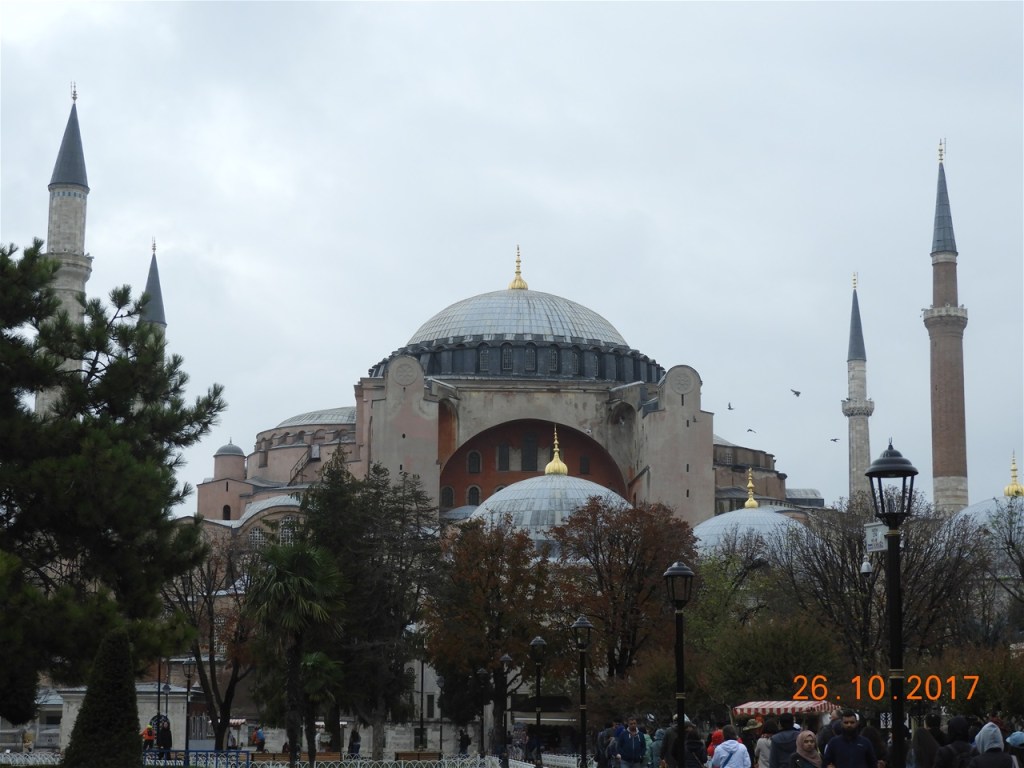
The Sultan Ahmed Mosque in Istanbul
Here are some links to the pics:
Sultan Ahmed Mosque: Soon come!!!
Hagia Sophia Museum: Soon come!!!
Istanbul and the Hippodrome: Soon come!!!
Day 52: Friday 27th October – the end of our epic Adventure!
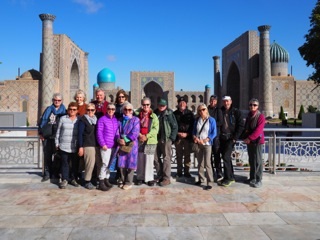
Getting up latish on Friday morning it was difficult to believe our adventure had come to an end…. we had journeyed together for 47 days and visited 27 Cities in six countries! Now we were about to scatter, literally, to the four corners of the earth. A journey like that simply cannot be summarised, so i won’t attempt it.
But I will play tribute to the 15 intrepid travellers with whom i made the trip – knowledgeable, experienced, humorous, endlessly patient, all of whom i will remember for a long time with great fondness. And of course big respect to Jude Holliday our Tour Leader who gently cajoled, encouraged, injected a dash of sympathy where required and some sterner stuff when rarely needed. I never once heard her say: ‘this is adventure travel, so stop whingeing’ which is mainly a further tribute to my fellow travellers!! Good game, Jude!
 Tony's Geriatric Adventures