Day 22: Wednesday 27th September – Another slow border crossing into Uzbekistan from Kyrgystan and our drive through the Fergana Valley to Kokand
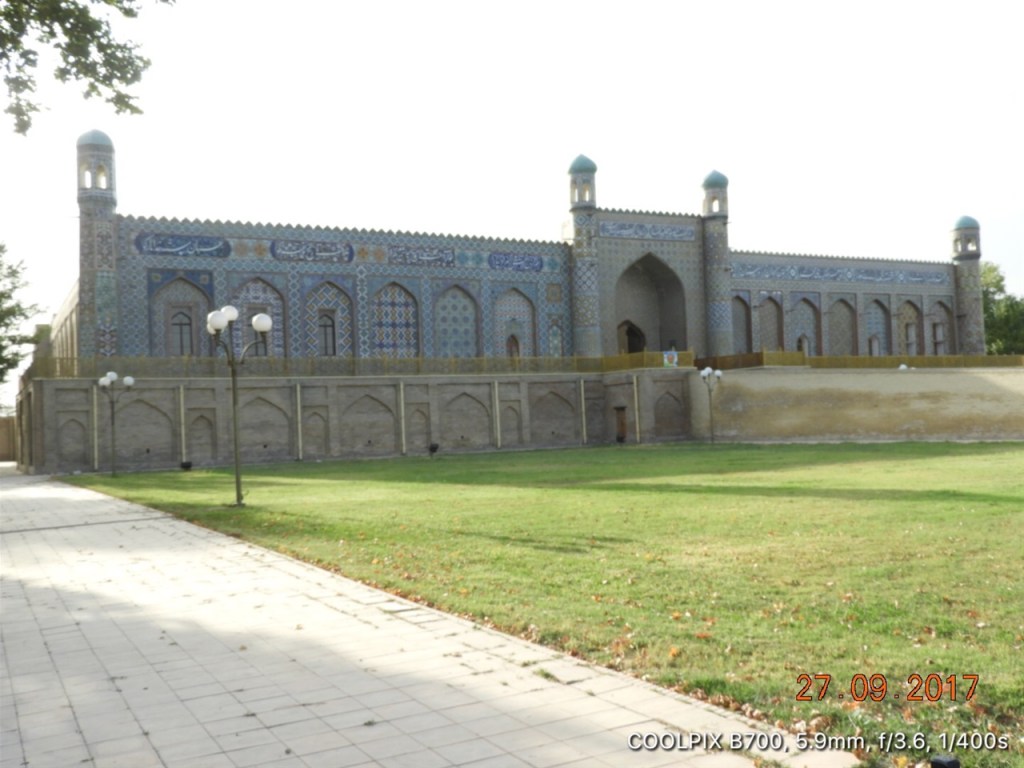
Another early start to get to the border between Kyrgyzstan and Uzbekistan. As before the Kyrgz were pretty easy going and getting out of their country was straightforward. Getting into Uzbekistan was another matter, seemingly endless requests to produce our passports and a finger tip search of our baggage, looking for prescription and other drugs.
As always with patience and good humour we eventually found ourselves in our third country.
The Palace of Khudayer Khan in Kokand
As we made our way along the road towards Kokand we saw the thousands and thousands of acres of cotton fields planted first by the Soviets when Uzbekistan was an SSR. We had expected that. What we did not expect was the sight of thousands of workers hand picking the cotton like a scene from Gone With The Wind. Our American fellows travellers assured us that it has been many decades since cotton was handpicked in the US fields. The other unanticipated outcome from the Soviet decision to grow cotton in this part of the world is that the crop requires huge amounts of water and the enormous irrigation projects that support cotton have been a major factor in the destruction of the Aral Sea.
We also had a little to visit a Silk Factory and i have included a few pics of that in the link below.
See Pics of The Palace of Khudayar Khan at Kokand: Soon come!!!
Day 23: Thursday 28th September – through the mountains from Kokand to Tashkent
Thursday morning saw us up at 5:00am to travel by car from Kokand to the capital of Uzbekistan, Tashkent. We have been used to travelling mostly by single deck coaches on this trip: excellent because we can spread ourselves around and everybody gets a window seat! So why travel in a convoy of five cars? The explanation was that the mountain road is too difficult for a coach….. that sounded promising!
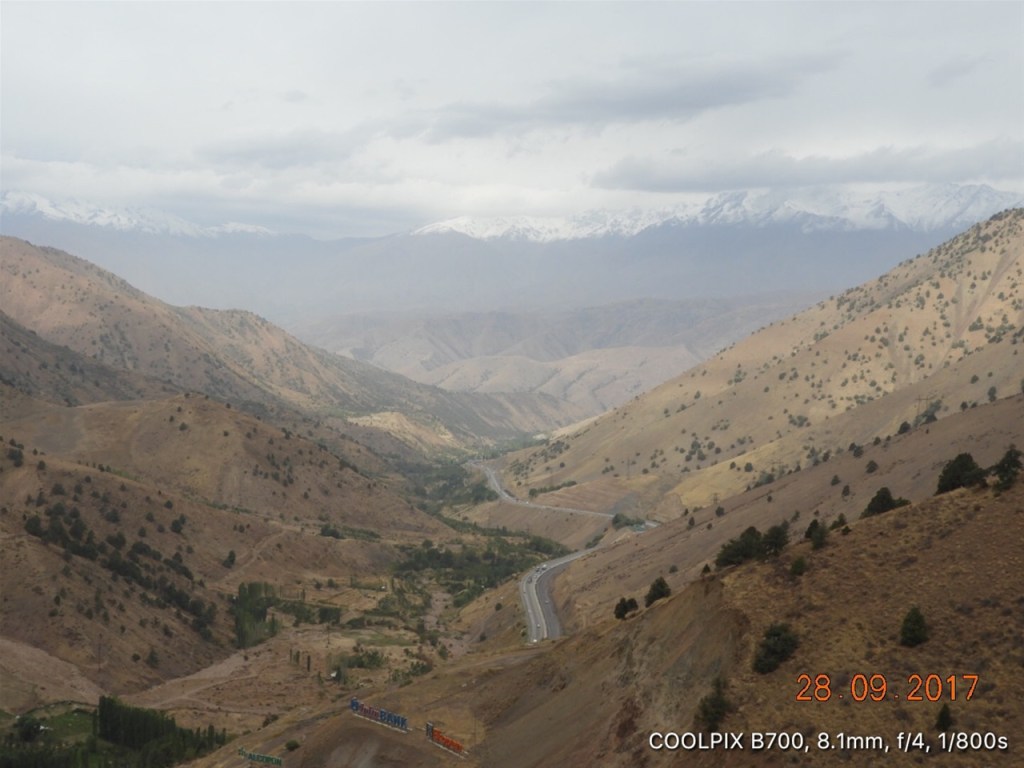
Road through the mountains between Kokand and Tashkent
They were not wrong about a coach, but this was not the kind of 10,000 feet deserted pass with 20,000 feet plus peaks we had experienced crossing the border between China and Kyrgyzstan…. this was to do with the enormous volume of traffic and the fact that the Uzbeks seem to be making a right meal of trying to re-develop the road!! Yes, there were some high passes and lots of zig zag roads up and down steep slopes, but the kind of modern coach we have been using could be expected to take such things in their stride. No, the road was simply a right battlefield because of the redevelopment and manic busy. So, we found ourselves in what seemed like some crazy Demolition Derby with the anarchic Central Asian driving we have come to know and love, to which was added the delights of travelling in a convoy comprising five Uzbek drivers! Of course we got there safely but five hours in the back seat of a tiny Uzbek built GM Chevrolet was not my idea of fun despite the many stretch and/or pee stops the guys kindly made. Scenery again was spectacular if not breathtaking and there was some spiteful fun watching what appeared to us to be the Uzbeks struggling to build their new road using antiquated construction techniques and bizarre traffic management. What a constrast with the Chinese way of doing things!!
Our Uzbek friends apologised for all the checkpoints along the road and they put it down to post-Soviet era bureaucracy and paranoia. Given it’s now over 25 years since they got their independence that sounded a bit strange. Patience of course is the absolute requirement which we have learned pretty good. However, Special Forces guys with black face masks and toting sub-machine guns can still make even the most hardened traveller a mite nervous….
In marked contrast to the Fergana valley we seemed initially to be driving through yet another desert as we left Kokand, but we soon realised much of this ‘desert’ was in fact grazing land, but poor looking grazing land. This was reinforced for us by the herds of a couple of hundred sheep or goats we ran into from time to time coming towards us on the wrong side of the dual carriageway! The land became more fertile as we got closer to Tashkent, with increasing heavy engineering and what looked like coal fired power stations
You can find some more pics of our journey and of Uzbekistan here: An epic journey from Kokand to Tashkent: Soon come!!!
Day 24: Friday 29th September – the Bullet Train from Tashkent to Samarkand; the Amir Temur Mausoleum and the Shah-i-Zinda Necropolis
Our second bullet train journey – from Tashkent to Samarkand – was much more comfortable than the first, not least because our guides had the foresight to arrange for our main luggage to be carried by coach overnight, instead of us having to lug it around….. the train left and arrived on time, topped 140 mph AND we were served a light breakfast as part of the deal! The scenery was interesting rather than spectacular: mainly rolling plains with varying degrees of fertility from low grade semi-desert used for grazing cattle, sheep, goats and horses to large cotton fields through to cereals, fruit and vegetables.
However, despite having large resources of natural wealth – gold, copper, oil and gas: as well as a great deal of potentially productive agricultural assets Uzbekistan does give me the impression of being dirt poor.
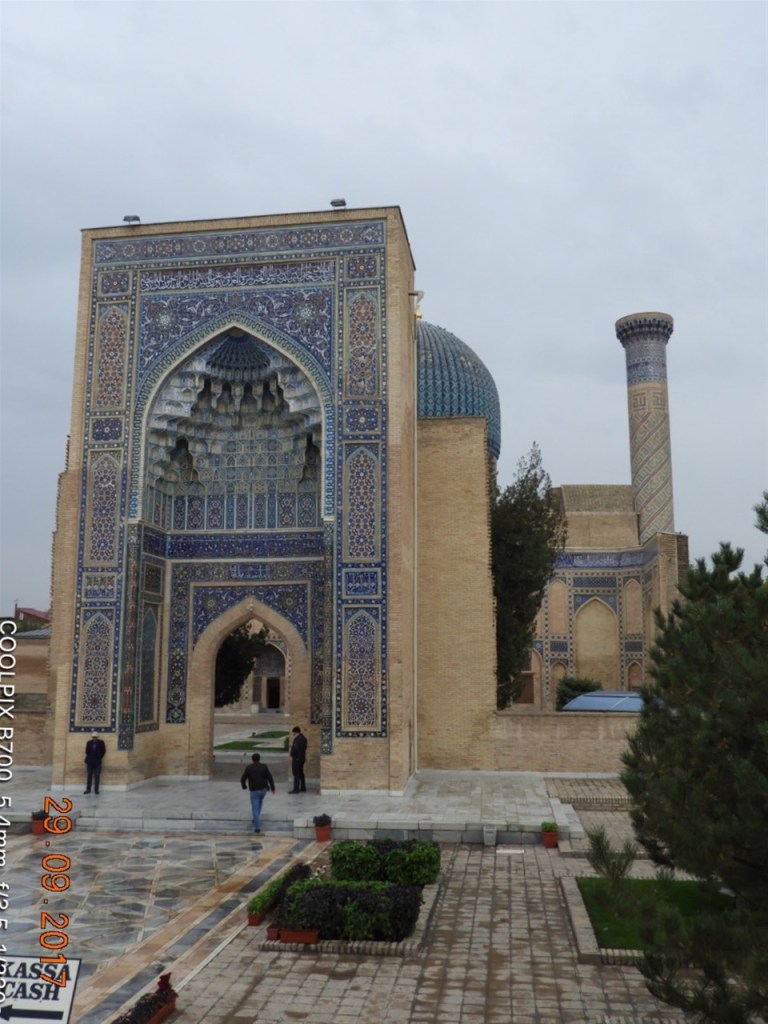
The entrance to the Amir Temur Mausoleum
As we have already seen, Uzbekistan’s vast production of cotton is harvested manually and we saw lots of images redolent of Gone With The Wind of folks bent double in the fields picking cotton by hand. Still, HSBC is predicting Uzbekistan will be one of the fastest growing economies in the world (top 26) in future decades. Much of this is based on the assumption that the new president will continue to relax stringent government controls on the economy and encourage foreign investment.
See Pics of our journey Bullet Train to Samarkand: Soon come!!!
Of course the country does have a remarkable heritage of history not least of which was its position at the heart of the Silk Road. Its Islamic Architecture is amongst the finest in the world and Samarkand is at the epicentre of that legacy. Our first exposure to this legacy was the Shah-i- Zinda Necropolis which was formed between the 11th and 19th Centuries and contains more than 20 buildings, many of them built to house the mortal remains of relatives of Amir Timur.
See pics of Shah i Zinda Necropolis: Soon come!!!
Timur who? Some of you may be thinking…. that would certainly have been my reaction until I started researching ahead of this trip! You might perhaps recognise him more easily by his alternative name of Tamerlane. Born in 1336 in Uzbekistan he was a Turco-Mongolian conqueror. He ruled over an empire that extended from southeastern Turkey, Syria, Iraq and Iran, through Central Asia encompassing part of Kazakhstan, Afghanistan, Armenia, Azerbaijan, Georgia, Turkmenistan, Uzbekistan, Kyrgyzstan and Pakistan. He approached Kashgar in China and captured Delhi in India in 1398. He died in 1405 while he was on his way to attack the Ming Dynasty in China. Although Timur’s empire was relatively short lived, his grandson Babur went on to found the Islamic Mughal Empire which ruled over most of Afghanistan and North India. Babur’s descendants expanded that empire to include most of the Indian subcontinent.
More about Amir Temur aka Tamerlane: Soon come!!!
Day 25: Saturday 30th September – The Registan in Samarkand
We got up Saturday morning very excited about the prospect of visiting the Registan, which we had seen briefly the previous evening. The whole place was almost overwhelming – it is beautifully laid out around the square, the architecture of the three madrasahs all stunning but each different and the weight of history was almost palpable. We were not disappointed!
See pics of The Registan in Samarkand: Soon come!!!
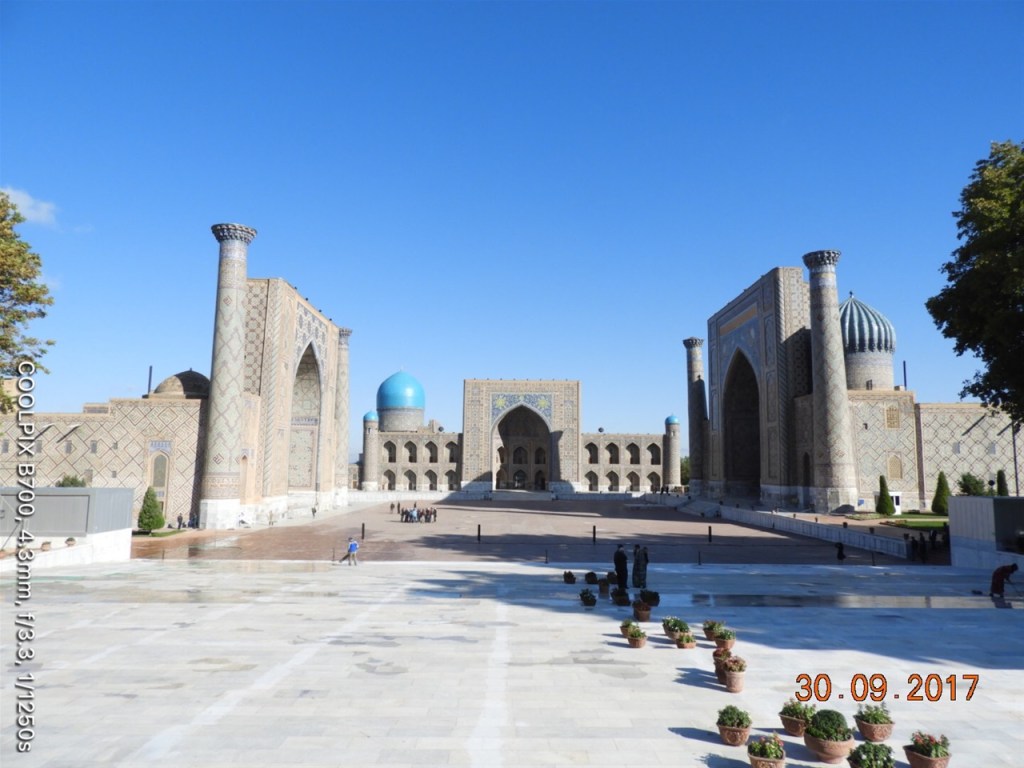
Classic view of the Registan in Samarkand
Having spent the morning at the Registan we got back on the bus to go visit Mirzo Ulugh Beg’s Observatory. If i seem a little inconsistent in some of my spellings it is partly because eminent figures from history would often have three different names and always each of those names would have at least a couple of different spellings! I have tried to be consistent, but i realize i have not always succeeded….
We went on to do the tour of the Old Samarkand Paper Factory where they have tried to reproduce faithfully the paper making process that was introduced to the city from along the Silk Road by the Chinese in the 7th Century. The Paper Makers of Samarkand proved to be very skilled and the paper was in demand throughout the Middle East and Central Asia.
See pics of Mirzo Ulughbeg’s Observatory and Samarkand Paper Making: Soon come!!!
Day 26: Sunday 1st October – Drive to Bukhara
Another interesting rather than spectacular drive, this time along the fertile valley of the Zeravshan River between Samarkand and Bukhara. The countryside was largely well cultivated, but with a great deal of cotton, manually harvested as always it seems in Uzbekistan. Pretty much every modern car on the road was a little white Chevrolet built in Uzbekstan…..
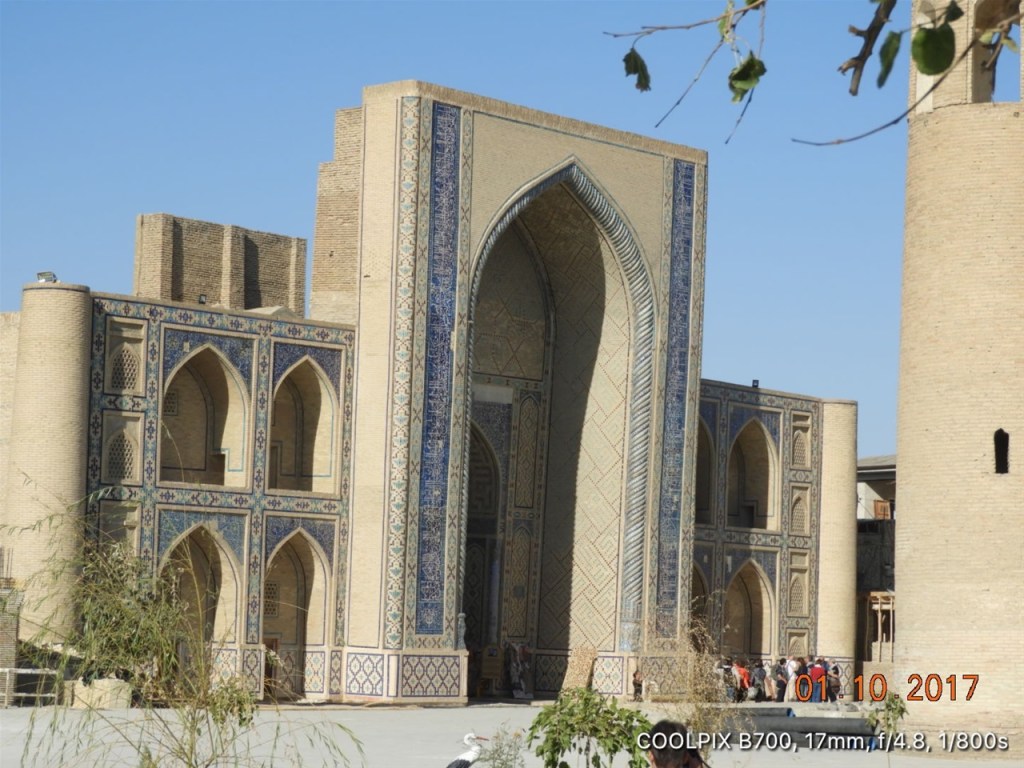
Ulugbek Madrassa in Bukhara
We enjoyed an excellent lunch at a roof top restaurant in Bukhara overlooking the ancient Bazaar and had our first browse around the city during the afternoon.
See more pics of Our drive from Samarkand to Bukhara and another Ulugh Beg Madrassa: Soon come!!!
Day 27: Monday 2nd October – Bukhara
We had a warm and busy day visiting the delights of Bukhara. There is little point comparing the city with Samarkand, but to me it seemed more intimate and its treasures more accessible than the vast complexes in the other city. Both were amazing!
One of the delights of Bukhara is that you can walk to pretty much everywhere and the city is very compact. We had no difficulty taking in the Ark Fortress, the Po-i Kalyan complex and the Bolo Hauz Mosque in a single day because there was no pressure to hop on and off the bus!
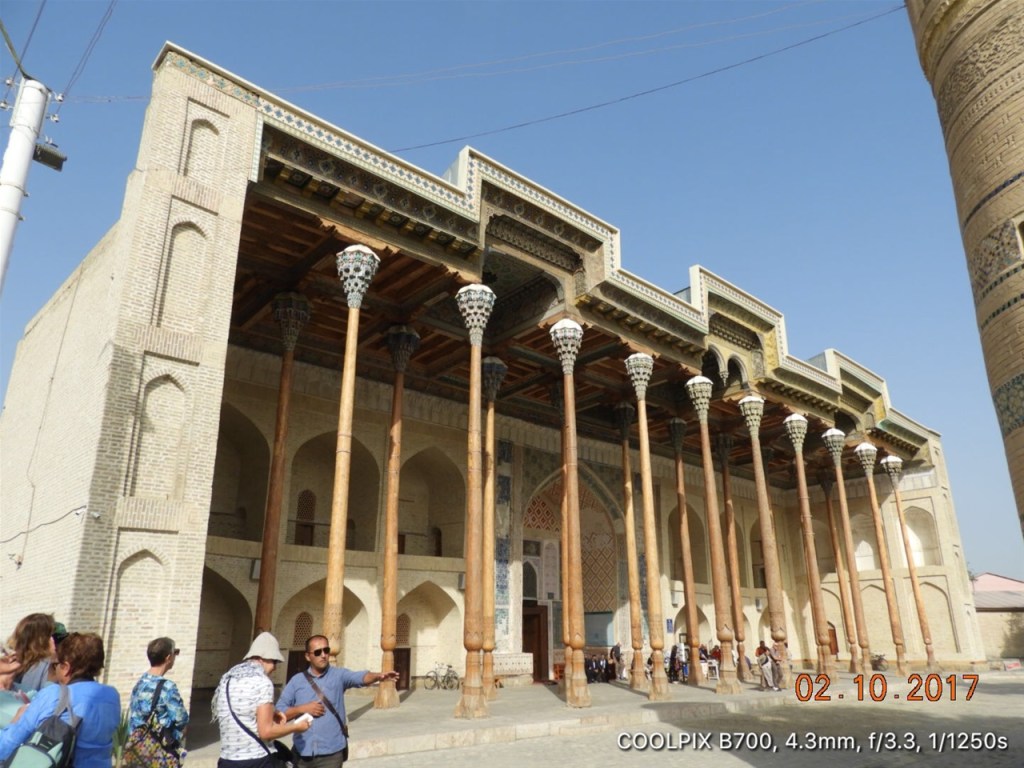
The lovely Bolo Houz Mosque
See more pics of Bukhara: Soon come!!!
See pics of Ark of Bukhara and its Friday Mosque: Soon come!!!
See more pics of Bolo Hauz Mosque: Soon come!!!
See pics of Po-i-Kalyan Complex: Soon come!!!
Onward to Turkmenistan……
 Tony's Geriatric Adventures